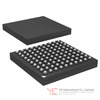
STM32F103VDT6 and the STM32F103xD Family Product Overview
STM32F103VDT6 is a 32-bit microcontroller from STMicroelectronics within the STM32F1 series, specifically the STM32F103xD performance line. It integrates an Arm Cortex-M3 core running at up to 72 MHz and combines embedded Flash, SRAM, analog peripherals, timers, and a wide set of communication interfaces in a 100-pin LQFP package.
Within the STM32F103xC, STM32F103xD, and STM32F103xE high-density performance-line group, STM32F103VDT6 corresponds to the STM32F103xD class and provides 384 KB of Flash memory. The wider family spans 256 KB to 512 KB Flash and up to 64 KB SRAM, while sharing a common architectural foundation and broad peripheral compatibility.
The device summary and family feature set place STM32F103VDT6 among MCUs intended for embedded designs that need a combination of processing capability, communication flexibility, motor-control-oriented timing resources, analog acquisition, and support for external memory through the FSMC. It also integrates USB 2.0 full-speed, CAN 2.0B active, SDIO, multiple USARTs, multiple SPI and I2C interfaces, dual 12-bit DACs, and three 12-bit ADCs.
From a top-level perspective, STM32F103VDT6 brings together:
an Arm 32-bit Cortex-M3 CPU,
up to 72 MHz operating frequency,
384 KB embedded Flash,
up to 64 KB SRAM in the family,
up to 112 fast I/O ports in the family,
11 timers,
3 ADCs,
2 DAC channels,
12-channel DMA,
and up to 13 communication interfaces.
This combination defines the device as a high-integration MCU for control, connectivity, and mixed-signal embedded systems.
STM32F103VDT6 Core Architecture, Performance Level, and Family Positioning
At the center of STM32F103VDT6 is the Arm Cortex-M3 32-bit single-core processor. The datasheet specifies a maximum frequency of 72 MHz and a performance level of 1.25 DMIPS/MHz based on Dhrystone 2.1 at 0 wait state memory access. The core also supports single-cycle multiplication and hardware division, which helps accelerate common arithmetic operations used in control loops, data processing, and communication stacks.
The STM32F103xC/xD/xE line is presented as a performance line, and STM32F103VDT6 sits in the high-density segment of that line. The family is designed so that multiple memory-density variants share broad functional compatibility. That means designs developed around one member can often be adapted across nearby variants with less architectural rework, provided package, memory size, and pin-count needs are checked carefully.
The core subsystem is supported by an NVIC, giving STM32F103VDT6 a structured interrupt architecture for handling multiple peripherals and external events. This matters in practical firmware because the device can concurrently manage communication channels, timer events, ADC conversions, DMA transfers, and external interrupts without relying on a polling-heavy software model.
In real product design terms, this architecture suits applications where one MCU may need to read sensors, update PWM outputs, exchange data over CAN or USB, and still maintain deterministic timing behavior. The Cortex-M3 plus NVIC combination is one of the reasons the STM32F103VDT6 class became widely adopted in industrial control and embedded interface designs.
STM32F103VDT6 Memory Resources, Memory Mapping, and External Memory Expansion
STM32F103VDT6 includes 384 KB of embedded Flash memory. The family documentation covers 256 KB to 512 KB Flash for STM32F103xC/xD/xE devices, placing this part in the middle of that range. Flash characteristics are documented separately in the electrical section, including endurance and data retention data.
The family also provides up to 64 KB of SRAM. This internal SRAM supports runtime data storage, stacks, buffers, and interrupt-driven processing. Combined with the Cortex-M3 core and DMA engine, it allows firmware to move data between peripherals and memory with reduced CPU involvement.
The datasheet includes a dedicated memory map section, indicating that STM32F103VDT6 is intended to be understood not only as a CPU-plus-peripherals device but also as a system-level MCU with defined internal address-space organization. This is useful when firmware needs predictable placement of code, data, peripheral registers, and external memory regions.
A notable extension capability of STM32F103VDT6 is the FSMC, or flexible static memory controller, with 4 chip select lines. The datasheet states support for Compact Flash, SRAM, PSRAM, NOR, and NAND memories. The FSMC also supports an LCD parallel interface in 8080/6800 modes. This expands the MCU beyond purely internal-memory designs.
For example, a design can use internal Flash for firmware, SRAM for runtime buffers, and then connect external parallel NOR or SRAM through FSMC if the system needs additional storage or memory-mapped display control. In display-oriented equipment, the same external bus can simplify interfacing to certain LCD modules using parallel command/data transactions.
STM32F103VDT6 Clock System, Reset Functions, and Boot Operation
STM32F103VDT6 supports several clock sources and clock-management functions. The documented options include:
a 4 MHz to 16 MHz crystal oscillator,
an internal 8 MHz factory-trimmed RC oscillator,
an internal 40 kHz RC oscillator with calibration,
and a 32 kHz oscillator for RTC operation with calibration.
The clock tree is documented as a dedicated figure in the datasheet, reflecting the role of clock selection and distribution in balancing performance, peripheral timing, and power consumption. The PLL characteristics are also documented, enabling system clock multiplication from selected input sources within the supported constraints.
This gives STM32F103VDT6 flexibility for different design priorities. An external crystal can be chosen where tighter timing control is required for communication or overall clock stability. The internal RC options can reduce bill-of-material count in applications where the tolerance is sufficient. The 32 kHz oscillator supports RTC use cases where backup-domain timing is needed.
Reset and supply management functions include POR, PDR, and a programmable voltage detector, or PVD. These blocks support controlled startup behavior and supply monitoring. The datasheet also includes NRST pin characteristics and a recommended protection approach.
Boot modes are covered in the functional overview section. In practice, boot-mode support allows STM32F103VDT6 systems to start from different memory contexts depending on hardware configuration and development needs. This is useful during board bring-up, firmware loading workflows, and field recovery strategies.
STM32F103VDT6 Power Supply Scheme, Supervision Circuits, and Low-Power Modes
The supply range for STM32F103VDT6 is 2.0 V to 3.6 V for application supply and I/Os. This range aligns with common 3.3 V embedded systems while also allowing lower-voltage operation under appropriate conditions.
The device integrates a voltage regulator and includes embedded power supervision features. The datasheet organizes this area into power supply schemes, supervisor behavior, reference voltage information, power-up and power-down operating conditions, and current consumption in multiple modes.
Low-power operation is structured around Sleep, Stop, and Standby modes. There is also VBAT supply support for the RTC and backup registers. This allows the backup domain to remain powered while the main system supply domain is reduced or removed, depending on system design.
Current-consumption tables and curves are provided for:
Run mode, with code running from Flash or RAM,
Sleep mode,
Stop mode,
Standby mode,
and peripheral-level current consumption.
This makes STM32F103VDT6 suitable for designs where duty-cycled operation matters. For instance, a metering or monitoring node might spend most of its time in Stop mode, keep RTC timing alive through the backup domain, and wake periodically to sample analog channels, communicate via UART or CAN, and then return to reduced-power operation.
Rather than describing low power in abstract terms, the datasheet supports engineering tradeoff analysis with specific timing and current data, including low-power wakeup timings and current-versus-temperature curves.
STM32F103VDT6 Timers, Watchdogs, DMA, and Real-Time Support
STM32F103VDT6 belongs to a family with up to 11 timers. The timer set includes:
up to four 16-bit timers, each with up to 4 input capture/output compare/PWM or pulse counter and quadrature encoder input,
2 × 16-bit motor-control PWM timers with dead-time generation and emergency stop,
2 × watchdog timers, one independent and one window type,
a SysTick 24-bit downcounter,
and 2 × 16-bit basic timers to drive the DAC.
This timer architecture allows STM32F103VDT6 to serve both general embedded timing needs and more specialized control tasks. Quadrature encoder input support is suited to motion and position tracking. Dead-time generation and emergency stop functions are aligned with motor-control topologies and power-stage driving scenarios. Input capture and output compare functions also support pulse measurement, event timing, and synchronized output generation.
The 12-channel DMA controller supports peripherals including timers, ADCs, DAC, SDIO, I2Ss, SPIs, I2Cs, and USARTs. In a practical design, DMA reduces CPU overhead when moving sampled data, outgoing frames, or stream-oriented payloads between peripherals and memory.
As an example, STM32F103VDT6 can sample multiple analog channels with the ADC, transfer those results into SRAM using DMA, and then format or transmit the results over a serial interface with less interrupt pressure than a fully CPU-managed approach.
The RTC and backup registers add another layer of real-time support. These functions are useful when a system needs to preserve timekeeping or state information across low-power intervals or supply interruptions to the main domain.
STM32F103VDT6 Communication Interfaces and Connectivity Options
One of the defining traits of STM32F103VDT6 is its broad communication set. The datasheet describes up to 13 communication interfaces across the family, including:
up to 2 I2C interfaces with SMBus/PMBus support,
up to 5 USARTs with ISO 7816, LIN, IrDA, and modem control capability,
up to 3 SPI interfaces at up to 18 Mbit/s, with 2 multiplexed with I2S,
CAN 2.0B active,
USB 2.0 full speed,
and SDIO.
This interface mix allows STM32F103VDT6 to bridge between many kinds of embedded subsystems. A single design can combine local sensor buses, industrial network links, service/debug ports, removable storage or memory-card connectivity, and PC-facing USB communication.
The inclusion of CAN 2.0B active makes the device suitable for systems that need robust networked communication in electrically noisy environments. USB 2.0 full-speed adds direct connectivity for device-side applications. SDIO provides an efficient path for SD and MMC style interfaces. The USART feature set extends beyond basic UART, supporting multiple protocol styles often encountered in instrumentation and embedded control products.
For serial audio or synchronous data applications, I2S functionality is available through two of the SPI blocks. This broadens the range of digital interface tasks beyond standard control-plane communications.
In practical system design, STM32F103VDT6 can be used as a central controller that talks to a host over USB, exchanges field data over CAN, connects to sensors over I2C, logs information to SD media through SDIO, and still leaves USART and SPI resources available for auxiliary modules.
STM32F103VDT6 Analog Functions, Data Conversion, and On-Chip Sensing
STM32F103VDT6 integrates three 12-bit ADCs with conversion time specified as 1 µs and support for up to 21 channels. The conversion range is 0 V to 3.6 V, and the ADC subsystem supports triple sample-and-hold capability. The family also includes an on-chip temperature sensor.
This analog subsystem allows the MCU to monitor multiple external analog sources while also measuring internal temperature. The electrical section provides ADC characteristics, accuracy information, test conditions, and guidance such as allowable source impedance at a given ADC clock.
The device also integrates 2 × 12-bit DACs. These DAC channels can be used for analog waveform generation, bias/reference generation, or low-bandwidth control signaling, depending on the end application and output requirements. The basic timers can be used to drive the DAC, which supports periodic update schemes.
A practical example helps illustrate the interaction among these blocks. In a control board, STM32F103VDT6 might read current, voltage, and temperature sensors through the ADCs, process the data in the Cortex-M3 core, and then generate a control threshold or analog reference using the DAC. DMA can be inserted into this path to move ADC samples efficiently.
The analog-related figures in the datasheet also include recommended ADC connection and decoupling diagrams. These are relevant because analog performance depends not only on converter specifications but also on reference routing, supply decoupling, and board-level noise control.
STM32F103VDT6 GPIO Structure, Interrupt Handling, and Debug Capabilities
The STM32F103xC/xD/xE family provides up to 112 fast I/O ports, with 51, 80, or 112 I/Os depending on package. These I/Os are mappable on 16 external interrupt vectors, and almost all are 5 V tolerant. GPIO flexibility is one of the family’s main integration advantages because it allows the same MCU architecture to scale across different board sizes and connectivity densities.
For STM32F103VDT6 specifically, the 100-pin LQFP package provides a substantial I/O count suitable for designs that need parallel buses, multiple communication ports, and significant external control or sensing lines.
External interrupt/event control is handled through EXTI, while the NVIC manages interrupt prioritization and dispatch at the core level. Together, these blocks let the device respond to both internal peripheral events and external pin-driven events with a structured interrupt model.
Debug support includes Serial Wire Debug and JTAG through the SWJ-DP, plus the Cortex-M3 Embedded Trace Macrocell. These capabilities support software development, board bring-up, fault tracing, and production-stage diagnostics.
For engineering teams, this means STM32F103VDT6 is not only feature-rich at runtime but also equipped for traceable development and test workflows. When diagnosing why a communication interrupt is delayed or a timer-driven control loop behaves unexpectedly, the available debug infrastructure can shorten investigation cycles.
STM32F103VDT6 Operating Conditions, Electrical Characteristics, and Reliability Considerations
STM32F103VDT6 is specified for an ambient operating temperature range of -40°C to +85°C. This supports deployment across a broad range of industrial and embedded equipment environments.
The datasheet includes detailed electrical characterization sections covering:
absolute maximum ratings,
general operating conditions,
power-up and power-down conditions,
reference voltage behavior,
current consumption,
clock source characteristics,
PLL behavior,
memory characteristics,
FSMC timing,
EMC characteristics,
ESD ratings,
I/O current injection behavior,
I/O static and dynamic characteristics,
reset pin behavior,
timer electrical characteristics,
communication interface electrical characteristics,
ADC characteristics,
DAC specifications,
and temperature sensor characteristics.
This level of detail matters during part selection because the MCU’s suitability is determined not only by peripheral presence but by whether timing margins, voltage levels, and environmental limits align with the intended design.
For example, a design using external SRAM through FSMC must consider the documented asynchronous or synchronous timing tables rather than assuming generic parallel-memory compatibility. Similarly, a USB implementation should be checked against startup time and full-speed electrical characteristics, while ADC-based sensing should be reviewed against accuracy tables and source impedance constraints.
The device is RoHS compliant, and the package information section also includes thermal characteristics. These details help complete the picture from functional selection to PCB and assembly planning.
STM32F103VDT6 Package Options and Mechanical Integration Context
The STM32F103xC/xD/xE family is offered in several package forms, including WLCSP64, LQFP64, LQFP100, LQFP144, LFBGA100, and LFBGA144. STM32F103VDT6 itself is the 100-pin LQFP variant.
The LQFP100 package is listed as 14 mm × 14 mm. This package choice balances I/O access, manufacturability, and board routing density. Compared with smaller packages, it exposes more pins for interfaces such as FSMC, communication peripherals, timers, and GPIO expansion. Compared with fine-pitch BGA or WLCSP options, LQFP100 can simplify inspection and assembly in many board-production flows.
The datasheet provides package mechanical drawings, recommended footprints, marking examples, and thermal data. These mechanical sections are useful in early layout planning because package selection directly affects available I/O, routing layers, escape complexity, and thermal assumptions.
In other words, the package is not just a physical enclosure; for STM32F103VDT6 it also defines how much of the family’s peripheral set can be practically exposed on a board.
STM32F103VDT6 Application Fit and Design Perspective
Taken as a whole, STM32F103VDT6 is a high-density performance-line MCU that combines control-oriented timing, mixed-signal acquisition, broad connectivity, and external memory support. The combination suggests a fit for embedded systems that must coordinate multiple functions within one controller.
Its timer resources align with motor-control and motion-related designs. Its CAN, USB, USART, SPI, I2C, and SDIO coverage aligns with communication gateways, human-machine interfaces, instrumentation, data loggers, and connected controllers. Its ADC and DAC resources support sensor-rich or signal-conditioning applications. Its FSMC support opens paths to external memory and parallel LCD interfacing.
A practical way to view STM32F103VDT6 is as a controller for medium-to-high peripheral density boards. Instead of adding separate interface ICs or moving to a larger processing platform, a design can often remain on a single MCU if the memory size, I/O count, and peripheral combination match system requirements.
That said, actual fit depends on close review of pin availability in the chosen package, current-consumption limits for the operating profile, external clock needs, analog accuracy expectations, and bus timing when external memory is used. The datasheet provides the necessary sections for each of those checks.
STM32F103VDT6 Conclusion
STM32F103VDT6 from STMicroelectronics is a member of the STM32F103xD performance-line family built around a 72 MHz Arm Cortex-M3 core. It combines 384 KB Flash, extensive timer resources, three 12-bit ADCs, two 12-bit DACs, a 12-channel DMA controller, USB 2.0 full-speed, CAN 2.0B active, SDIO, multiple SPI, I2C, and USART interfaces, and support for external parallel memories through FSMC.
Its 2.0 V to 3.6 V operating range, low-power modes, RTC backup domain, broad package-family compatibility, and detailed electrical documentation make it a well-defined platform for designs requiring a balance of processing, connectivity, analog integration, and control capability. In the 100-pin LQFP form, STM32F103VDT6 offers a package-level compromise between accessible I/O density and manageable board integration, while retaining the broader functional profile of the STM32F103xD high-density line.
STM32F103VDT6
Frequently Asked Questions (FAQ)
- Q1. What processor core does STM32F103VDT6 use?
-
- A1. STM32F103VDT6 uses an Arm Cortex-M3 32-bit core. The device is specified for operation up to 72 MHz and delivers 1.25 DMIPS/MHz performance at 0 wait state memory access according to Dhrystone 2.1.
- Q2. How much Flash memory is integrated in STM32F103VDT6?
-
- A2. STM32F103VDT6 integrates 384 KB of embedded Flash memory. Within the STM32F103xC/xD/xE family, Flash density ranges from 256 KB to 512 KB, and this specific device belongs to the STM32F103xD group.
- Q3. Is STM32F103VDT6 part of the STM32F1 series?
-
- A3. Yes. STM32F103VDT6 belongs to the STM32F1 family from STMicroelectronics and specifically to the STM32F103 high-density performance line.
- Q4. What package does STM32F103VDT6 use?
-
- A4. STM32F103VDT6 is provided in a 100-pin LQFP package. The family also includes other package options such as LQFP64, LQFP144, LFBGA100, LFBGA144, and WLCSP64.
- Q5. What is the operating voltage range of STM32F103VDT6?
-
- A5. STM32F103VDT6 supports a 2.0 V to 3.6 V application supply and I/O voltage range.
- Q6. What temperature range is specified for STM32F103VDT6?
-
- A6. STM32F103VDT6 is specified for an ambient operating temperature range of -40°C to +85°C.
- Q7. Does STM32F103VDT6 include CAN and USB?
-
- A7. Yes. STM32F103VDT6 includes a CAN 2.0B active interface and a USB 2.0 full-speed interface.
- Q8. How many serial communication interfaces are available in the STM32F103VDT6 family group?
-
- A8. The STM32F103xC/xD/xE family supports up to 13 communication interfaces, including up to 2 I2C, up to 5 USART, up to 3 SPI, I2S functionality on 2 SPI instances, CAN, USB, and SDIO. Actual interface availability should be checked against the specific package and pinout of STM32F103VDT6.
- Q9. Does STM32F103VDT6 support external memory?
-
- A9. Yes. STM32F103VDT6 includes an FSMC with 4 chip select lines. It supports Compact Flash, SRAM, PSRAM, NOR, and NAND memories, and also supports LCD parallel interface modes based on 8080/6800 bus styles.
- Q10. How many ADCs are available in STM32F103VDT6?
-
- A10. STM32F103VDT6 includes 3 × 12-bit ADCs. The datasheet specifies conversion time of 1 µs, support for up to 21 channels, and a conversion range of 0 V to 3.6 V.
- Q11. Does STM32F103VDT6 include DAC outputs?
-
- A11. Yes. STM32F103VDT6 includes 2 × 12-bit DACs.
- Q12. Is there a DMA controller in STM32F103VDT6?
-
- A12. Yes. STM32F103VDT6 provides a 12-channel DMA controller. The supported peripherals include timers, ADCs, DAC, SDIO, I2Ss, SPIs, I2Cs, and USARTs.
- Q13. What timer resources does STM32F103VDT6 offer?
-
- A13. The STM32F103xD high-density line includes up to 11 timers. These include up to four 16-bit timers with capture/compare/PWM and quadrature encoder input capability, 2 × 16-bit motor-control PWM timers with dead-time generation and emergency stop, 2 watchdog timers, a SysTick 24-bit downcounter, and 2 × 16-bit basic timers for DAC driving.
- Q14. Does STM32F103VDT6 support motor-control style PWM generation?
-
- A14. Yes. The family includes 2 × 16-bit motor-control PWM timers with dead-time generation and emergency stop, which are suitable for inverter, actuator, and motor-drive style control tasks.
- Q15. Can STM32F103VDT6 be used with quadrature encoders?
-
- A15. Yes. The timer set includes support for quadrature encoder input on applicable 16-bit timers.
- Q16. What clock sources are available on STM32F103VDT6?
-
- A16. STM32F103VDT6 supports a 4 MHz to 16 MHz external crystal oscillator, an internal 8 MHz factory-trimmed RC oscillator, an internal 40 kHz RC oscillator with calibration, and a 32 kHz oscillator for RTC operation with calibration.
- Q17. Does STM32F103VDT6 support low-power modes?
-
- A17. Yes. STM32F103VDT6 supports Sleep, Stop, and Standby modes. It also provides VBAT supply support for RTC and backup registers.
- Q18. Is there a real-time clock in STM32F103VDT6?
-
- A18. Yes. STM32F103VDT6 includes RTC functionality along with backup registers. These can remain supplied from VBAT for timekeeping and state retention in suitable power architectures.
- Q19. What reset and voltage-monitoring features are built into STM32F103VDT6?
-
- A19. STM32F103VDT6 includes POR, PDR, and a programmable voltage detector (PVD). These functions support controlled startup and supply monitoring behavior.
- Q20. Are the GPIOs on STM32F103VDT6 5 V tolerant?
-
- A20. The datasheet states that almost all I/Os in the STM32F103xC/xD/xE family are 5 V tolerant. Pin-specific confirmation should be made using the STM32F103VDT6 pin descriptions and I/O characteristics.
- Q21. How many external interrupt vectors can STM32F103VDT6 GPIOs map to?
-
- A21. The family supports GPIO mapping onto 16 external interrupt vectors through the EXTI structure.
- Q22. What debug interfaces are available on STM32F103VDT6?
-
- A22. STM32F103VDT6 supports Serial Wire Debug and JTAG through the SWJ-DP. It also includes Cortex-M3 Embedded Trace Macrocell support.
- Q23. Does STM32F103VDT6 contain a hardware CRC unit?
-
- A23. Yes. STM32F103VDT6 includes a CRC calculation unit.
- Q24. Is there an internal temperature sensor in STM32F103VDT6?
-
- A24. Yes. The device includes an on-chip temperature sensor, and its characteristics are documented in the datasheet electrical section.
- Q25. Can STM32F103VDT6 interface directly with an LCD over a parallel bus?
-
- A25. Yes. Through the FSMC, STM32F103VDT6 supports an LCD parallel interface using 8080/6800 modes.
- Q26. What should be checked first when considering STM32F103VDT6 for an external memory design?
-
- A26. The main checks are FSMC timing compatibility with the target SRAM, PSRAM, NOR, NAND, or Compact Flash device, plus confirmation that the required FSMC pins are available in the STM32F103VDT6 LQFP100 package and do not conflict with other needed peripherals.
- Q27. What should be checked first when using STM32F103VDT6 for analog measurement?
-
- A27. The practical starting points are the ADC accuracy tables, ADC clock conditions, input source impedance guidance, supply/reference decoupling recommendations, and channel availability on the selected pins of STM32F103VDT6.
- Q28. In what kind of embedded systems does STM32F103VDT6 fit naturally based on its documented features?
-
- A28. Based on the datasheet feature set, STM32F103VDT6 fits systems that combine control, sensing, and communication functions in one MCU, such as boards using PWM generation, ADC-based monitoring, CAN or USB connectivity, SDIO storage interfacing, or external memory and LCD parallel buses.