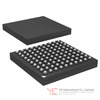
STM32F103VET7 Product Overview
The STM32F103VET7 is a 32-bit microcontroller from STMicroelectronics based on the Arm Cortex-M3 core. It belongs to the STM32F103xE group within the broader STM32F103xC, STM32F103xD, and STM32F103xE performance line. In this device, the CPU operates at up to 72 MHz and delivers 1.25 DMIPS/MHz based on Dhrystone 2.1 performance at 0 wait-state memory access.
This device integrates 512 Kbytes of embedded Flash memory and up to 64 Kbytes of SRAM, combining processing capability with a broad peripheral set. The datasheet describes the performance line as offering Flash, USB, CAN, 11 timers, 3 ADCs, and 13 communication interfaces, making the family suitable for systems that need a balance of control, connectivity, and analog capability in a single-chip design.
The STM32F103VET7 specifically is offered in a 100-pin LQFP package with 14 × 14 mm body dimensions. The device supports a 2.0 V to 3.6 V supply range and operates over an ambient temperature range of -40°C to 105°C. It is a surface-mount device and is identified in the family as a high-density member.
From a functional standpoint, the STM32F103VET7 combines processing, analog acquisition, communication, timing, and external memory interfacing. That combination allows one MCU to cover roles such as control logic, sensor acquisition, communications gateway handling, motor-control timing, and user-interface support. For example, in an industrial control node, the device can sample multiple analog channels, communicate over CAN and USART, generate PWM outputs for actuators, and retain timekeeping using its RTC backup domain.
STM32F103VET7 Position Within the STM32F103xC/xD/xE Family
The STM32F103VET7 is part of the STM32F103xE category, which represents the upper Flash-density range in the STM32F103 performance line covered by this datasheet. The family spans:
- STM32F103xC
- STM32F103xD
- STM32F103xE
Across this family, Flash memory ranges from 256 Kbytes to 512 Kbytes, while SRAM goes up to 64 Kbytes. The STM32F103VET7 is one of the 512 Kbyte variants, placing it among the larger memory options in the series. This is useful when firmware size grows due to communication stacks, control algorithms, or larger data tables.
The datasheet also emphasizes full compatibility throughout the family. That means designers can often scale within the family to match application memory or package requirements while keeping a similar architecture and peripheral approach. In practice, this can simplify platform reuse. A design first developed on a smaller-memory STM32F103 derivative can be migrated to STM32F103VET7 when the firmware expands or additional application features are added.
The family is offered in several package options, including WLCSP64, LQFP64, LQFP100, LQFP144, LFBGA100, and LFBGA144. STM32F103VET7 uses the LQFP100 package. Package choice directly affects available I/O count and pin access to peripheral functions, so the 100-pin version offers a broader connectivity range than smaller package members while remaining easier to assemble than fine-pitch BGA formats in many production environments.
STM32F103VET7 Core Architecture, Performance, and Memory Resources
At the processing level, the STM32F103VET7 uses an Arm 32-bit Cortex-M3 CPU. The Cortex-M3 architecture brings features such as single-cycle multiplication and hardware division, which help with efficient execution of arithmetic-heavy firmware tasks. The maximum operating frequency is 72 MHz.
The embedded memory subsystem includes:
- 512 Kbytes of Flash memory
- Up to 64 Kbytes of SRAM
The Flash memory provides program storage, while SRAM supports runtime data, stacks, buffers, and peripheral data handling. For code that must execute with predictable timing, the memory and CPU structure are designed for high-performance embedded control.
The STM32F103VET7 also includes a CRC calculation unit. This hardware block can be used for data integrity checking without placing the entire burden on the CPU. In applications that validate communication frames, firmware images, or stored configuration blocks, hardware CRC support can reduce software overhead.
Memory expansion is another distinguishing capability of this line. The flexible static memory controller, or FSMC, supports four chip-select signals and external memories including CompactFlash, SRAM, PSRAM, NOR, and NAND devices. It also supports an LCD parallel interface in 8080/6800 modes. This opens a path for systems that need more external storage or a direct parallel display interface beyond the MCU’s internal memory resources.
A practical example would be a data logger with a local interface: the STM32F103VET7 can execute from internal Flash, buffer measured data in SRAM, exchange data through communication interfaces, and use the FSMC to connect either external memory or a parallel display.
STM32F103VET7 Clock System, Reset Control, and Boot Operation
The STM32F103VET7 provides several clocking options intended to support both performance operation and low-power behavior. The device supports:
- A 4 MHz to 16 MHz high-speed external crystal oscillator
- An internal 8 MHz factory-trimmed RC oscillator
- An internal 40 kHz RC oscillator with calibration
- A 32 kHz oscillator for RTC operation with calibration
This mix allows designs to choose between external precision timing and lower-component-count internal clock operation. An external crystal may be used when tighter timing is needed for interfaces or system synchronization, while the internal oscillators can simplify the board when absolute accuracy demands are lower.
A PLL is also included to derive the higher internal operating frequency. The device clock tree is structured to distribute clocks to the CPU core, buses, and peripherals according to the selected operating mode and source.
For reset and startup management, the STM32F103VET7 integrates POR, PDR, and a programmable voltage detector. These functions help supervise supply behavior during startup and operation. The programmable voltage detector can be used to monitor the supply against a defined threshold, which is useful for maintaining controlled behavior when voltage conditions drift.
The datasheet also includes boot mode support. Boot configuration determines how the microcontroller starts execution, allowing flexibility for standard user Flash startup or alternative boot arrangements. This is often useful during production programming, firmware recovery, or field maintenance procedures.
STM32F103VET7 Power Supply Scheme and Low-Power Operating Modes
The STM32F103VET7 operates from a 2.0 V to 3.6 V supply. Both the application supply and I/O structures are designed for this range, and the datasheet also notes a VBAT supply for the RTC and backup registers. This separation allows timekeeping and backup-domain retention when the main supply is not present.
The internal power architecture includes:
- Power-on reset
- Power-down reset
- Programmable voltage detector
- Internal voltage regulator
Low-power operating support is organized around three modes:
- Sleep
- Stop
- Standby
These modes provide different tradeoffs between retained functionality, wakeup time, and current consumption. Sleep mode reduces activity while preserving more of the operating context. Stop mode reduces power further. Standby mode targets the lowest consumption with more limited retention.
For applications with periodic activity, such as metering, monitoring, or remote control nodes, these modes allow the microcontroller to remain inactive for long intervals and wake only for acquisition, communication, or control events. If the RTC remains powered through VBAT, scheduled wakeup and timekeeping can continue even while the main domain is powered down.
The datasheet includes supply current data for Run, Sleep, Stop, and Standby modes, along with temperature and voltage dependencies. This is useful because power behavior is not represented by a single number; it changes with clock frequency, enabled peripherals, execution location, and supply level. For example, a design that runs control loops continuously from Flash at high frequency will exhibit a different current profile from one that wakes briefly, samples a sensor, transmits a packet, and returns to Stop mode.
STM32F103VET7 Timers, Watchdogs, and Control Functions
The STM32F103VET7 includes up to 11 timers, which is one of the defining features of the performance line. The timer resources include:
- Up to four 16-bit timers with up to four IC/OC/PWM channels or pulse counter and quadrature encoder input
- 2 × 16-bit motor-control PWM timers with dead-time generation and emergency stop
- SysTick 24-bit downcounter
- 2 × 16-bit basic timers for DAC driving
- 2 watchdog timers: Independent watchdog and Window watchdog
This timer arrangement supports a broad set of timing and control applications. General-purpose timers can be used for periodic scheduling, pulse measurement, input capture, output compare, and PWM generation. Encoder support is useful in motion and position-tracking systems. The motor-control PWM timers add dead-time insertion and emergency stop behavior, which are relevant in inverter and motor-drive topologies.
The SysTick timer supports operating system tick generation or periodic software scheduling. The watchdog timers provide supervisory functions. The Independent watchdog is commonly used to reset the system if firmware execution becomes unresponsive. The Window watchdog adds timing window constraints for a stricter supervision scheme.
In a motor-control example, one timer can acquire encoder position, another can generate PWM waveforms, while watchdogs supervise firmware execution and a basic timer can trigger DAC updates or regular service routines.
STM32F103VET7 Communication Interfaces and Data Movement Capabilities
Communication density is a major aspect of the STM32F103VET7. The performance line provides up to 13 communication interfaces, including:
- Up to 2 × I2C interfaces with SMBus/PMBus support
- Up to 5 USARTs with ISO 7816, LIN, IrDA, and modem control features
- Up to 3 SPIs at up to 18 Mbit/s, with 2 supporting I2S multiplexing
- CAN 2.0B Active interface
- USB 2.0 full-speed interface
- SDIO interface
This set supports both board-level and network-level connectivity. I2C is suited to low-pin-count peripheral attachment. USARTs cover asynchronous serial links and protocol extensions such as LIN and IrDA. SPI supports fast peripheral communication, and I2S capability allows audio-oriented serial interfacing on selected SPI blocks. CAN enables robust message-based networking. USB full-speed supports host-connected applications. SDIO supports SD/MMC card interfacing.
The STM32F103VET7 also includes a 12-channel DMA controller. DMA support extends to timers, ADCs, DAC, SDIO, I2S, SPI, I2C, and USARTs. This means many transfers can occur without continuous CPU intervention. For example, ADC conversion results can be moved into memory while the CPU processes earlier samples, or serial communication data can be transferred in blocks with reduced interrupt overhead.
In practical embedded systems, the combination of communication interfaces and DMA can change the software structure significantly. Instead of a CPU polling each peripheral, the microcontroller can move data in the background and reserve CPU cycles for protocol handling, filtering, control calculations, or user application logic.
STM32F103VET7 Analog Functions, CRC, Temperature Sensing, and Debug Support
The STM32F103VET7 integrates substantial analog capability. The datasheet specifies:
- 3 × 12-bit ADCs
- 1 µs conversion time
- Up to 21 channels
- Conversion range from 0 V to 3.6 V
- Triple sample-and-hold capability
- Temperature sensor
- 2 × 12-bit DACs
The three ADCs allow multi-channel acquisition and can support higher aggregate throughput or simultaneous sampling schemes through the triple sample-and-hold capability. This is useful when several analog inputs must be observed with close timing alignment, such as current and voltage sampling in control systems.
The integrated temperature sensor provides internal thermal measurement support. It is not a replacement for all external temperature sensing use cases, but it can assist with internal monitoring, compensation strategies, or basic thermal supervision.
The two 12-bit DACs provide analog output generation. These can be used for waveform output, threshold generation, bias control, or analog test/reference functions. The basic timers can be used to drive DAC update timing, which helps create deterministic analog output behavior.
The CRC unit, noted earlier, complements these functions by supporting data verification.
For development and debugging, the STM32F103VET7 includes:
- Serial wire debug (SWD)
- JTAG interfaces
- Cortex-M3 Embedded Trace Macrocell
These features support program download, debugging access, and trace capability. During firmware development, SWD may be preferred for lower pin usage, while JTAG remains available where a fuller interface is desired.
STM32F103VET7 GPIO Structure, Interrupt Handling, and External Memory Expansion
The STM32F103VET7 belongs to a family offering up to 112 fast I/O ports, with package-dependent availability. For the broader high-density family, 51, 80, or 112 I/Os are available depending on package. These I/O lines are mapped onto up to 16 external interrupt vectors, and almost all are 5 V-tolerant.
This I/O structure supports mixed-signal and digital expansion without extensive external logic. Fast GPIO behavior is relevant when interfaces are bit-driven in software, timing edges matter, or parallel control signals are used.
Interrupt handling is supported through:
- Nested vectored interrupt controller (NVIC)
- External interrupt/event controller (EXTI)
The NVIC is part of the Cortex-M3 architecture and provides efficient interrupt servicing. EXTI allows external lines to generate interrupts or events. Together, these blocks allow the MCU to react quickly to communication activity, input changes, timer events, ADC completion, and other peripheral conditions.
The FSMC broadens system integration options beyond the internal resources. It supports:
- SRAM
- PSRAM
- NOR
- NAND
- CompactFlash
- LCD parallel interface in 8080/6800 modes
This means the STM32F103VET7 can be used in designs where the MCU does more than local embedded control. It can also act as the controller for memory-mapped displays or external storage. For instance, in a human-machine interface design, the MCU can drive an LCD in parallel mode while storing fonts, images, or buffered data in external memory attached through the FSMC.
STM32F103VET7 Electrical Characteristics, Operating Limits, and Reliability Considerations
The STM32F103VET7 datasheet provides detailed electrical characteristics rather than only headline specifications. The general operating conditions include a supply range of 2.0 V to 3.6 V, with defined conditions for power-up and power-down behavior. The ambient operating temperature range for the device variant shown is -40°C to 105°C.
The electrical coverage includes:
- Absolute maximum ratings
- Supply current characteristics
- External and internal clock characteristics
- PLL characteristics
- Flash memory characteristics
- FSMC timing characteristics
- EMC and ESD-related information
- I/O injection current characteristics
- I/O port static and AC characteristics
- NRST pin characteristics
- Timer characteristics
- Interface electrical characteristics for I2C, SPI, I2S, SDIO, USB, CAN
- ADC, DAC, and temperature sensor characteristics
This breadth matters because system behavior is shaped by interaction between blocks. As one example, ADC accuracy depends not only on ADC resolution but also on clock setup, input source impedance, and reference decoupling conditions. Similarly, USB startup and full-speed electrical behavior rely on meeting the device’s clock and electrical limits. A design using 5 V-tolerant digital inputs still must observe the stated input characteristics and injection limits to prevent behavior outside specification.
The Flash memory section also includes endurance and data retention information, which is relevant for applications that rewrite stored parameters, calibration constants, or logs. Repeated field updates or runtime storage use should be considered against those memory characteristics.
STM32F103VET7 Package, Thermal, and Integration Considerations
The STM32F103VET7 is supplied in a 100-pin LQFP package measuring 14 × 14 mm. The package style balances I/O access, board routing practicality, and assembly familiarity for many designs. The package section in the datasheet includes mechanical data and recommended footprint guidance for LQFP100.
The broader family also offers LQFP64, LQFP144, LFBGA100, LFBGA144, and WLCSP64 versions. This wider packaging strategy allows the same architectural platform to be used in more compact designs or in systems that need additional pins.
Thermal characteristics are documented separately, and the datasheet includes guidance on selecting the product temperature range. Thermal behavior should be evaluated together with package style, ambient conditions, board layout, and total power dissipation. For a 72 MHz MCU with multiple active interfaces, analog blocks, and external bus activity, local board thermal conditions can differ substantially from a lightly loaded design using the same part number.
At the board level, package and pin planning should be tied to peripheral use. A design that needs USB, CAN, multiple serial ports, ADC channels, and FSMC signals simultaneously should verify pin assignment early, since peripheral multiplexing and package pin count determine what can be used at the same time.
Conclusion
The STM32F103VET7 from STMicroelectronics is a high-density STM32F103xE microcontroller built around a 72 MHz Arm Cortex-M3 core with 512 Kbytes of Flash and up to 64 Kbytes of SRAM. Its feature set combines embedded control resources, broad communication support, analog conversion, DAC outputs, timer depth, low-power operating modes, and external memory expansion.
Within the STM32F103xC/xD/xE performance line, the STM32F103VET7 stands out as a 100-pin, 512 Kbyte option that can support designs requiring more program space and a wide peripheral mix. The inclusion of USB, CAN, SDIO, multiple USARTs, SPI/I2S, I2C, 3 ADCs, 2 DACs, 11 timers, DMA, RTC backup support, and FSMC makes it suitable for systems that combine control, sensing, communication, and interface functions in one MCU.
Its datasheet shows that the device is not defined by a single headline parameter, but by how its CPU, memory, clocks, power management, peripherals, and electrical limits work together. When these blocks are aligned with the application’s timing, I/O, analog, power, and package needs, the STM32F103VET7 provides a flexible platform inside the STM32F103 family.
Frequently Asked Questions (FAQ)
- Q1. What is the processor core used in the STM32F103VET7?
-
- A1. The STM32F103VET7 uses an Arm 32-bit Cortex-M3 CPU.
- Q2. What is the maximum operating frequency of the STM32F103VET7?
-
- A2. The STM32F103VET7 operates at up to 72 MHz.
- Q3. How much Flash memory is integrated in the STM32F103VET7?
-
- A3. The STM32F103VET7 integrates 512 Kbytes of embedded Flash memory.
- Q4. How much SRAM is available in the STM32F103VET7 family variant?
-
- A4. The datasheet specifies up to 64 Kbytes of SRAM for the STM32F103xC/xD/xE performance line, including the high-density STM32F103VET7 category.
- Q5. What supply voltage range does the STM32F103VET7 support?
-
- A5. The STM32F103VET7 supports a 2.0 V to 3.6 V application supply range.
- Q6. What package is used by the STM32F103VET7?
-
- A6. The STM32F103VET7 is provided in a 100-pin LQFP package with 14 × 14 mm dimensions.
- Q7. What temperature range is specified for the STM32F103VET7?
-
- A7. The listed operating ambient temperature range is -40°C to 105°C.
- Q8. How many timers are available in the STM32F103VET7 performance line?
-
- A8. The STM32F103xC/xD/xE performance line provides up to 11 timers.
- Q9. Does the STM32F103VET7 support motor-control PWM functions?
-
- A9. Yes. It includes 2 × 16-bit motor-control PWM timers with dead-time generation and emergency stop.
- Q10. What watchdog options are available in the STM32F103VET7?
-
- A10. The STM32F103VET7 includes two watchdog timers: an Independent watchdog and a Window watchdog.
- Q11. How many ADCs are integrated in the STM32F103VET7?
-
- A11. The device family integrates 3 × 12-bit ADCs.
- Q12. What ADC performance details are given for the STM32F103VET7?
-
- A12. The ADCs provide 12-bit resolution, 1 µs conversion time, support up to 21 channels, and operate over a conversion range from 0 V to 3.6 V.
- Q13. Does the STM32F103VET7 include DAC outputs?
-
- A13. Yes. The device includes 2 × 12-bit DACs.
- Q14. Is there an internal temperature sensor in the STM32F103VET7?
-
- A14. Yes. The STM32F103VET7 includes an internal temperature sensor.
- Q15. What communication interfaces are available in the STM32F103VET7?
-
- A15. The STM32F103VET7 performance line includes up to 2 I2C interfaces, up to 5 USARTs, up to 3 SPIs, 2 of which can multiplex to I2S, one CAN 2.0B Active interface, one USB 2.0 full-speed interface, and one SDIO interface.
- Q16. Does the STM32F103VET7 support USB?
-
- A16. Yes. It includes a USB 2.0 full-speed interface.
- Q17. Does the STM32F103VET7 support CAN networking?
-
- A17. Yes. It includes a CAN 2.0B Active interface.
- Q18. Does the STM32F103VET7 support SD cards or MMC cards?
-
- A18. The STM32F103VET7 includes an SDIO interface, which supports SD/MMC interfacing.
- Q19. What is the maximum SPI speed specified for the STM32F103VET7 family?
-
- A19. The SPI interfaces support up to 18 Mbit/s.
- Q20. Is DMA available in the STM32F103VET7?
-
- A20. Yes. The device includes a 12-channel DMA controller.
- Q21. Which peripherals can use DMA in the STM32F103VET7?
-
- A21. The datasheet lists support for timers, ADCs, DAC, SDIO, I2Ss, SPIs, I2Cs, and USARTs.
- Q22. What clock sources can be used with the STM32F103VET7?
-
- A22. The STM32F103VET7 supports a 4 MHz to 16 MHz external crystal oscillator, an internal 8 MHz factory-trimmed RC oscillator, an internal 40 kHz RC oscillator with calibration, and a 32 kHz oscillator for RTC use with calibration.
- Q23. Does the STM32F103VET7 include RTC support?
-
- A23. Yes. The STM32F103VET7 includes RTC support and backup registers, with VBAT supply support for maintaining that domain.
- Q24. What low-power modes are available in the STM32F103VET7?
-
- A24. The STM32F103VET7 supports Sleep, Stop, and Standby modes.
- Q25. Can the STM32F103VET7 retain RTC operation when the main supply is absent?
-
- A25. Yes. The datasheet specifies a VBAT supply for the RTC and backup registers, allowing backup-domain operation independently of the main application supply.
- Q26. Does the STM32F103VET7 include hardware CRC support?
-
- A26. Yes. It includes a CRC calculation unit.
- Q27. What external memory types can the STM32F103VET7 connect to through FSMC?
-
- A27. Through the flexible static memory controller, the STM32F103VET7 can interface with CompactFlash, SRAM, PSRAM, NOR, and NAND memories.
- Q28. Can the STM32F103VET7 drive a parallel LCD interface?
-
- A28. Yes. The FSMC supports an LCD parallel interface in 8080/6800 modes.
- Q29. Are the GPIOs on the STM32F103VET7 family 5 V-tolerant?
-
- A29. The datasheet states that almost all I/Os are 5 V-tolerant.
- Q30. How many external interrupt vectors are available for GPIO-related interrupt mapping in the STM32F103VET7 family?
-
- A30. The family provides mapping on 16 external interrupt vectors.
- Q31. What debug interfaces are available on the STM32F103VET7?
-
- A31. The STM32F103VET7 supports Serial Wire Debug (SWD), JTAG, and the Cortex-M3 Embedded Trace Macrocell.
- Q32. How does the STM32F103VET7 fit within the STM32F103 family?
-
- A32. The STM32F103VET7 is part of the STM32F103xE group, which is the higher Flash-density range within the STM32F103xC/xD/xE performance line.
- Q33. Why might a design choose the STM32F103VET7 over a smaller member of the same family?
-
- A33. Based on the datasheet, the STM32F103VET7 offers 512 Kbytes of Flash and comes in a 100-pin package, which can be advantageous when firmware size grows or when more peripheral signals and I/O access are needed.
- Q34. What type of applications align with the STM32F103VET7 feature set?
-
- A34. The datasheet feature mix supports use cases that combine control, analog sensing, communication, timing, and possibly external memory or display interfacing. Examples include industrial nodes, motor-control systems, data loggers, embedded communication gateways, and local display controllers.
- Q35. What should be checked early in a board design using STM32F103VET7?
-
- A35. The datasheet indicates that package pinout, peripheral multiplexing, electrical operating conditions, clock source selection, power supply scheme, and any need for FSMC, USB, CAN, ADC, or multiple serial interfaces should be reviewed together early in the design phase.