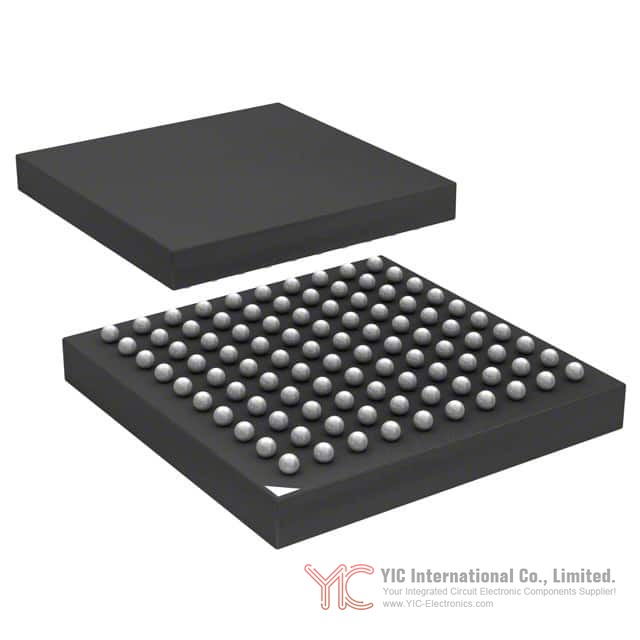
Product overview of STM32F103VCH6
STM32F103VCH6 belongs to the STM32F103xE high‑density performance line of 32‑bit microcontrollers from STMicroelectronics. It integrates an ARM Cortex‑M3 CPU running up to 72 MHz, 256 KB of embedded Flash and 48 KB of SRAM, a rich set of timers, 12‑bit ADCs and DACs, and up to 13 communication interfaces, all within a 100‑ball LFBGA package (10 × 10 mm).
Key parameters of STM32F103VCH6 include:
- Core: ARM 32‑bit Cortex‑M3, single‑core, up to 72 MHz, ~1.25 DMIPS/MHz (Dhrystone 2.1) at 0 wait states
- Program memory: 256 KB Flash (part of the STM32F103xE range of 256–512 KB)
- SRAM: 48 KB
- Supply voltage: 2.0 V to 3.6 V for core and I/Os
- Operating temperature: –40 °C to +85 °C (TA)
- I/O: up to 80 I/Os on STM32F103VCH6, all fast, most 5 V tolerant, mapped on 16 external interrupt vectors
- Analog: three 12‑bit ADCs (up to 21 channels, 1 μs conversion), two 12‑bit DAC channels
- Timers: up to 11 timers, including motor‑control PWM and basic timers, plus two watchdogs and SysTick
- Communications: CAN 2.0B active, USB 2.0 full‑speed, SDIO, up to 2× I²C, up to 5× USART, up to 3× SPI (2 with I²S), plus IrDA, LIN, ISO 7816 and modem control support
- Package: 100‑LFBGA (10 × 10 mm), moisture sensitivity level MSL 3 (168 hours), RoHS3 compliant, REACH unaffected
The STM32F103VCH6 is part of a family (STM32F103xC/xD/xE) that shares the same core and peripheral architecture, allowing reuse of hardware and software designs across different memory and pin‑count options such as STM32F103RC/RD/RE and STM32F103VC/VD/VE.
2.
Core architecture and performance of STM32F103VCH6
The STM32F103VCH6 is built around an ARM Cortex‑M3 core optimized for deterministic 32‑bit embedded applications.
Core characteristics of STM32F103VCH6:
- 72 MHz maximum frequency
- 1.25 DMIPS/MHz (Dhrystone 2.1) performance at 0 wait states from Flash
- Single‑cycle multiplication and hardware division for efficient signal processing and control algorithms
- Integrated nested vectored interrupt controller (NVIC) for low‑latency interrupt handling
- SysTick 24‑bit downcounter for OS tick and timebase generation
The Cortex‑M3 in STM32F103VCH6 is supported by:
- Serial Wire and JTAG debug port (SWJ‑DP)
- Embedded Trace Macrocell (ETM) for advanced trace and profiling
- A CRC (cyclic redundancy check) unit to support data integrity checks, protocol verification and memory content verification
In a typical control loop scenario—such as a motor‑control inverter using STM32F103VCH6—the combination of 72 MHz execution speed, single‑cycle arithmetic, and fast interrupt response allows the microcontroller to execute field‑oriented control algorithms while simultaneously managing communication interfaces and diagnostic tasks.
3.
Memory system and FSMC expansion of STM32F103VCH6
The STM32F103VCH6 memory subsystem is organized to support both internal code execution and external memory expansion.
Internal memories in STM32F103VCH6:
- Flash memory: 256 KB embedded Flash for code and non‑volatile data
- SRAM: 48 KB embedded SRAM for stack, heap, and data buffers
Flash characteristics (shared within the STM32F103xE line):
- Optimized for 72 MHz operation with appropriate wait‑state configuration
- Guaranteed endurance and data retention (see device memory characteristics tables such as Flash endurance and retention)
To extend memory and interface parallel peripherals, STM32F103VCH6 integrates a Flexible Static Memory Controller (FSMC):
- 4 chip select banks
- Support for external:
- SRAM and PSRAM
- NOR Flash
- NAND Flash
- PC Card / CompactFlash
- Support for both asynchronous and synchronous operation
- Dedicated timing parameters for read/write operations (as described in the FSMC timing tables and associated waveforms: asynchronous, synchronous, multiplexed and non‑multiplexed modes)
Real‑world design example with STM32F103VCH6:
- The internal 256 KB Flash hosts the main application and bootloader.
- External NOR/PSRAM on FSMC provides large data buffers for user interface elements or data logging.
- CompactFlash via FSMC is used as mass storage for configuration files and logs.
This architecture allows STM32F103VCH6 to fit designs where internal non‑volatile memory is supplemented by external memory without changing the microcontroller family.
4.
Clock, reset and power architecture of STM32F103VCH6
The STM32F103VCH6 clocking strategy supports flexible performance/power tradeoffs and multiple clock sources.
Clock sources for STM32F103VCH6:
- External high‑speed crystal/oscillator (HSE): 4–16 MHz
- Internal high‑speed RC (HSI): 8 MHz factory‑trimmed RC oscillator
- External low‑speed crystal/oscillator (LSE): 32.768 kHz for RTC
- Internal low‑speed RC (LSI): ~40 kHz with calibration
A PLL (phase‑locked loop) allows multiplication of HSE or HSI to generate the 72 MHz system clock. The clock tree (as shown in the device documentation) distributes this clock to:
- AHB bus for core and high‑speed peripherals
- APB1 and APB2 peripheral buses with prescalers
- Independent clocks for USB (derived from PLL), SDIO, ADC, and RTC
Reset and power control features in STM32F103VCH6:
- Power‑on reset (POR) and power‑down reset (PDR)
- Programmable voltage detector (PVD) to monitor VDD and generate interrupts/reset when the supply falls below configurable thresholds
- NRST dedicated reset pin with recommended external protection network
Boot modes in STM32F103VCH6 are determined by boot configuration pins, enabling boot from:
- Embedded Flash memory
- System memory (for bootloader access)
- Embedded SRAM
This flexibility supports firmware update strategies such as in‑field update via USART, USB or CAN, while keeping a robust primary boot path from Flash.
5.
Low‑power modes and current consumption of STM32F103VCH6
STM32F103VCH6 integrates a power management system designed to reduce consumption in inactive periods while keeping key functions available.
Power supply scheme for STM32F103VCH6:
- 2.0 V to 3.6 V main supply for core and I/Os
- Dedicated VBAT supply domain to power the RTC and backup registers when main VDD is removed
Voltage regulator in STM32F103VCH6:
- Provides regulated core voltage from VDD
- Operates in normal run or low‑power mode depending on system low‑power state
Low‑power modes of STM32F103VCH6:
- Sleep mode:
- CPU stopped, most peripherals can remain active
- Wakeup via any interrupt/event
- Stop mode:
- Main regulator configurable in run or low‑power mode
- Internal RC oscillators stopped; RTC (with LSE or LSI) can remain active
- Wakeup via external interrupts, RTC or specific internal events
- Standby mode:
- Lowest consumption; core and most peripherals powered down
- VBAT‑powered RTC and backup domain can remain active
- Wakeup via reset, RTC alarm, or wakeup pins
Current consumption data for STM32F103VCH6 is characterized in multiple tables and curves:
- Run mode: typical and maximum current vs. frequency and supply voltage, from Flash or SRAM (with peripherals enabled/disabled)
- Sleep mode: typical and maximum current with different clock configurations
- Stop and Standby modes: typical currents vs. temperature and VDD, including VBAT consumption for RTC
Example: in a battery‑powered data logger with STM32F103VCH6, the system can:
- Run at 72 MHz from Flash to acquire multi‑channel ADC data quickly.
- Store data to external NAND via FSMC.
- Enter Stop mode with RTC active between acquisitions, minimizing average current.
6.
Timer and motor control resources in STM32F103VCH6
STM32F103VCH6 features a comprehensive timer subsystem suited to precise timing, motor control and waveform generation.
Timer resources available in STM32F103VCH6:
- Up to four general‑purpose 16‑bit timers:
- Each with up to four channels for input capture, output compare, PWM generation or pulse counting
- Support for quadrature encoder input for position/speed sensing
- Two 16‑bit advanced motor control PWM timers:
- Complementary outputs with programmable dead‑time insertion
- Emergency stop input for rapid shut‑down in fault conditions
- Two basic 16‑bit timers:
- Commonly used as timebases or to drive the DAC
- Two watchdogs:
- Independent watchdog (IWDG) running from LSI for system recovery in case of software failure
- Window watchdog (WWDG) with a defined refresh window for tighter supervision
- SysTick: 24‑bit downcounter for periodic interrupt generation
Timer characteristics are detailed in the documentation (e.g., TIMx characteristics tables) and cover:
- Maximum input capture frequency
- PWM resolution and frequency ranges
- Timer clock relationships to APB bus clocks
Motor‑control application example with STM32F103VCH6:
- One advanced timer drives three‑phase inverter PWM with complementary outputs and dead‑time.
- Another timer is configured in encoder mode to read rotor position from a quadrature encoder.
- ADC triggers are synchronized with PWM to sample phase currents at precise instants.
7.
Communication interfaces of STM32F103VCH6
The STM32F103VCH6 integrates up to 13 communication interfaces covering industrial buses, serial links and multimedia audio.
I²C interfaces on STM32F103VCH6:
- Up to 2 × I²C controllers
- Support for standard and fast modes with SMBus / PMBus compatibility
- Parameters documented in I²C characteristics tables, including SCL frequency limits and timing requirements
USART interfaces on STM32F103VCH6:
- Up to 5 × USARTs
- Support for:
- Asynchronous UART mode
- Synchronous mode
- LIN bus protocol
- IrDA (infrared)
- ISO 7816 smart card interface
- Modem control signals
- Electrical and timing data provided in communication interface characteristics tables
SPI / I²S interfaces on STM32F103VCH6:
- Up to 3 × SPI interfaces, two of which support I²S audio mode
- SPI speed up to 18 Mbit/s
- Supported modes include master and slave; timing diagrams are provided for CPHA/CPOL configurations
- I²S master/slave modes compatible with standard audio data formats (Philips protocol timing diagrams provided)
CAN interface in STM32F103VCH6:
- CAN 2.0B Active
- Suitable for automotive and industrial control networks
- Detailed CAN electrical and timing characteristics are given in dedicated tables
USB 2.0 Full‑Speed in STM32F103VCH6:
- Integrated USB full‑speed device interface
- Startup times, DC and AC characteristics, and electrical parameters are documented (USB startup time, DC characteristics, and full‑speed characteristics tables)
SDIO interface in STM32F103VCH6:
- SDIO controller for SD and MMC cards
- Supports default and high‑speed modes (corresponding diagrams and timings provided)
A typical connectivity design with STM32F103VCH6 could include:
- USB FS as a device interface for configuration and firmware update
- CAN for networked control with other nodes
- SDIO to log data to an SD card
- I²C for sensor interfacing
- USART for legacy serial or LIN communication
8.
Analog peripherals and on‑chip monitoring in STM32F103VCH6
STM32F103VCH6 integrates analog functions that reduce external component count and support mixed‑signal designs.
ADC subsystem in STM32F103VCH6:
- Three 12‑bit ADCs (up to 21 channels total)
- 1 μs conversion time (fADC up to 14 MHz)
- Conversion range: 0 to 3.6 V
- Triple sample‑and‑hold capability for synchronous sampling
- Internal temperature sensor channel
- ADC accuracy, linearity, sampling times, input impedance and RAin limits are covered in detailed tables (ADC characteristics, accuracy tables, RAin max vs. fADC)
The documentation provides recommended connection diagrams and decoupling strategies:
- Example ADC connection diagram showing reference and supply filtering
- Two options for VREF+:
- VREF+ not connected to VDDA, using a separate reference connection
- VREF+ internally tied to VDDA with appropriate decoupling capacitors
DAC subsystem in STM32F103VCH6:
- Two 12‑bit DAC converters
- Buffered and non‑buffered output modes as shown in the DAC block diagram
- Electrical characteristics such as output settling time, accuracy and output drive capability are tabulated
On‑chip temperature sensor in STM32F103VCH6:
- Connected to an ADC channel
- Temperature sensor characteristics include output voltage vs. temperature and calibration parameters
These resources allow STM32F103VCH6 to perform functions such as:
- Multi‑channel sensor measurement with 12‑bit resolution
- Generating reference voltages and analog control signals via the DAC
- Monitoring the device’s own temperature for derating or thermal protection strategies
9.
GPIO, interrupt and debug resources of STM32F103VCH6
The STM32F103VCH6 digital I/O and interrupt structures provide flexible signal mapping and fast response.
GPIO in STM32F103VCH6:
- Up to 80 fast I/O pins available in the 100‑ball LFBGA package
- All I/Os can be configured as:
- Input (with or without pull‑up/pull‑down)
- Push‑pull or open‑drain output
- Alternate function
- Many pins are 5 V tolerant, enabling interface with 5 V logic without external level shifters (subject to documented input voltage limits)
I/O electrical characteristics are detailed in:
- I/O static characteristics (input leakage, output drive capability)
- Output voltage characteristics versus load current
- I/O AC characteristics (rise/fall times, maximum toggle frequency)
- Input characteristics for CMOS and TTL modes, including 5 V tolerant configurations
External interrupt and event controller (EXTI) in STM32F103VCH6:
- Up to 16 external interrupt lines
- Most GPIO pins can be mapped to EXTI lines
- Configurable for edge or level sensitivity
- Supports wakeup from low‑power modes
Debug resources in STM32F103VCH6:
- Serial Wire Debug (SWD) and full JTAG port available via SWJ‑DP
- Embedded Trace Macrocell (ETM) for instruction trace
- NRST pin characteristics and recommended protection circuit for robust reset behavior
In a development and production environment, STM32F103VCH6 can be:
- Programmed and debugged with SWD/JTAG through the standard header
- Diagnosed in‑system using ETM trace output (on devices and boards that route the trace pins)
10.
Package, pinout and thermal characteristics of STM32F103VCH6
The STM32F103VCH6 is offered in a 100‑ball LFBGA package optimized for high‑pin‑count designs with constrained board area.
Package details for STM32F103VCH6:
- Package type: 100‑LFBGA, 10 × 10 mm, 0.8 mm ball pitch
- Mechanical data:
- Package outline including body dimensions and ball grid layout
- Recommended PCB footprint and design rules for 0.8 mm pitch BGA (pad diameter, solder mask opening, via strategy)
- Marking: top‑view marking conventions defined for device identification
Thermal characteristics of STM32F103VCH6:
- Thermal parameters such as junction‑to‑ambient thermal resistance (RθJA) are specified in the package thermal characteristics table.
- Power dissipation vs. ambient temperature graphs (for similar packages such as LQFP100) guide product temperature range selection and thermal design.
The device shares pinout conventions with other STM32F103xC/xD/xE family members:
- BGA100 ballout diagrams show signal assignments for all balls, grouped by function (power, ground, I/O, analog, communication interfaces, FSMC, etc.).
- This family alignment allows reuse of board layouts when migrating between memory sizes or different package pin counts (e.g., LQFP64, LQFP100, LQFP144, LFBGA144, WLCSP64) while keeping the same STM32F103xC/xD/xE microcontroller architecture.
11.
Reliability, environmental and regulatory data for STM32F103VCH6
From a compliance and reliability perspective, STM32F103VCH6 is characterized for environmental and export‑related aspects.
Environmental compliance for STM32F103VCH6:
- RoHS status: RoHS3 compliant
- REACH status: REACH unaffected
Moisture Sensitivity Level (MSL) for STM32F103VCH6:
- MSL 3 (168 hours), meaning that after opening the dry pack, the device must be mounted and reflowed within 168 hours under specified ambient conditions or be re‑baked according to standard handling procedures.
Export classification for STM32F103VCH6:
- ECCN: 3A991A2
- HS/HTS code: 8542.31.0001
Electrical robustness is characterized by:
- Absolute maximum ratings and electrical sensitivity tables (ESD performance, electromagnetic susceptibility)
- EMC performance (EMI/EMS) derived from the EMC characteristics tables
These data points enable integration of STM32F103VCH6 into end products requiring compliance with international environmental and regulatory frameworks.
12.
Conclusion: Application positioning of STM32F103VCH6
STM32F103VCH6, as a member of the STM32F103xE high‑density performance line, combines a 72 MHz ARM Cortex‑M3 core, 256 KB Flash, 48 KB SRAM, extensive timers, multiple ADCs and DACs, and a broad set of connectivity options (CAN, USB FS, SDIO, multiple USART, I²C and SPI/I²S) in a 100‑LFBGA package.
The integrated FSMC enables connection to external SRAM, NOR/NAND Flash and CompactFlash, extending memory and storage beyond the on‑chip resources. Low‑power modes with detailed current consumption data, along with a VBAT‑powered RTC domain, support designs that must balance performance and energy usage.
With family‑wide compatibility across STM32F103xC/xD/xE devices, STM32F103VCH6 fits applications such as motor drives, industrial control nodes, communication gateways, instrumentation, and dataloggers where deterministic 32‑bit performance, rich peripheral sets and scalable memory configurations are required.
13.
Frequently Asked Questions (FAQ)
- Q1. What core and maximum operating frequency does STM32F103VCH6 use?
-
- A1. STM32F103VCH6 uses an Arm 32‑bit Cortex‑M3 CPU running at up to 72 MHz. At this frequency, the core delivers around 1.25 DMIPS/MHz (Dhrystone 2.1) at 0 wait states from Flash, supported by single‑cycle multiply and hardware divide instructions.
- Q2. How much Flash and SRAM are available in STM32F103VCH6?
-
- A2. STM32F103VCH6 provides 256 KB of embedded Flash memory for program storage and 48 KB of embedded SRAM for data. These values place the device in the STM32F103xE high‑density category within the STM32F103xC/xD/xE family.
- Q3. What is the supply voltage and operating temperature range of STM32F103VCH6?
-
- A3. The supply voltage range for STM32F103VCH6 is 2.0 V to 3.6 V for the main VDD and I/O domains. The specified ambient operating temperature range (TA) is –40 °C to +85 °C. A separate VBAT pin can power the RTC and backup registers when VDD is removed.
- Q4. Which communication interfaces are integrated in STM32F103VCH6?
-
- A4. STM32F103VCH6 integrates up to 13 communication interfaces:
- Up to 2 × I²C (SMBus/PMBus‑compatible)
- Up to 5 × USART (supporting ISO 7816, LIN, IrDA, modem control)
- Up to 3 × SPI (2 of which also support I²S)
- 1 × CAN 2.0B Active
- 1 × USB 2.0 full‑speed device interface
- 1 × SDIO interface for SD/MMC cards
This combination enables simultaneous support for field buses, serial links, storage and audio/streaming applications. - Q5. What timer resources does STM32F103VCH6 provide for control and motor applications?
-
- A5. STM32F103VCH6 provides up to 11 timers:
- Up to four 16‑bit general‑purpose timers, each with up to four IC/OC/PWM channels, capable of quadrature encoder interface
- Two 16‑bit motor control PWM timers with complementary outputs, dead‑time generation and emergency stop
- Two 16‑bit basic timers, often used to drive the DAC or as general timebases
- Two watchdog timers (independent and window)
- One SysTick 24‑bit downcounter
These timers support fine‑grained PWM, input capture, position/speed sensing, and system supervision. - Q6. How many ADCs and DACs are available in STM32F103VCH6 and what are their key specs?
-
- A6. STM32F103VCH6 features:
- Three 12‑bit ADCs with up to 21 channels in total, conversion range 0–3.6 V and minimum conversion time of 1 μs (fADC up to 14 MHz). They support triple sample‑and‑hold capability and include an internal temperature sensor channel.
- Two 12‑bit DAC channels with buffered/non‑buffered output options.
The documentation provides detailed ADC and DAC electrical characteristics, including accuracy, input impedance, and timing constraints. - Q7. What low‑power modes are supported by STM32F103VCH6 and how do they differ?
-
- A7. STM32F103VCH6 supports three main low‑power modes:
- Sleep mode: CPU is halted while peripherals can remain clocked; wakeup occurs from any enabled interrupt/event.
- Stop mode: high‑speed oscillators are stopped, regulator in run or low‑power mode, RTC and backup domain can remain active; wakeup from external interrupt lines or RTC.
- Standby mode: lowest power state, core and most peripherals powered down, only VBAT domain (RTC and backup registers) can remain supplied; wakeup via wakeup pins, RTC alarm or reset.
Current consumption in each mode is given in multiple tables and curves, allowing quantitative estimation of battery life. - Q8. Can STM32F103VCH6 be used with external memories such as SRAM or NAND Flash?
-
- A8. Yes. STM32F103VCH6 integrates a Flexible Static Memory Controller (FSMC) with four chip‑select banks. FSMC supports external SRAM, PSRAM, NOR Flash, NAND Flash and PC Card/CompactFlash in both asynchronous and synchronous modes. The datasheet includes read/write timing tables and waveforms for each memory type, enabling proper design of external memory interfaces.
- Q9. What package is used by STM32F103VCH6 and how many I/Os are accessible?
-
- A9. STM32F103VCH6 is supplied in a 100‑ball LFBGA package (10 × 10 mm body, 0.8 mm pitch). In this package up to 80 fast I/O pins are available, many of which are 5 V tolerant. Ballout diagrams and recommended PCB footprint/layout guidelines are provided in the package information section.
- Q10. Are STM32F103VCH6 I/O pins 5 V tolerant?
-
- A10. Most STM32F103VCH6 I/Os are 5 V tolerant when configured as digital inputs or alternate‑function inputs, according to the documented pin input voltage limits. The datasheet provides separate input characteristic curves for 5 V tolerant CMOS and TTL ports, as well as maximum injection current and protection diode constraints. Analog input pins and certain dedicated pins are not 5 V tolerant and must adhere strictly to the 0–VDD range.
- Q11. How does STM32F103VCH6 handle resets and supply supervision?
-
- A11. STM32F103VCH6 includes:
- Power‑on reset (POR) and power‑down reset (PDR) circuits to ensure defined startup and shutdown behavior
- A programmable voltage detector (PVD) that monitors VDD and can trigger interrupts or resets when the voltage crosses configurable thresholds
- A dedicated NRST pin, whose characteristics and recommended external protection network are defined in the NRST pin characteristics section
These features help maintain reliable operation during brownouts, power cycling and external reset events. - Q12. What debug and trace interfaces are available on STM32F103VCH6?
-
- A12. STM32F103VCH6 offers:
- Serial Wire Debug (SWD) and full JTAG via the SWJ‑DP (Serial Wire JTAG Debug Port), allowing standard debugging and programming tools
- An Embedded Trace Macrocell (ETM), which provides real‑time instruction trace for advanced debugging and performance tuning
These interfaces rely on dedicated pins defined in the pinout and can be used both during development and, if routed, for in‑field diagnostics. - Q13. What are the environmental and export classifications of STM32F103VCH6?
-
- A13. STM32F103VCH6 is RoHS3 compliant and REACH unaffected. Its export classification includes ECCN 3A991A2, and the HS code is 8542.31.0001. The device’s moisture sensitivity level is MSL 3 (168 hours), which determines storage and handling procedures before reflow.
- Q14. How does STM32F103VCH6 manage the real‑time clock (RTC) when the main supply is off?
-
- A14. STM32F103VCH6 provides a VBAT supply pin dedicated to the RTC and backup registers. When the main VDD supply is removed, connecting VBAT to a backup source (such as a battery) allows the RTC and backup registers to remain powered. The RTC uses either the external 32.768 kHz LSE crystal or the internal LSI oscillator, and typical VBAT current consumption versus temperature and VBAT is specified in the datasheet.
- Q15. Is STM32F103VCH6 pin‑compatible with other STM32F103xC/xD/xE devices?
-
- A15. STM32F103VCH6 is part of the STM32F103xC/xD/xE performance line, which has been designed for full compatibility within the family. Devices in these sub‑families share common pinouts and peripheral mappings for the same package types (e.g., LFBGA100, LQFP100, LFBGA144, LQFP64, LQFP144, WLCSP64). This allows migration between different Flash sizes (256–512 KB) and pin counts with minimal hardware changes, provided the same package family is used.