Product overview of STM32F103VEH7
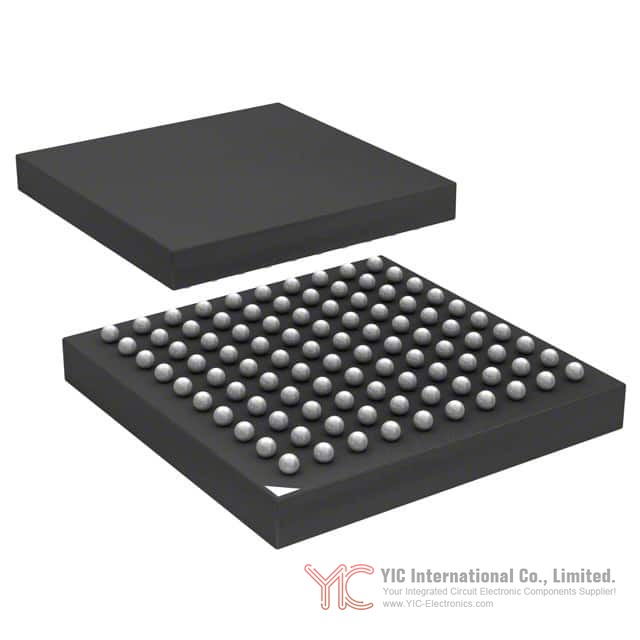
STM32F103VEH7 is a 32-bit microcontroller from STMicroelectronics’ STM32F103xE performance line, based on the Arm Cortex-M3 core. It integrates 512 Kbytes of on-chip Flash and 64 Kbytes of SRAM in a 100‑LFBGA 10 × 10 mm package, targeting applications that require high integration, multiple communication interfaces and precise control.
The core runs up to 72 MHz and delivers around 1.25 DMIPS/MHz (Dhrystone 2.1) at 0 wait-state memory access. STM32F103VEH7 belongs to the high-density subfamily (xC/xD/xE) which provides up to 112 fast I/Os, a rich set of timers, three 12-bit ADCs, dual 12-bit DACs, and up to 13 communication interfaces including USB full-speed and CAN 2.0B.
Key characteristics of STM32F103VEH7:
- Core: 32-bit Arm Cortex-M3, 72 MHz max
- Flash: 512 Kbytes; SRAM: 64 Kbytes
- Supply voltage: 2.0 V to 3.6 V
- Temperature range: −40 °C to +105 °C (TA)
- Package: 100‑LFBGA (10 × 10 mm), RoHS3 compliant, MSL 3 (168 h)
- Peripherals: up to 11 timers, 3 × 12-bit ADCs (up to 21 channels), 2 × 12-bit DACs
- Interfaces: CAN, USB FS, SDIO, up to 5 USARTs, up to 3 SPIs (with I2S), up to 2 I2C, LIN, IrDA
Within the broader STM32F103xC/D/E family, STM32F103VEH7 is positioned as a high-density device where on-chip Flash ranges from 256 Kbytes to 512 Kbytes depending on the specific part number, enabling reuse of hardware and software across multiple memory footprints.
---
2.
Core architecture and processing capabilities of STM32F103VEH7
STM32F103VEH7 uses an Arm 32-bit Cortex-M3 CPU optimized for cost-sensitive embedded applications where deterministic behavior and low interrupt latency are needed. The core offers:
- 72 MHz maximum frequency
- 1.25 DMIPS/MHz performance (Dhrystone 2.1)
- Single-cycle multiplication and hardware division
This architecture allows STM32F103VEH7 to execute control loops, protocol stacks and signal-processing algorithms with predictable execution time. For example, a motor-control application can combine PWM update, ADC sampling and communication in a single main loop while keeping enough headroom for diagnostics and safety checks.
A SysTick 24-bit downcounter is integrated for system tick generation, simplifying OS scheduling and periodic task management. This hardware timer helps implement precise periodic functions without consuming general-purpose timers.
The Cortex-M3 in STM32F103VEH7 is supported by a Nested Vectored Interrupt Controller (NVIC), which handles up to 16 external interrupt vectors mapped to up to 112 I/Os. This enables fine-grained interrupt management; time-sensitive events such as encoder inputs or communication receive lines can be assigned higher priority than background tasks.
For debugging and trace, STM32F103VEH7 supports Serial Wire Debug (SWD), JTAG and an Embedded Trace Macrocell (ETM), which jointly facilitate firmware development, real-time profiling and fault analysis.
---
3.
Memory subsystem and FSMC external expansion in STM32F103VEH7
The internal memory configuration of STM32F103VEH7 includes:
- Up to 512 Kbytes of embedded Flash memory
- Up to 64 Kbytes of embedded SRAM
The Flash supports zero-wait-state execution at up to 72 MHz under specified conditions, which is reflected in the performance figures. The datasheet details Flash timing characteristics, endurance and data retention; these parameters allow estimating lifecycle behavior for firmware with frequent updates or data logging.
SRAM is used for data, stack and heap, and its 64 Kbyte size in STM32F103VEH7 supports complex applications with communication buffers, RTOS objects and algorithm working memory.
Beyond internal memory, STM32F103VEH7 integrates an FSMC (Flexible Static Memory Controller) enabling connection of external memories and LCD modules:
- Up to 4 chip-select regions
- Support for CompactFlash, SRAM, PSRAM, NOR and NAND Flash
- Synchronous and asynchronous modes
- LCD parallel interface (8080/6800 modes)
Typical examples:
- A data logger can combine internal Flash for firmware and external NAND via FSMC for bulk data storage.
- A graphical HMI system can use FSMC to drive a parallel LCD while external SRAM provides frame buffering.
The memory map described in the documentation outlines address ranges for Flash, SRAM, peripheral registers, FSMC regions and system memory, guiding linker script configuration and external memory mapping.
CRC calculation hardware is also embedded. STM32F103VEH7 uses this CRC unit to check memory contents or payloads, improving robustness of firmware updates and communication protocols without heavy CPU overhead.
---
4.
Clock system, reset and power management of STM32F103VEH7
STM32F103VEH7 includes a flexible clock tree, allowing selection and prescaling of multiple clock sources:
- External high-speed oscillator (HSE): 4–16 MHz crystal or user clock
- Internal high-speed oscillator (HSI): 8 MHz factory-trimmed RC
- External low-speed oscillator (LSE): 32.768 kHz crystal for RTC
- Internal low-speed oscillator (LSI): ~40 kHz RC
- PLL used to multiply clock frequency up to 72 MHz
Designers can select combinations of HSE/HSI, LSE/LSI and PLL to optimize between precision, startup time and power consumption. For example, mains-synchronized metering may rely on HSE for accuracy, whereas a battery-powered sensor node may use the internal RC oscillators to reduce BOM cost.
The clock tree diagram in the datasheet shows how different peripherals (timers, communication interfaces, ADC) can be clocked from APB1/APB2 buses with prescalers. Peripheral timings such as I2C SCL, SPI clock or ADC sampling speed are derived from these clock domains; understanding clock relationships is necessary when configuring high-speed communication or ADC conversion rates.
Reset and supply supervision in STM32F103VEH7 includes:
- Power-on reset (POR)
- Power-down reset (PDR)
- Programmable voltage detector (PVD)
These circuits monitor VDD between 2.0 V and 3.6 V and ensure deterministic reset behavior at power-up and power-down. Configuration of PVD thresholds can protect against brownout scenarios, avoiding erratic operation when supply dips occur.
An on-chip voltage regulator provides the core supply from the external VDD line. Its characteristics, combined with external decoupling recommendations, affect stability and noise performance in applications with fast load transients, such as motor drives and switching power supplies.
---
5. Low-power operating modes of STM32F103VEH7
STM32F103VEH7 offers several low-power modes that allow tailoring energy usage to application profiles:
- Sleep mode: CPU clock stopped, peripherals and Flash available
- Stop mode: main regulator either in run or low-power mode, clocks stopped, SRAM and register contents preserved
- Standby mode: lowest consumption, with backup domain and RTC optionally powered via VBAT
Current consumption tables in the datasheet provide both maximum and typical values for each mode, for different supply voltages and temperatures. Wakeup times from low-power states are also specified, enabling budgeting of response latency.
An example is a data acquisition node:
- Run mode briefly during sampling and transmission
- Sleep while waiting for timer or external interrupt
- Stop or Standby between acquisition windows to extend battery life
The VBAT pin allows maintaining RTC and backup registers when the main supply is off. With LSE running and VBAT applied, STM32F103VEH7 can keep time and retain small amounts of backup data, which is useful in metering, logging or clock-equipped devices.
---
6. Timer resources and motor-control functions of STM32F103VEH7
STM32F103VEH7 includes up to 11 timers, enabling a wide range of time-based functions:
- Up to four general-purpose 16-bit timers, each with:
- Up to 4 input capture/output compare/PWM channels
- Pulse counting
- Quadrature encoder (incremental) inputs for position feedback
- Two dedicated 16-bit motor-control PWM timers:
- Complementary outputs
- Dead-time generation
- Emergency stop inputs
- Two basic 16-bit timers for general time-base generation and DAC triggering
- Two watchdog timers: independent watchdog and window watchdog
- SysTick 24-bit downcounter as system tick
The specialized PWM timers in STM32F103VEH7 are suited to driving three-phase inverters or brushless DC motors. Dead-time insertion helps prevent shoot-through in high-side/low-side transistor pairs, and emergency stop inputs can be linked to fault signals from overcurrent or overtemperature protection circuits.
Encoder interface mode allows direct decoding of incremental encoders for motion-control applications without external logic. Combining encoder capture with PWM generation and ADC sampling, STM32F103VEH7 can manage closed-loop control of motors or actuators.
Watchdog timers are used to recover from software lockups:
- Independent watchdog: typically clocked from LSI, runs even when main clocks fail
- Window watchdog: detects not only missing refresh events but also too-early refresh, which helps identify certain faulty behaviors
Timer characteristics in the datasheet provide details on resolution, maximum count frequency, and timing accuracy, which are needed when designing high-frequency PWM or precise measurement intervals.
---
7.
Communication interfaces and connectivity options of STM32F103VEH7
STM32F103VEH7 integrates up to 13 communication interfaces, enabling simultaneous connections to multiple buses and external devices:
I2C interfaces
- Up to 2 × I2C (supporting SMBus/PMBus)
- Multi-master capability, standard and fast modes as defined in the electrical tables
These channels can connect to sensors, power-management devices or other MCUs.
USART interfaces
- Up to 5 × USARTs with features including:
- ISO 7816 smartcard interface
- LIN support
- IrDA
- Modem control lines
These cover classical UART communication, smartcard readers, LIN automotive sub-networks and infrared communication.
SPI and I2S interfaces
- Up to 3 × SPI (up to 18 Mbit/s), with 2 supporting I2S mode
- I2S suitable for digital audio streams
SPI timing diagrams in the documentation show master and slave mode characteristics and clock phase/polarity behavior, which are important when interfacing external ADCs, codecs or display controllers.
CAN interface
- CAN 2.0B active controller
This supports standard and extended frames and fits industrial networking, automotive nodes or distributed control systems.
USB full-speed interface
- USB 2.0 full-speed device
- DC and AC electrical characteristics and startup times are documented
STM32F103VEH7 can implement USB devices such as virtual COM ports, mass-storage or HID devices without additional USB controller ICs.
SDIO interface
- Dedicated SDIO peripheral for SD/MMC cards
- High-speed and default mode timings specified
This allows direct use of SD cards for data logging or firmware storage.
These interfaces in STM32F103VEH7 can operate concurrently, within bus bandwidth limits, enabling designs such as: a gateway that aggregates CAN and UART data and exposes it over USB; or a logger that stores sensor data to SD card while communicating via RS-485 and USB.
---
8.
Analog functions: ADC, DAC and temperature sensor in STM32F103VEH7
STM32F103VEH7 provides rich analog capabilities:
ADC subsystem
- Three 12-bit ADCs
- Up to 21 external channels
- Conversion range 0–3.6 V
- Conversion time down to 1 μs
- Triple-sample-and-hold capability
- Integrated temperature sensor channel
The ADCs can be used in single, continuous, scan and injected modes, and are tightly integrated with DMA and timers. Typical use cases: multi-channel acquisition of sensor arrays, phase current measurement in motor drives, or battery-voltage monitoring. The datasheet contains detailed ADC accuracy figures, linearity, offset and sampling constraints (RAIN_max vs fADC), which guide the design of analog front ends, input impedance, and sampling frequency.
Two typical connection diagrams in the documentation illustrate decoupling and reference configurations:
- VREF+ tied to VDDA with specific decoupling networks
- VREF+ separated from VDDA to improve analog performance
DAC subsystem
- Two 12-bit DAC channels
- Can be triggered by timers
These DACs can generate analog control signals for external circuits, voltage setpoints, or waveform outputs. The internal architecture (buffered/non-buffered) is shown in the datasheet, with associated specifications such as settling time, output range and linearity.
Temperature sensor
- Internal temperature sensor connected to ADC
- Characterization curves provided
This feature allows basic internal temperature monitoring, useful for thermal protection, calibration adjustment or diagnostics.
In a practical system, STM32F103VEH7’s ADCs can acquire phase currents with synchronized sampling triggered by PWM timers, while DACs output test signals or drive external reference circuits. This tight integration reduces component count in measurement and control equipment.
---
9.
GPIO, interrupt system and debug resources of STM32F103VEH7
GPIO subsystem
STM32F103VEH7 supports up to 80 I/Os in the 100-LFBGA package, with the broader family offering up to 112 fast I/Os on larger pin-count variants. These I/Os are:
- Mappable to 16 external interrupt vectors
- Mostly 5 V tolerant (as outlined in the electrical tables)
- Configurable as push-pull, open-drain, with pull-up or pull-down
Input characteristics for CMOS and TTL levels, drive capability and AC timing specifications are all detailed in the documentation, enabling proper matching with external logic and buses.
External interrupt/event controller (EXTI)
- Allows each configurable pin to generate interrupts or events
- Supports rising/falling edge triggers
This enables responsive designs where GPIO edges (e.g., push buttons, Hall sensors, external clock signals) are directly linked to NVIC-managed interrupts.
Debug and trace
STM32F103VEH7 benefits from multiple debug features:
- SWJ-DP: a combined JTAG and Serial Wire debug port
- Embedded Trace Macrocell for real-time trace
These tools allow step-by-step debugging, non-intrusive trace capture and performance analysis, vital in complex firmware with real-time constraints.
The documentation’s pinouts, ballouts and pin definitions (for BGA and LQFP versions) provide the mapping between GPIO pins and their alternate functions (USART, SPI, CAN, ADC inputs, etc.). Proper pin planning using STM32F103VEH7 data is necessary to balance analog input placement, high-speed interface routing and external memory connections.
---
10.
Electrical characteristics and operating conditions of STM32F103VEH7
Operating conditions
STM32F103VEH7 is specified for:
- Supply voltage VDD from 2.0 V to 3.6 V
- Ambient temperature TA from −40 °C to +105 °C
General operating conditions, power-up/down behavior and reset thresholds are given in multiple tables, which support supply design and sequencing.
Current consumption
The documentation distinguishes:
- Maximum current consumption in Run mode (code from Flash vs RAM, peripherals enabled/disabled)
- Typical consumption in Run, Sleep, Stop and Standby modes
- Peripheral-specific current consumption
Figures show current versus frequency at a given VDD, and versus temperature in low-power modes. These curves allow estimation of power budget and thermal behavior in final systems. For instance, a 3.6 V system running at high CPU frequency with many peripherals enabled can be compared against Stop mode at low temperature to determine average current for a given duty cycle.
Clock source characteristics
The datasheet provides:
- External high-speed and low-speed oscillator characteristics
- Internal HSI and LSI RC oscillator frequency tolerance and drift
- PLL input/output limits
Waveforms and equivalent circuits show how to select crystal load capacitors and series resistors. Example application circuits illustrate 8 MHz HSE and 32.768 kHz LSE connections, helping to ensure reliable startup and maintain frequency stability.
Memory, FSMC, EMC and ESD
Electrical sections cover:
- Flash memory access times, endurance and retention
- FSMC timing parameters for various memory types (asynchronous, synchronous, multiplexed/non-multiplexed)
- EMC (emission and susceptibility) characteristics
- ESD and latch-up robustness
These parameters guide selection of external memories, PCB layout practices and protection components for STM32F103VEH7 designs in industrial or noisy environments.
Regulatory and environmental data
- RoHS3 compliant
- REACH unaffected
- ECCN 3A991A2
- HTSUS 8542.31.0001
Moisture Sensitivity Level (MSL 3, 168 h) indicates storage and handling requirements during assembly, especially for the 100-LFBGA package of STM32F103VEH7.
---
11.
Packaging options and thermal considerations for STM32F103VEH7
STM32F103VEH7 itself is delivered in a 100-LFBGA (10 × 10 mm) package. Within the STM32F103xC/D/E family, multiple packages are available (LFBGA100, LFBGA144, LQFP64/100/144, WLCSP64), all detailed in the package information section. Although the specific part number STM32F103VEH7 uses LFBGA100, other pin-compatible options in the family allow migration or reuse of board designs with different memory sizes or pin counts where pin mapping is maintained.
For STM32F103VEH7’s 100-LFBGA:
- Mechanical dimensions and tolerance are specified
- Recommended PCB footprint and design rules (0.8 mm pitch) are provided
- Marking examples support correct device identification on assembled boards
Thermal characteristics tables list junction-to-ambient thermal resistance (θJA) and power dissipation vs ambient temperature, including graphs such as Pp_max vs TA for related packages. These graphs support thermal design decisions such as copper area sizing, via placement and airflow requirements.
When placing STM32F103VEH7 on a dense PCB, adhering to the recommended footprint and routing guidelines helps ensure solder joint reliability and signal integrity, particularly for high-speed FSMC, SDIO and USB signals.
---
12.
Conclusion on STM32F103VEH7 selection and usage
STM32F103VEH7 combines a 72 MHz Cortex-M3 core with 512 Kbytes Flash, 64 Kbytes SRAM and a comprehensive set of digital, analog and communication peripherals in a compact 100-LFBGA package. Within the STM32F103xC/D/E performance line, it addresses designs requiring a balance of processing performance, broad connectivity (USB, CAN, SDIO, multiple USART/SPI/I2C), multi-channel analog acquisition and motor-control capability.
The documentation provides detailed information on the core architecture, memory map, power supply schemes, low-power modes, timer capabilities, communication interfaces, ADC/DAC subsystems, electrical limits and package specifications. Using this information, designers can size power supplies, define thermal budgets, choose external components (crystals, memories, analog front ends), and plan PCB layouts that fully exploit STM32F103VEH7 features while remaining within specified operating conditions.
---
Frequently Asked Questions (FAQ)
- Q1. What is the maximum operating frequency and supply voltage range of STM32F103VEH7?
-
- A1. STM32F103VEH7 runs at up to 72 MHz with a supply voltage range from 2.0 V to 3.6 V for both the core and I/Os. The Flash is specified to operate at this frequency with appropriate wait-state configuration as described in the Flash memory characteristics table.
- Q2. How much Flash and SRAM does STM32F103VEH7 integrate, and how does it compare within the STM32F103xE family?
-
- A2. STM32F103VEH7 provides 512 Kbytes of embedded Flash and 64 Kbytes of embedded SRAM. In the broader STM32F103xC/D/E family, Flash ranges from 256 Kbytes to 512 Kbytes. STM32F103VEH7 is a high-density member (xE series) at the top of this memory range, while sharing a common architecture with lower-density parts.
- Q3. Which communication interfaces are available in STM32F103VEH7 for connecting to external devices and networks?
-
- A3. STM32F103VEH7 includes up to:
- 2 × I2C (with SMBus/PMBus support)
- 5 × USARTs (with LIN, IrDA, ISO 7816, modem control capabilities)
- 3 × SPI, 2 of which support I2S mode for audio
- 1 × CAN 2.0B active
- 1 × USB 2.0 full-speed device
- 1 × SDIO interface for SD/MMC cards
These interfaces can be enabled concurrently subject to bus bandwidth and pin mapping, allowing complex communication topologies. - Q4. Can STM32F103VEH7 interface with external memories or LCDs, and how is this achieved?
-
- A4. Yes. STM32F103VEH7 integrates an FSMC (Flexible Static Memory Controller) that supports external SRAM, PSRAM, NOR, NAND and CompactFlash devices, as well as an LCD parallel interface in 8080/6800 modes. Up to four chip-select regions can be configured with dedicated timing parameters. The FSMC timing tables and waveforms in the datasheet guide configuration for asynchronous and synchronous transactions, including for PC Card/CF and NAND.
- Q5. What analog resources does STM32F103VEH7 offer for data acquisition and signal generation?
-
- A5. STM32F103VEH7 has three 12-bit ADCs with up to 21 input channels, conversion time down to 1 μs, and triple-sample-and-hold capability. It also integrates two 12-bit DAC channels and an internal temperature sensor connected to the ADC. The ADC and DAC are closely coupled with timers and DMA, allowing synchronized multi-channel sampling and triggered analog output.
- Q6. How suitable is STM32F103VEH7 for motor-control applications?
-
- A6. STM32F103VEH7 features:
- Two dedicated 16-bit motor-control PWM timers with complementary outputs, dead-time generation and emergency stop inputs
- Up to four 16-bit general-purpose timers with input capture, output compare, PWM and encoder interface modes
- Three ADCs for current and voltage measurement
These resources, combined with the 72 MHz Cortex-M3 core and DMA, support field-oriented control, BLDC drive and other advanced control schemes. The motor-control timers’ dead-time and emergency-stop capabilities are specifically designed to manage power stages safely. - Q7. What low-power modes are supported in STM32F103VEH7, and how can they be used in battery-powered designs?
-
- A7. STM32F103VEH7 supports Sleep, Stop (with regulator in run or low-power mode) and Standby modes. Sleep stops the CPU while keeping peripherals active; Stop turns off clocks but retains SRAM and registers; Standby powers down most of the device while preserving the backup domain (RTC and backup registers via VBAT). Current consumption and wakeup times are quantified in the datasheet, enabling duty-cycle planning for battery-powered devices such as remote sensors or handheld instruments.
- Q8. How can the real-time clock (RTC) be maintained when the main supply of STM32F103VEH7 is off?
-
- A8. STM32F103VEH7 includes a backup domain supplied by VBAT. By connecting a backup battery or supercapacitor to VBAT and using the external 32.768 kHz LSE oscillator or internal LSI, the RTC and backup registers remain functional when VDD is removed. Typical current consumption on VBAT versus temperature is provided to estimate backup battery lifetime.
- Q9. What are the key GPIO capabilities of STM32F103VEH7, and are the pins 5 V tolerant?
-
- A9. STM32F103VEH7 provides up to 80 I/O pins in the 100-LFBGA package, with up to 112 I/Os available on the largest package variants of the family. Most GPIOs are 5 V tolerant as indicated by the pin and I/O characteristic tables, enabling direct connection to certain 5 V logic signals when configured as inputs. Each I/O can be configured for different modes (input, push-pull or open-drain output, alternate function, with pull-up or pull-down). Electrical tables describe input thresholds, output drivers and AC timing.
- Q10. How is STM32F103VEH7 debugged and programmed?
-
- A10. STM32F103VEH7 supports JTAG and Serial Wire Debug (SWD) through a Serial Wire JTAG debug port (SWJ-DP) and includes an Embedded Trace Macrocell. These interfaces allow programming Flash memory, debugging firmware, setting breakpoints and capturing real-time trace information. The boot modes described in the clock and startup section also define how the device can boot from different memory regions for programming scenarios.
- Q11. What environmental and regulatory classifications apply to STM32F103VEH7?
-
- A11. STM32F103VEH7 is RoHS3 compliant and REACH unaffected according to the documentation. Its export classification is ECCN 3A991A2 and tariff classification is HTSUS 8542.31.0001. The MSL rating is 3 (168 hours), which determines handling and baking requirements before reflow soldering, especially for its 100-LFBGA package.
- Q12. Which package does STM32F103VEH7 use, and what PCB design rules should be followed?
-
- A12. STM32F103VEH7 is provided in a 100-LFBGA package (10 × 10 mm, 0.8 mm pitch). The datasheet includes package mechanical drawings, recommended PCB footprint, and design rules such as pad dimensions and solder-mask openings. Adhering to these recommendations improves solder joint reliability and facilitates routing of high-speed signals like FSMC, SDIO and USB.
- Q13. How does the internal temperature sensor of STM32F103VEH7 work in practice?
-
- A13. The internal temperature sensor is connected to one of the ADC channels. By performing ADC conversions on this channel and applying the calibration data and formulas indicated in the temperature sensor characteristics, firmware can estimate the die temperature. While not intended as a precise external thermometer, this function supports thermal management, drift compensation and protection in combination with other system-level measurements.
- Q14. What are the key considerations when using external crystals with STM32F103VEH7?
-
- A14. For the high-speed external oscillator (4–16 MHz) and low-speed external oscillator (32.768 kHz), the datasheet specifies load capacitances, startup times and drive characteristics. Typical connection diagrams show how to connect crystals, including series resistors and capacitors. Matching component values to the crystal’s specified load capacitance and following the layout guidance helps ensure reliable oscillation and minimize jitter.