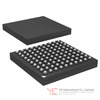
Product Overview of STM32F103VBT7TR
STM32F103VBT7TR is a 32-bit microcontroller based on the ARM Cortex-M3 core, positioned within the STM32F103xB medium-density “performance line” family. It combines a 72 MHz CPU, 128 KB of embedded Flash memory, 20 KB of SRAM, and a rich set of analog and digital peripherals in a 100‑pin LQFP (14 × 14 mm) surface-mount package.
The device operates from a 2.0 V to 3.6 V supply and supports an operating temperature range from -40 °C to 105 °C (TA), making it suitable for both consumer and industrial environments. With up to 80 I/O ports, multiple communication interfaces (USB 2.0 full-speed, CAN 2.0B, USART, SPI, I2C), 7 timers, and dual 12-bit ADCs, STM32F103VBT7TR can address applications ranging from motor control and industrial automation to communication gateways and instrumentation.
RoHS3 compliance and a moisture sensitivity level of 3 (168 hours) align STM32F103VBT7TR with modern environmental and manufacturing requirements. Within the broader STM32F103x8/xB family, STM32F103VBT7TR provides 128 KB Flash and the high-pin-count, feature-rich configuration that maximizes peripheral and I/O availability.
---
2.
Core Architecture and Processing Performance of STM32F103VBT7TR
At the heart of STM32F103VBT7TR is an ARM 32-bit Cortex-M3 CPU running at up to 72 MHz. The core achieves 1.25 DMIPS/MHz (Dhrystone 2.1) at 0 wait-state memory access, providing responsive control performance for real-time embedded tasks.
Key core features of STM32F103VBT7TR include:
- 32-bit single-core Cortex-M3 with Thumb-2 instruction set
- Single-cycle multiplication and hardware division to accelerate arithmetic-intensive routines
- A nested vectored interrupt controller (NVIC) supporting multiple interrupt sources with programmable priority
- Support for a SysTick 24-bit downcounter timer, often used as an OS tick or system timebase
The Cortex-M3 architecture in STM32F103VBT7TR targets deterministic interrupt latency and efficient exception handling. This allows precise control loops, such as those in motor control or power conversion, to run reliably alongside communication stacks and user interface logic.
---
3.
Memory System and Data Integrity Features of STM32F103VBT7TR
STM32F103VBT7TR integrates a structured memory system that balances code storage, data storage, and data integrity:
- 128 Kbytes of embedded Flash memory for program and non-volatile data (medium-density, xB variant)
- 20 Kbytes of embedded SRAM for stack, heap, and runtime data
- Memory mapping architecture shared with the STM32F103x8/xB family, supporting code execution from Flash or RAM
For data robustness and system reliability, STM32F103VBT7TR includes:
- A CRC (cyclic redundancy check) calculation unit, enabling integrity checks for code images, communication payloads, or stored data
- A 96-bit unique ID that allows traceability, secure provisioning, or device-level personalization
Typical usage in STM32F103VBT7TR designs includes running the main application code from Flash, with performance-critical routines optionally placed in SRAM for reduced latency. The integrated CRC unit can be used during firmware updates to verify images before activation, reducing the risk of corrupted code execution.
---
4. Power Supply, Clocking, and Low-Power Modes in STM32F103VBT7TR
STM32F103VBT7TR operates from a 2.0 V to 3.6 V application supply (VDD) and I/O supply, with on-chip functions that manage power integrity and clock sources.
Power supply and supervision in STM32F103VBT7TR:
- Power-on reset (POR) and power-down reset (PDR) circuits to ensure predictable startup and shutdown
- Programmable voltage detector (PVD) to monitor the VDD level and generate an interrupt or reset when supply falls below a programmed threshold
- An internal voltage regulator providing regulated core supply from the external VDD
Clock sources and startup for STM32F103VBT7TR:
- 4–16 MHz external high-speed crystal/oscillator (HSE)
- 32.768 kHz low-speed external crystal (LSE) for real-time clock (RTC) operation
- Internal 8 MHz RC oscillator (HSI), factory-trimmed
- Internal 40 kHz low-speed RC oscillator (LSI)
- PLL for generating higher CPU frequencies from lower-speed sources
The clock tree of STM32F103VBT7TR allows selecting and prescaling different sources to feed the system clock, peripheral clocks, and communications modules. Designers can trade off performance and consumption by adjusting PLL and prescalers.
Low-power modes supported by STM32F103VBT7TR:
- Sleep mode: CPU stopped, peripherals and memory active as configured
- Stop mode: Low power mode with the main regulator in Run or Low-power mode; RAM and register contents preserved, clocks stopped (except for selected low-speed sources)
- Standby mode: Minimal consumption with backup domain and RTC (via VBAT) optionally maintained, main regulator off
Typical usage: STM32F103VBT7TR can run at 72 MHz for active processing, then enter Sleep or Stop while waiting for interrupts (from timers, communication, or GPIO). Stop or Standby modes are chosen when extended battery life is required, with wakeup timing and data retention tailored to the application.
---
5.
Timer, PWM, and Watchdog Resources of STM32F103VBT7TR
STM32F103VBT7TR integrates 7 timers designed to handle timebase generation, PWM, input capture, output compare, and specialized motor control tasks.
Timer resources in STM32F103VBT7TR include:
- Three general-purpose 16-bit timers, each with up to 4 channels for:
- Input capture (IC)
- Output compare (OC)
- PWM generation
- Pulse counting
- Quadrature (incremental) encoder input
- One 16-bit advanced motor-control PWM timer with:
- Complementary outputs and dead-time generation
- Emergency stop input for safety-related shutdown
- Two watchdog timers:
- Independent watchdog (IWDG) running from LSI for system recovery in case of software failure
- Window watchdog (WWDG) providing timing windows to detect early or late refresh
- One SysTick timer: 24-bit decrementing counter for periodic interrupts
In STM32F103VBT7TR, the motor control timer can directly drive power stages for three-phase motors, while encoder interface capabilities on general-purpose timers support closed-loop speed or position feedback. System robustness is strengthened through the dual-watchdog approach, allowing different layers of software supervision.
---
6.
Communication Interfaces and Connectivity Options in STM32F103VBT7TR
STM32F103VBT7TR is designed with extensive communication capabilities suitable for a wide range of protocols and topologies:
Integrated communication peripherals of STM32F103VBT7TR:
- Up to 2 × I2C interfaces with SMBus/PMBus support
- Up to 3 × USART interfaces supporting:
- Asynchronous UART mode
- ISO 7816 smartcard interface
- LIN bus support
- IrDA capability
- Modem control
- Up to 2 × SPI interfaces with speeds up to 18 Mbit/s
- CAN interface (2.0B Active) for automotive and industrial bus networks
- USB 2.0 full-speed device interface
These interfaces, combined with up to 9 total communication channels in STM32F103VBT7TR, make it suitable for acting as a connectivity hub. For example, a design can use CAN to communicate with an industrial fieldbus, USB for configuration and firmware updates, and USART for external module interfacing, all concurrently.
Electrical characteristics for these interfaces (such as USB DC parameters, CAN timings, and I2C/SPI bus timing) are specified in the device electrical characteristics, allowing accurate bus loading and speed calculations during design.
---
7. GPIO, Interrupts, and Real-Time Control with STM32F103VBT7TR
STM32F103VBT7TR provides up to 80 fast I/O ports, with the following characteristics:
- 26/37/51/80 I/Os available depending on package and pin configuration; STM32F103VBT7TR in LQFP100 uses the upper range
- Almost all I/O pins are 5 V tolerant, allowing direct interface to mixed-voltage digital systems (within specified conditions)
- I/O lines are individually configurable as input, output, alternate function, or analog, and support multiple output driver options
The external interrupt/event controller (EXTI) in STM32F103VBT7TR:
- Maps up to 16 external lines to interrupt/event inputs
- Allows edge-triggered interrupts or events on GPIO lines
- Supports flexible routing from different GPIO pins
Combined with the NVIC, STM32F103VBT7TR can implement responsive real-time control schemes where sensor events, communication arrivals, or user inputs trigger rapid ISR execution. For example, an external encoder on a motor shaft can be connected to timer encoder mode inputs, while external limit switches use EXTI lines to halt motion.
---
8. Analog Front-End and Temperature Sensing in STM32F103VBT7TR
Analog capabilities of STM32F103VBT7TR are built around two 12-bit, 1 µs ADCs:
- Up to 16 total channels multiplexed across two 12-bit ADC units
- Conversion range from 0 to 3.6 V (aligned with supply domain)
- Dual sample-and-hold capability for simultaneous sampling in multi-channel scenarios
ADC characteristics of STM32F103VBT7TR include:
- Up to 14 MHz ADC clock operation
- Various conversion and sampling modes configurable through registers
- Specified accuracy and linearity parameters for typical and limited test conditions
Additionally, STM32F103VBT7TR integrates a temperature sensor connected internally to the ADC. This can be used for:
- Monitoring device junction temperature
- Implementing thermal protection or compensation in applications such as motor drives or power supplies
Real-world usage: an STM32F103VBT7TR-based design can use one ADC channel for DC bus current, another for phase current, and additional channels for voltage feedback. The internal temperature sensor can feed temperature data into control algorithms or simple overtemperature protection routines.
---
9. DMA, RTC, and System-Level Support Functions of STM32F103VBT7TR
STM32F103VBT7TR contains system-level support functions that reduce CPU load and support real-time operation.
DMA in STM32F103VBT7TR:
- 7-channel DMA controller
- Supports transfers for timers, ADC, SPI, I2C, and USART peripherals
- Allows peripheral-to-memory, memory-to-peripheral, and memory-to-memory transfers without CPU intervention
Typical use: the ADC in STM32F103VBT7TR can continuously convert multiple channels and use DMA to store data into a memory buffer. The CPU can then process large data sets (e.g., for digital filtering) without servicing each conversion individually.
RTC and backup domain in STM32F103VBT7TR:
- Real-time clock (RTC) powered optionally by a dedicated VBAT supply pin
- 32.768 kHz LSE crystal input for precise timekeeping
- Backup registers retained while main VDD is removed and VBAT remains present
With VBAT, STM32F103VBT7TR can preserve time and key backup data across power cycles or while the system is in Standby mode, which is useful in metering, logging, and timing applications.
Debug and programming support in STM32F103VBT7TR:
- Serial wire debug (SWD) and JTAG interfaces via combined SWJ-DP (Serial Wire JTAG Debug Port)
- Support for in-circuit debugging, programming, and boundary-scan operations
These features simplify development, testing, and production programming of STM32F103VBT7TR-based designs.
---
10.
Package, Pinout, and Environmental Characteristics of STM32F103VBT7TR
STM32F103VBT7TR is delivered in:
- 100‑pin low-profile quad flat package (100-LQFP), 14 × 14 mm
Within the STM32F103x8/xB family, other package options include LQFP48, LQFP64, BGA100, BGA64, and VFQFPN36, but the STM32F103VBT7TR specifically corresponds to the 100‑LQFP variant, providing the highest I/O count in the family.
Package-related data for STM32F103VBT7TR:
- Mechanical details defined in the 100-LQFP package mechanical data and outline figures
- Recommended PCB footprint to ensure solder joint reliability and manufacturability
- Thermal characteristics that relate maximum power dissipation (Pp max) to ambient temperature (TA)
Environmental characteristics of STM32F103VBT7TR:
- RoHS3 compliant
- Moisture Sensitivity Level (MSL) 3 with a 168-hour floor life after opening the dry pack, requiring appropriate storage and reflow handling
- REACH unaffected classification
These parameters allow STM32F103VBT7TR to be integrated into standard SMT processes while meeting regulatory and environmental constraints.
---
11.
Electrical Performance and Operating Conditions of STM32F103VBT7TR
The STM32F103VBT7TR electrical characteristics define safe operation and performance boundaries:
General operating conditions for STM32F103VBT7TR:
- Supply voltage (VDD): 2.0 V to 3.6 V
- Ambient temperature (TA): -40 °C to 105 °C
- On-chip reference voltage and internal regulator specifications
Absolute maximum ratings for STM32F103VBT7TR:
- Maximum ratings on supply and I/O pins beyond which permanent damage may occur
- Electrical sensitivity limits for ESD and EMC
Current consumption characteristics in STM32F103VBT7TR:
- Maximum and typical currents in Run mode from Flash and RAM, at different frequencies and temperatures
- Sleep mode consumption with peripherals enabled or disabled
- Stop and Standby mode current levels across the temperature range
- Peripheral-specific current consumption
Clock source characteristics in STM32F103VBT7TR:
- HSE: 4–16 MHz oscillator specifications and external clock conditions
- LSE: 32.768 kHz oscillator characteristics
- HSI and LSI internal RC oscillator tolerances and startup times
- PLL operating ranges
I/O characteristics in STM32F103VBT7TR:
- Static and dynamic I/O parameters (VIH, VIL, VOH, VOL, drive capability)
- NRST pin characteristics and recommended protection circuit
- EMC and EMI performance data
Communication and ADC performance in STM32F103VBT7TR:
- I2C timing and maximum SCL frequencies under given bus speeds
- SPI timing diagrams for master and slave modes
- USB DC/AC parameters for full-speed operation
- CAN interface specifications
- 12-bit ADC accuracy, linearity, input impedance constraints, and RAIN(max) values at specified fADC
- Temperature sensor characteristics
These detailed specifications support accurate budgeting of power, noise margins, bus speeds, and measurement precision when designing with STM32F103VBT7TR.
---
12.
Design and Application Considerations for STM32F103VBT7TR
Given its feature set, STM32F103VBT7TR fits numerous embedded use cases:
- Motor control: motor-control PWM timer with dead-time and emergency stop, encoder interface, dual 12-bit ADCs for current/voltage measurements, and temperature sensor for thermal management
- Communication gateways: multiple USARTs, SPI, I2C, CAN, and USB full-speed device interface allow bridging between fieldbuses, legacy serial interfaces, and PC-based tools
- Industrial and instrumentation systems: 0–3.6 V ADC range for sensor interfaces, wide operating temperature range, and robust power supervisory functions
- Low-power devices: Sleep/Stop/Standby modes combined with VBAT-powered RTC and backup registers for long-term battery operation
Example scenario using STM32F103VBT7TR:
A three-phase motor drive may implement:
- CPU at 72 MHz for FOC (field-oriented control) computations
- Motor-control PWM timer generating gate signals with dead-time and emergency stop
- ADCs sampling phase currents and bus voltage, triggered synchronously by timers
- CAN interface for industrial communication to a central controller
- Internal temperature sensor monitoring junction temperature and adjusting operating limits
By leveraging DMA for ADC data acquisition and timers for synchronized sampling, STM32F103VBT7TR offloads repetitive tasks from the CPU, leaving processing bandwidth for control algorithms and communication stacks.
---
13.
Conclusion on STM32F103VBT7TR for Embedded Applications
STM32F103VBT7TR, as a 32-bit ARM Cortex‑M3 microcontroller within the STM32F103xB medium-density line, provides a combination of 72 MHz performance, 128 KB Flash, 20 KB SRAM, and a rich set of analog, timer, and communication peripherals. Its 100‑pin LQFP package exposes up to 80 fast, largely 5 V-tolerant I/Os, making it suitable for complex embedded designs requiring multiple interfaces and precise real-time control.
With flexible clocking, multiple low-power modes, dual watchdogs, integrated CRC, and a 96‑bit unique ID, STM32F103VBT7TR supports designs that must balance performance, reliability, and power consumption. Electrical and mechanical characteristics are thoroughly specified, enabling robust design-in across a broad temperature and supply range.
---
Frequently Asked Questions (FAQ)
- Q1. What are the main differentiating features of STM32F103VBT7TR within the STM32F103x8/xB family?
-
- A1. STM32F103VBT7TR belongs to the STM32F103xB medium-density family with 128 KB Flash and 20 KB SRAM. It is associated with the 100‑pin LQFP package, providing up to 80 fast I/O ports and the full complement of available peripherals: 7 timers, 2 × 12-bit ADCs, up to 9 communication interfaces (including USB full-speed and CAN 2.0B), DMA, RTC, and integrated temperature sensor. Compared to devices in smaller packages or with 64 KB Flash (x8), STM32F103VBT7TR offers more memory and I/O availability.
- Q2. What is the maximum operating frequency of STM32F103VBT7TR, and how is it achieved?
-
- A2. The maximum CPU frequency of STM32F103VBT7TR is 72 MHz. This is typically achieved by using the internal PLL fed by either the 8 MHz internal HSI oscillator or an external 4–16 MHz HSE crystal/oscillator. The PLL and prescaler settings are configured to multiply the input clock to reach 72 MHz while respecting the clock tree limits defined in the electrical characteristics.
- Q3. How much program and data memory does STM32F103VBT7TR provide, and what is their intended use?
-
- A3. STM32F103VBT7TR includes 128 Kbytes of embedded Flash memory and 20 Kbytes of SRAM. The Flash is used to store program code and non-volatile data such as parameters or configuration tables. The SRAM is used for runtime data, including stacks, heaps, and variables. Time-critical routines can be placed in SRAM for improved execution speed when necessary.
- Q4. Does STM32F103VBT7TR support USB and CAN, and can they operate concurrently?
-
- A4. Yes. STM32F103VBT7TR integrates a USB 2.0 full-speed device interface and a CAN 2.0B Active interface. Both are separate peripherals with their own registers and can operate concurrently when configured, provided that the system clock and peripheral clocks are set appropriately and that the CPU/DMA bandwidth is managed.
- Q5. What low-power modes are available in STM32F103VBT7TR, and when are they typically used?
-
- A5. STM32F103VBT7TR supports Sleep, Stop, and Standby modes. Sleep mode stops the CPU while keeping clocks and peripherals active as configured, suitable for short idle periods. Stop mode halts most clocks with the core regulator in Run or Low-power mode, preserving RAM and registers, used for longer idle times with fast wakeup. Standby mode powers down the main regulator while maintaining the backup domain (RTC and backup registers via VBAT), used for very low power consumption across long intervals, such as battery-powered standbys.
- Q6. How many timers and PWM outputs does STM32F103VBT7TR provide for motor control and timing tasks?
-
- A6. STM32F103VBT7TR includes 7 timers in total: one 16-bit advanced motor-control PWM timer, three 16-bit general-purpose timers, two watchdog timers (independent and window), and the SysTick 24-bit downcounter. The advanced motor-control timer and general-purpose timers each support up to four channels for IC/OC/PWM. This structure allows multi-channel PWM generation, complementary outputs with dead-time, and synchronized timing for complex motor control or power conversion tasks.
- Q7. What ADC resources are available in STM32F103VBT7TR, and what is their performance?
-
- A7. STM32F103VBT7TR integrates two 12-bit ADCs with up to 16 total channels and dual sample-and-hold capability. The conversion range is 0 to 3.6 V, aligned with the analog supply. With an ADC clock up to 14 MHz, conversion times can reach approximately 1 µs. Device documentation provides detailed accuracy, linearity, and input impedance requirements to guide sensor interface design.
- Q8. Does STM32F103VBT7TR have an internal temperature sensor, and how is it used?
-
- A8. Yes. STM32F103VBT7TR has an internal temperature sensor connected to one of the ADC channels. It is used to measure the device junction temperature. Applications can use this measurement for thermal management, such as derating performance at higher temperatures or implementing overtemperature shutdown. Calibration and conversion formulas are provided in the device documentation.
- Q9. What is the operating voltage and temperature range of STM32F103VBT7TR?
-
- A9. STM32F103VBT7TR operates with a supply voltage from 2.0 V to 3.6 V and supports an ambient temperature range from -40 °C to 105 °C (TA). These ranges cover many industrial and embedded environments, provided that power supply and thermal design ensure compliance with the full set of electrical and thermal specifications.
- Q10. Are the I/O pins of STM32F103VBT7TR 5 V tolerant?
-
- A10. Almost all I/O pins of STM32F103VBT7TR are 5 V tolerant when configured appropriately, allowing connection to external 5 V logic without level shifting, within the conditions specified in the I/O characteristics. The exact list of 5 V tolerant pins and any exceptions are indicated in the pin definition tables and electrical characteristics.
- Q11. How does STM32F103VBT7TR support data integrity and system reliability?
-
- A11. STM32F103VBT7TR includes several features that enhance data integrity and reliability:
- CRC calculation unit for verifying data blocks, firmware images, or communication payloads
- Independent and window watchdog timers to recover from software anomalies
- POR/PDR circuits and PVD to ensure controlled startup and brown-out handling
- 96-bit unique ID for device identification, useful in secure provisioning and tracking
These features help maintain stable operation even under challenging power or software conditions. - Q12. What debug and programming interfaces are available on STM32F103VBT7TR?
-
- A12. STM32F103VBT7TR provides Serial Wire Debug (SWD) and JTAG interfaces combined in the Serial Wire JTAG Debug Port (SWJ-DP). These support full in-circuit debugging, programming, and boundary-scan capabilities, enabling firmware development, production programming, and in-circuit testing.
- Q13. Is STM32F103VBT7TR suitable for battery-powered applications?
-
- A13. STM32F103VBT7TR offers several features beneficial for battery-powered systems: low-power modes (Sleep, Stop, Standby), an RTC and backup registers powered from VBAT, and optimized current consumption specified across modes and temperatures. By using Stop or Standby modes between active periods, designs can reduce average power consumption while maintaining timekeeping and essential backup data.
- Q14. What packaging and environmental compliance details apply to STM32F103VBT7TR?
-
- A14. STM32F103VBT7TR is supplied in a 100‑pin LQFP package (14 × 14 mm) suitable for standard SMT assembly. It is RoHS3 compliant and has a Moisture Sensitivity Level (MSL) of 3, with 168 hours of floor life after opening under standard conditions. These attributes support compliance with modern environmental regulations and standard reflow processes.
- Q15. How is RTC functionality implemented on STM32F103VBT7TR, and what is VBAT used for?
-
- A15. The RTC in STM32F103VBT7TR resides in the backup domain and can be clocked by a 32.768 kHz LSE crystal. VBAT is a dedicated supply pin powering the RTC and backup registers when the main VDD is absent. This allows STM32F103VBT7TR to maintain time and critical backup data through system power-offs or deep low-power states, which is useful in metering, logging, or scheduled-activity applications.
- Q16. What should be considered when designing the clock circuitry for STM32F103VBT7TR?
-
- A16. When using external oscillators with STM32F103VBT7TR, designers should follow the specified ranges and electrical parameters:
- HSE: 4–16 MHz external crystal/oscillator with the recommended load capacitors and layout, as shown in reference application circuits
- LSE: 32.768 kHz crystal with appropriate load capacitors and board layout to ensure stable oscillation
- HSI and LSI internal RCs can be used where external crystals are not desired, with awareness of their tolerances
Additionally, clock security and startup behavior are governed by the clock tree and PLL characteristics detailed in the electrical section, which should be followed for robust operation. - Q17. How does STM32F103VBT7TR handle external interrupts and events?
-
- A17. STM32F103VBT7TR uses the EXTI (external interrupt/event controller) to map up to 16 external lines to interrupt or event lines. Each line can be configured for rising, falling, or both edges, and can generate either an interrupt (handled by the NVIC) or an event to wake the system or trigger internal logic. GPIO pins are mapped to EXTI lines via configurable routing, allowing flexible assignment of external signals to interrupt-capable inputs.