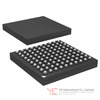
STM32F103VET6 product overview and STM32F103xE family positioning
The STM32F103VET6 is a 32-bit microcontroller from STMicroelectronics in the STM32F1 series, based on the Arm Cortex-M3 core. It belongs to the high-density STM32F103xE group and combines a 72 MHz maximum CPU frequency with 512 Kbytes of embedded Flash memory, up to 64 Kbytes of SRAM in the family, and a broad peripheral set that includes USB, CAN, SDIO, multiple serial interfaces, timers, ADCs, DACs, DMA, and external memory support through FSMC.
Within the device summary provided for this model, STM32F103VET6 is described as a 32-bit single-core microcontroller with 512 KB Flash in a 100-pin LQFP package. The specified supply range is 2.0 V to 3.6 V, and the operating temperature range is -40°C to 85°C. The package for this specific model is 100-LQFP.
The broader STM32F103xC, STM32F103xD, and STM32F103xE documentation places this device in a performance-oriented branch of the STM32F1 family. Across this high-density family, Flash density ranges from 256 Kbytes to 512 Kbytes, while the peripheral mix remains centered on high integration: up to 11 timers, 3 ADCs, 2 DACs, and up to 13 communication interfaces.
A practical way to view STM32F103VET6 is as a device aimed at designs that need a combination of moderate-to-high on-chip code space, several connectivity options, and direct support for control-oriented and mixed-signal functions without moving to a larger or more power-hungry processor class.
STM32F103VET6 core architecture, memory resources, and performance profile
At the center of the STM32F103VET6 is the Arm Cortex-M3 CPU, operating at up to 72 MHz. STMicroelectronics specifies performance of 1.25 DMIPS/MHz based on Dhrystone 2.1, with 0 wait-state memory access under stated conditions. The core also includes single-cycle multiplication and hardware division, which supports control loops, signal processing steps, protocol handling, and general embedded computing workloads with lower software overhead than simpler microcontroller cores.
The memory structure is one of the defining characteristics of the STM32F103VET6. The model provides 512 Kbytes of embedded Flash memory, and the family supports up to 64 Kbytes of SRAM. This balance allows the device to hold a relatively large firmware image while keeping sufficient working memory for stacks, buffers, protocol frames, and data-processing tasks.
The documentation also notes Flash endurance and data-retention characteristics as part of the electrical section, which is relevant where field updates or long service intervals are part of the design plan. In addition, the presence of a CRC calculation unit helps firmware verify data integrity for stored images, communication payloads, or table validation.
The family includes a nested vectored interrupt controller, which is part of the Cortex-M3 architecture and supports efficient exception handling. In applications with multiple asynchronous events such as timer captures, communication interrupts, and ADC conversion completion, this structure helps reduce interrupt latency and improves firmware organization.
For designs that need external memory expansion, the STM32F103xE family adds a flexible static memory controller. This changes the role of the microcontroller from a self-contained controller into a device that can also act as the center of a wider memory-mapped subsystem.
STM32F103VET6 clock system, reset behavior, boot modes, and power architecture
The STM32F103VET6 supports several clocking options. The clock system includes a 4 MHz to 16 MHz external high-speed crystal oscillator, an internal 8 MHz factory-trimmed RC oscillator, an internal 40 kHz RC oscillator with calibration, and a 32 kHz oscillator for the RTC with calibration. A PLL is also available to generate the higher system clock frequency.
This gives designers several implementation paths. A design may use the internal oscillator to reduce component count, or an external crystal where tighter timing characteristics are preferred for communication interfaces or time-base accuracy. For RTC operation, the 32.768 kHz source fits calendar or long-duration timing applications.
Reset and supply management are integrated through POR, PDR, and a programmable voltage detector. The documentation also identifies an embedded reset and power control block and an internal voltage regulator. These features work together to manage startup, undervoltage behavior, and internal operating stability across the 2.0 V to 3.6 V supply range.
Boot modes are supported, allowing the device to start from different memory contexts. In practice, that can simplify manufacturing programming flows, field-update arrangements, or recovery mechanisms. For example, a design can reserve a maintenance path that uses built-in boot behavior without requiring custom hardware redesign.
The documentation’s power-supply scheme also separates application and backup considerations. That becomes more useful when RTC retention or backup-register preservation is needed during main-supply loss.
STM32F103VET6 low-power operating modes and backup-domain capabilities
The STM32F103VET6 includes Sleep, Stop, and Standby low-power modes. These modes allow different tradeoffs between wake-up speed, state retention, and current consumption. The documentation provides typical and maximum current figures for Run, Sleep, Stop, and Standby conditions, including the effect of voltage and temperature.
Sleep mode keeps more of the system context active and is suitable when the CPU needs to pause between interrupts while maintaining quick responsiveness. Stop mode reduces consumption further, and the regulator can operate in run mode or low-power mode depending on the selected balance. Standby mode goes further still for designs that remain inactive for longer intervals.
The family also supports VBAT supply for the RTC and backup registers. That means timekeeping and a small protected data domain can remain powered while the main supply is absent. A common example is a system that must preserve timestamps, fault counters, or retained configuration values through battery backup while the main electronics are shut down.
The RTC and backup-register arrangement is useful in systems that require event logging or scheduled wake-up behavior. When paired with low-power modes, the microcontroller can reduce average system power consumption while still retaining enough context to restart operation in a controlled manner.
STM32F103VET6 timer subsystem, watchdogs, and motor-control-related features
One of the strongest integration areas in the STM32F103VET6 family is timing and control. The documentation states support for up to 11 timers. These include up to four 16-bit timers, each with up to four input capture, output compare, PWM, or pulse-counter channels, plus quadrature encoder input capability. There are also 2 × 16-bit motor-control PWM timers with dead-time generation and emergency stop, a SysTick 24-bit downcounter, and 2 × 16-bit basic timers intended to drive the DAC.
This timer mix allows the microcontroller to support several categories of applications from the same platform. Standard timing jobs include periodic interrupts, waveform generation, event measurement, and pulse counting. Encoder input support fits motion and position tracking. Motor-control timers extend usefulness in inverter, actuator, and drive-related designs where complementary PWM outputs and fault shutdown behavior are needed.
The inclusion of both independent and window watchdog timers adds supervision coverage. The independent watchdog is suited for autonomous recovery based on its own clock source, while the window watchdog can detect software timing faults where servicing occurs too early or too late.
A concrete example helps illustrate the flexibility. In a motorized control board, one timer may generate center-aligned PWM outputs, another may decode an encoder, a third may schedule current-sampling triggers for the ADC, while SysTick maintains the firmware scheduler. This reduces the need for external logic and keeps timing functions tightly coupled to the control firmware.
STM32F103VET6 communication interfaces and data-movement architecture
The STM32F103VET6 integrates a broad communication set. The documentation describes up to 13 communication interfaces in the family, including up to 2 I2C interfaces with SMBus/PMBus support, up to 5 USARTs with support for ISO 7816, LIN, IrDA, and modem control, up to 3 SPI interfaces operating up to 18 Mbit/s, 2 of which can be multiplexed with I2S, one CAN 2.0B Active interface, one USB 2.0 full-speed interface, and one SDIO interface.
This interface density allows one device to connect simultaneously to sensors, local peripherals, a host interface, removable or embedded storage, and industrial or automotive-style networks. In many systems, that reduces the need for protocol bridges or secondary controllers.
The USB full-speed interface supports direct USB device connectivity. The CAN interface supports CAN 2.0B Active, which fits controller-area networking environments. SDIO enables direct SD/MMC-style card interfacing at higher efficiency than bit-banged or SPI-based alternatives in designs that need local data logging or file-based storage.
The DMA controller has 12 channels and supports peripherals including timers, ADCs, DAC, SDIO, I2S, SPI, I2C, and USARTs. DMA changes the data-flow model significantly. Instead of requiring the CPU to move every sample or frame byte-by-byte, peripherals can exchange data with memory with less CPU intervention. This is especially useful when several interfaces are active at the same time.
For instance, a design could sample analog channels through ADC with DMA into SRAM while simultaneously streaming data over USART and maintaining communication on CAN. The Cortex-M3 core then remains available for application logic instead of spending most of its cycles on data shuttling.
STM32F103VET6 analog functions, temperature sensing, and mixed-signal integration
The STM32F103VET6 family includes 3 × 12-bit ADCs with conversion time down to 1 µs and support for up to 21 channels, depending on device and package context. The ADC conversion range is 0 to 3.6 V, and the documentation notes triple sample-and-hold capability. The family also integrates 2 × 12-bit DACs and an internal temperature sensor.
This combination allows the microcontroller to manage both input measurement and output waveform or bias generation. ADC channels can be used for voltage, current, position, sensor, or housekeeping measurements. DAC outputs can generate analog references, threshold levels, or simple waveforms.
The documentation includes ADC and DAC electrical specifications and also shows recommended power-supply and reference-decoupling connections. These details matter because mixed-signal performance depends not just on the converter block itself but also on board-level implementation, source impedance, and reference stability.
The internal temperature sensor provides an on-chip measurement point for thermal monitoring. It is not a replacement for all external temperature sensors, but it can be used for local die-temperature observation, thermal derating logic, or diagnostic reporting.
As a practical example, in an industrial control node the ADCs may read multiple analog process signals and supply rails, the DAC may generate a setpoint or calibration output, and the internal temperature sensor may help firmware compensate behavior under changing board temperature.
STM32F103VET6 GPIO structure, interrupt handling, debug support, and trace features
The STM32F103VET6 belongs to a family that provides up to 112 fast I/O ports, with 51, 80, or 112 I/Os depending on package. The documentation notes that all I/Os are mappable on 16 external interrupt vectors and almost all are 5 V-tolerant.
For the STM32F103VET6 specifically, the product listing indicates 80 I/Os in the 100-LQFP package. This gives the device enough pin availability for designs that need several interfaces active together, external memory signals, multiple ADC inputs, or dense control wiring.
The external interrupt/event controller supports event-driven design. Signals from external sensors, buttons, comparators, encoders, or communication-related lines can be routed into the interrupt system, helping firmware react without constant polling.
On the development side, the device supports serial wire debug and JTAG through the SWJ-DP interface, and the Cortex-M3 Embedded Trace Macrocell is also documented. This simplifies debugging, firmware bring-up, and runtime analysis, especially in applications where several interrupts and peripherals interact in tight timing windows.
In practice, this means a design team can move from basic board bring-up to deeper trace-based timing analysis without changing the core microcontroller platform. That continuity helps during prototype work and later firmware optimization.
STM32F103VET6 external memory support, LCD parallel interface, and memory mapping
The STM32F103xE family includes a flexible static memory controller with four chip selects. It supports Compact Flash, SRAM, PSRAM, NOR, and NAND memories, and also provides an LCD parallel interface in 8080/6800 modes.
This changes the integration level of the STM32F103VET6 substantially compared with microcontrollers limited to internal Flash and SRAM only. External memory support can be used to add frame buffers, code or data storage, nonvolatile memory devices, or compact storage-style interfaces where the application requires more capacity or specialized memory types.
The LCD parallel interface is relevant in designs with display modules that use common parallel controller buses. Rather than bit-banging a display or dedicating extensive firmware overhead to screen updates, the memory-mapped interface model can simplify display transactions.
The documentation includes a family memory map and detailed FSMC timing tables for SRAM, PSRAM, NOR, NAND, and CompactFlash/PC Card accesses. These timing definitions are useful when checking whether a selected external memory device can be matched to the MCU bus timing.
A practical example is an HMI-style controller that combines local data logging and a graphical or text display. External SRAM can hold a frame buffer or transaction data, the LCD interface can connect to the display controller, and the internal Flash remains reserved for firmware.
STM32F103VET6 electrical characteristics, operating conditions, and current-consumption considerations
The STM32F103VET6 operates from a 2.0 V to 3.6 V supply range, with application supply and I/O support in that range. The documentation provides absolute maximum ratings, operating conditions, embedded reference voltage characteristics, clock-source characteristics, PLL data, memory characteristics, I/O characteristics, and current-consumption tables.
The model’s stated ambient operating temperature range is -40°C to 85°C. The electrical section also includes conditions for power-up and power-down, current injection susceptibility, output-voltage behavior, NRST characteristics, timer timing characteristics, and interface-level specifications for I2C, SPI, I2S, SDIO, USB, ADC, DAC, and the temperature sensor.
Current consumption is broken down across Run, Sleep, Stop, and Standby modes, with separate cases such as code running from Flash or RAM and peripherals enabled or disabled. That helps when estimating system power budgets. A firmware architecture that uses DMA and aggressive peripheral gating will behave differently from one that keeps several communication blocks active continuously.
The oscillator section covers both external and internal source characteristics. That provides the information needed to choose between crystal-based accuracy and reduced BOM count using internal RC sources. USB and some communication timings may drive one choice, while simpler standalone controllers may favor the other.
The datasheet also includes EMC, EMI, and ESD-related information. While those values do not replace full end-product compliance work, they provide a device-level baseline for electrical robustness considerations.
STM32F103VET6 package, pin-count context, thermal considerations, and device compatibility
The STM32F103VET6 is supplied in a 100-pin LQFP package. In the family documentation, package options across the broader STM32F103xC/D/E range include WLCSP64, LQFP64, LQFP100, LQFP144, LFBGA100, and LFBGA144. For this specific model, the package of interest is LQFP100 with a 14 × 14 mm body.
The 100-pin package provides a balance between I/O availability and board space. In this package class, the device can expose a large portion of its communication, timer, analog, and external-memory-related functions without moving to the larger 144-pin variants.
The documentation also highlights full compatibility throughout the family. That can simplify migration within the STM32F103xC, STM32F103xD, and STM32F103xE line when memory size, package, or pin count needs change. The family tables and pin definitions are the basis for checking whether a design can scale upward or sideways with limited PCB and firmware changes.
Thermal characteristics are included in the package section, along with package mechanical data and recommended footprint information. These details support layout planning, assembly preparation, and package-level thermal assessment.
For a design team, that means the STM32F103VET6 can serve both as a fixed end-device choice and as part of a broader family strategy where one PCB concept may be adapted across several memory or package variants.
Conclusion
The STM32F103VET6 from STMicroelectronics combines a 72 MHz Arm Cortex-M3 core, 512 Kbytes of Flash, broad serial connectivity, USB full speed, CAN 2.0B Active, SDIO, multiple timers, 12-bit ADCs, dual 12-bit DACs, DMA, RTC backup support, and external memory interfacing in a 100-pin LQFP package.
Its position inside the STM32F103xE high-density family explains much of its appeal: it offers the integration level needed for control, communication, mixed-signal, and interface-heavy embedded systems while remaining within a standard microcontroller architecture. The device’s combination of internal resources and expansion features makes it suitable for designs that need to connect to multiple external devices, process analog and digital signals, support real-time control tasks, and still maintain a relatively compact board-level implementation.
Frequently Asked Questions (FAQ)
- Q1. What processor core does the STM32F103VET6 use?
-
- A1. The STM32F103VET6 uses an Arm Cortex-M3 32-bit core. The datasheet specifies operation up to 72 MHz and performance of 1.25 DMIPS/MHz based on Dhrystone 2.1.
- Q2. How much Flash memory is available in the STM32F103VET6?
-
- A2. The STM32F103VET6 provides 512 Kbytes of embedded Flash memory. It belongs to the STM32F103xE high-density group, where Flash density can reach 512 Kbytes.
- Q3. How much SRAM does the STM32F103VET6 family support?
-
- A3. The STM32F103xC/D/E documentation specifies up to 64 Kbytes of SRAM in the family.
- Q4. What is the operating voltage range of the STM32F103VET6?
-
- A4. The specified supply range is 2.0 V to 3.6 V for application supply and I/Os.
- Q5. What temperature range is specified for the STM32F103VET6?
-
- A5. The STM32F103VET6 is specified for operation from -40°C to 85°C ambient temperature.
- Q6. What package does the STM32F103VET6 use?
-
- A6. The STM32F103VET6 is provided in a 100-pin LQFP package. The family documentation identifies the LQFP100 body size as 14 × 14 mm.
- Q7. How many I/O pins are available on the STM32F103VET6?
-
- A7. The product information provided for STM32F103VET6 lists 80 I/Os for this 100-pin version.
- Q8. Does the STM32F103VET6 support USB?
-
- A8. Yes. The STM32F103VET6 family includes a USB 2.0 full-speed interface, and the electrical section includes USB startup and full-speed characteristics.
- Q9. Does the STM32F103VET6 support CAN communication?
-
- A9. Yes. The device family includes one CAN interface compliant with CAN 2.0B Active.
- Q10. How many USART interfaces are available in the STM32F103VET6 family?
-
- A10. The datasheet specifies up to 5 USARTs in the STM32F103xC/D/E family. These support features such as ISO 7816, LIN, IrDA, and modem control.
- Q11. How many I2C interfaces are available on the STM32F103VET6 family?
-
- A11. The family supports up to 2 I2C interfaces, with SMBus/PMBus capability.
- Q12. How many SPI interfaces does the STM32F103VET6 family include?
-
- A12. The family supports up to 3 SPI interfaces, with data rates up to 18 Mbit/s. Two of these can also be multiplexed with I2S functionality.
- Q13. Does the STM32F103VET6 support SD cards or MMC devices?
-
- A13. The family includes an SDIO interface, which supports SD/MMC-style connections and is suitable for applications such as local data storage.
- Q14. How many DMA channels does the STM32F103VET6 provide?
-
- A14. The STM32F103VET6 family includes a 12-channel DMA controller. Supported peripherals include timers, ADCs, DAC, SDIO, I2S, SPI, I2C, and USARTs.
- Q15. How many timers are integrated in the STM32F103VET6 family?
-
- A15. The family includes up to 11 timers. These include general-purpose 16-bit timers, motor-control PWM timers, a SysTick timer, and basic timers for DAC driving.
- Q16. Does the STM32F103VET6 support motor control applications?
-
- A16. The family includes 2 × 16-bit motor-control PWM timers with dead-time generation and emergency stop. It also supports quadrature encoder input on timers, which is useful in motion-related systems.
- Q17. What watchdog functions are available in the STM32F103VET6?
-
- A17. The STM32F103VET6 family includes two watchdog timers: an Independent watchdog and a Window watchdog.
- Q18. How many ADCs are included in the STM32F103VET6 family?
-
- A18. The family includes 3 × 12-bit ADCs with conversion times down to 1 µs and support for up to 21 channels, depending on device and package context.
- Q19. What is the ADC input conversion range on the STM32F103VET6?
-
- A19. The ADC conversion range is specified as 0 V to 3.6 V.
- Q20. Does the STM32F103VET6 include DAC outputs?
-
- A20. Yes. The family includes 2 × 12-bit DACs.
- Q21. Is there an internal temperature sensor in the STM32F103VET6?
-
- A21. Yes. The STM32F103VET6 family includes an internal temperature sensor, and its characteristics are covered in the datasheet.
- Q22. What clock sources can be used with the STM32F103VET6?
-
- A22. The STM32F103VET6 supports a 4 MHz to 16 MHz external high-speed crystal oscillator, an internal 8 MHz factory-trimmed RC oscillator, an internal 40 kHz RC oscillator with calibration, and a 32 kHz oscillator for RTC operation with calibration.
- Q23. Does the STM32F103VET6 include low-power modes?
-
- A23. Yes. The STM32F103VET6 supports Sleep, Stop, and Standby modes. The datasheet provides current-consumption figures and wake-up timing information for these states.
- Q24. Can the STM32F103VET6 keep time when the main power is removed?
-
- A24. Yes. The family includes VBAT support for the RTC and backup registers, allowing the backup domain to remain powered independently of the main supply.
- Q25. Does the STM32F103VET6 support external memory?
-
- A25. Yes. In the STM32F103xE family, the flexible static memory controller supports Compact Flash, SRAM, PSRAM, NOR, and NAND memories with four chip selects.
- Q26. Can the STM32F103VET6 interface directly with parallel LCDs?
-
- A26. Yes. The family documentation lists an LCD parallel interface supporting 8080/6800 modes.
- Q27. What debug interfaces are available on the STM32F103VET6?
-
- A27. The STM32F103VET6 supports Serial Wire Debug and JTAG through the SWJ-DP interface. The family also includes Cortex-M3 Embedded Trace Macrocell support.
- Q28. Are the GPIOs on the STM32F103VET6 5 V tolerant?
-
- A28. The datasheet states that almost all fast I/O ports are 5 V tolerant.
- Q29. Can the STM32F103VET6 be used without an external crystal?
-
- A29. Yes. The internal 8 MHz factory-trimmed RC oscillator allows operation without an external high-speed crystal in applications where its clock characteristics are suitable.
- Q30. What kind of applications fit the STM32F103VET6 based on its documented feature set?
-
- A30. Based on the datasheet, the STM32F103VET6 fits embedded designs that combine code density, multiple communication links, timer-driven control, analog measurement, USB or CAN connectivity, and optional external memory or display interfacing. Examples include control nodes, communication gateways, motor-related controllers, HMI subsystems, and data-logging equipment.