Product Overview and Core Architecture
The STM32H743IIK6TR represents a sophisticated 32-bit microcontroller built on the ARM Cortex-M7 architecture, operating at frequencies up to 480 MHz. This device combines high computational performance with comprehensive peripheral integration, making it suitable for applications ranging from industrial control systems to consumer electronics requiring advanced signal processing and connectivity features.
The STM32H743IIK6TR is built around the ARM Cortex-M7 core with a double-precision floating-point unit (FPU) that supports both IEEE 754 single and double-precision data processing. The processor incorporates a six-stage dual-issue pipeline with dynamic branch prediction, enabling efficient instruction execution. The architecture includes Harvard memory organization with separate instruction and data buses, complemented by L1 caches comprising 16 Kbytes of instruction cache and 16 Kbytes of data cache. This design reduces memory access latency and improves overall system throughput.
The STM32H743IIK6TR processor supports a comprehensive set of DSP (Digital Signal Processing) instructions, allowing developers to implement complex algorithms for audio processing, motor control, and signal analysis without requiring external specialized hardware. The memory protection unit (MPU) provides security features by managing CPU access rights and system resource attributes, enabling the definition of up to 16 protected memory regions with configurable access permissions.
STM32H743IIK6TR Processing Capabilities and Performance Specifications
The STM32H743IIK6TR delivers 1027 DMIPS (Dhrystone 2.1) at 480 MHz, translating to 2.14 DMIPS per megahertz. This performance metric indicates the device's ability to execute complex computational tasks efficiently. The dual-issue pipeline architecture allows the processor to execute multiple instructions per clock cycle under optimal conditions, significantly enhancing throughput for data-intensive applications.
The STM32H743IIK6TR supports multiple operating frequency configurations through its flexible clock management system. The device can operate at various performance levels, with the maximum 480 MHz frequency available on revision V devices. This frequency scalability enables developers to balance performance requirements against power consumption, a critical consideration in battery-powered or thermally constrained applications.
The floating-point unit integrated into the STM32H743IIK6TR core eliminates the need for software emulation of floating-point operations, reducing computational overhead and improving execution speed for scientific calculations, signal processing, and control algorithms. The FPU handles both single-precision (32-bit) and double-precision (64-bit) operations, providing flexibility for applications with varying accuracy requirements.
STM32H743IIK6TR Memory Organization and Data Storage
The STM32H743IIK6TR incorporates up to 2 Mbytes of embedded flash memory organized into two independent banks, each containing eight user sectors of 128 Kbytes. This dual-bank architecture enables read-while-write operations, allowing the system to execute code from one bank while programming the other, a feature valuable for firmware updates without system interruption.
The flash memory structure includes 128 Kbytes of system flash memory from which the device can boot, along with 2 Kbytes of user option bytes for configuration storage. The flash memory employs error correction code (ECC) protection with 10 ECC bits per 256-bit word, supporting single-error correction and double-error detection through the SECDED algorithm. This protection mechanism ensures data integrity over the device's operational lifetime, particularly important in applications exposed to radiation or electromagnetic interference.
The STM32H743IIK6TR provides up to 1 Mbyte of RAM distributed across multiple memory domains. The tightly coupled memory (TCM) subsystem includes 64 Kbytes of instruction TCM (ITCM) and 128 Kbytes of data TCM (DTCM) organized as two 64-Kbyte banks. These zero-wait-state memories connect directly to the processor through dedicated interfaces, enabling deterministic access times for real-time critical routines and interrupt service handlers.
The STM32H743IIK6TR features AXI-SRAM mapped to the AXI bus on the D1 domain, providing 384 or 512 Kbytes depending on the specific variant. Additional SRAM blocks mapped to the D2 domain include SRAM1, SRAM2, and SRAM3, with capacities varying by device variant. The D3 domain contains 64 Kbytes of SRAM4, while 4 Kbytes of backup SRAM retains data during low-power modes and system resets.
The STM32H743IIK6TR supports external memory expansion through the flexible memory controller (FMC) interface, accommodating static RAM, PSRAM, NOR flash, NAND flash, and SDRAM/LPSDR SDRAM devices. The FMC operates with up to 32-bit data bus width and supports synchronous access at frequencies up to 100 MHz, enabling high-speed data transfers for applications requiring large external storage or high-bandwidth memory access.
STM32H743IIK6TR Power Management and Supply Architecture
The STM32H743IIK6TR operates from a 1.62 to 3.6 V power supply, with the ability to reduce the minimum voltage to 1.62 V through external power supervision. The device incorporates three independent power domains (D1, D2, and D3) that can be individually clock-gated or powered down, enabling fine-grained power management for complex applications.
The STM32H743IIK6TR integrates an embedded voltage regulator (LDO) with configurable output levels supporting six power supply scales. In run mode, scales 0 through 3 provide boosted performance, high performance, medium performance, and optimized low-power operation respectively. In stop mode, scales 3 through 5 allow peripheral operation with varying levels of power consumption reduction. This voltage scaling capability enables dynamic power adjustment based on instantaneous performance requirements.
The STM32H743IIK6TR includes comprehensive power supply supervision through integrated power-on reset (POR), power-down reset (PDR), and brownout reset (BOR) circuits. The POR supervisor monitors the supply voltage and maintains the device in reset when VDD is below the threshold. The PDR supervisor can be enabled or disabled through the PDR_ON pin, allowing external power supervisors to extend the minimum operating voltage. The BOR circuit provides three configurable thresholds between 2.1 and 2.7 V, generating a reset when the supply drops below the selected level.
The STM32H743IIK6TR features dedicated USB power inputs (VDD33USB and VDD50USB) on all packages except LQFP100, enabling independent USB power supply management. An internal USB regulator can generate VDD33USB from VDD50USB supplied through the USB cable, supporting applications with varying main supply voltages.
The STM32H743IIK6TR supports VBAT operation through a dedicated power domain supplied by the VBAT pin when the main VDD supply is absent. This domain powers the real-time clock (RTC), backup registers, and backup SRAM, enabling timekeeping and data retention during power loss. The VBAT pin can be supplied by an external battery, supercapacitor, or directly from VDD for applications without battery backup requirements.
STM32H743IIK6TR Clock Generation and System Timing
The STM32H743IIK6TR incorporates four internal oscillators and supports two external oscillator inputs, providing flexible clock source selection. The internal oscillators include a 64 MHz high-speed internal (HSI) oscillator, a 48 MHz HSI48 oscillator for USB applications, a 4 MHz low-power CSI oscillator, and a 32 kHz low-speed internal (LSI) oscillator. The external oscillator inputs support 4-48 MHz high-speed external (HSE) sources and 32.768 kHz low-speed external (LSE) sources.
The STM32H743IIK6TR features three phase-locked loops (PLLs) for clock generation: one dedicated to system clock generation and two for kernel clock generation. The PLLs support fractional mode operation, enabling precise frequency synthesis for applications requiring specific clock rates. The system starts on the HSI clock, with the application software selecting the desired clock configuration after initialization.
The STM32H743IIK6TR reset and clock controller (RCC) manages all system clocks and provides clock gating for individual peripherals. The RCC enables independent clock domain management, allowing peripherals to operate at different frequencies or be disabled independently to reduce power consumption. The clock management system supports multiple reset sources including power-on reset, brownout reset, external reset through the NRST pin, watchdog resets, and software-initiated resets.
STM32H743IIK6TR Input/Output Configuration and GPIO Management
The STM32H743IIK6TR provides up to 168 I/O ports with interrupt capability, distributed across multiple GPIO ports (A through K). Each GPIO pin can be configured as a general-purpose input or output, or as an alternate function for peripheral connectivity. The GPIO configuration includes options for push-pull or open-drain output modes, with or without internal pull-up or pull-down resistors.
The STM32H743IIK6TR GPIO pins support high-current capability with selectable output speeds to manage internal noise, power consumption, and electromagnetic emissions. After reset, all GPIO pins (except debug pins) default to analog mode to minimize power consumption. The I/O configuration can be locked through a specific software sequence to prevent accidental modification of critical pin settings.
The STM32H743IIK6TR incorporates an I/O compensation cell that optimizes output timing characteristics based on supply voltage and temperature variations. The HSLV (High-Speed Low Voltage) option enables I/O speed optimization when the supply voltage drops below 2.5 V, maintaining signal integrity across the full operating voltage range.
The STM32H743IIK6TR features an extended interrupt and event controller (EXTI) managing up to 89 independent event/interrupt lines. The EXTI handles 28 configurable events with dedicated pending flags and active edge selection, plus 61 direct events from peripherals. This flexible interrupt architecture enables efficient event handling and system wake-up from low-power modes.
STM32H743IIK6TR Communication Interfaces and Connectivity
The STM32H743IIK6TR integrates up to 35 communication peripherals supporting diverse connectivity standards. The device includes four I2C interfaces supporting standard mode (100 kbit/s), fast mode (400 kbit/s), and fast-mode plus (1 Mbit/s) operation. The I2C peripherals support both 7-bit and 10-bit addressing modes, with optional clock stretching and programmable setup/hold times. Hardware packet error checking (PEC) and address resolution protocol (ARP) support enable system management bus (SMBus) and power management bus (PMBus) compatibility.
The STM32H743IIK6TR provides four USART and four UART interfaces capable of communicating at speeds up to 12.5 Mbit/s. The USART interfaces support synchronous and asynchronous modes, with additional features including ISO 7816 smartcard mode, LIN master/slave capability, and IrDA support. All USART interfaces include transmit and receive FIFOs, enabling efficient data buffering and reducing CPU interrupt overhead. The device also includes one low-power UART (LPUART) capable of operating in stop mode with minimal power consumption.
The STM32H743IIK6TR features six SPI interfaces supporting master and slave modes with data rates up to 150 Mbit/s. Three SPI interfaces can be multiplexed with I2S audio interfaces, supporting 16-bit and 32-bit audio resolutions with sampling frequencies from 8 kHz to 192 kHz. The I2S interfaces can be clocked by an internal audio PLL or external clock source, enabling audio synchronization in multi-device systems.
The STM32H743IIK6TR includes four serial audio interfaces (SAI) supporting flexible audio protocol implementation including I2S, LSB/MSB-justified, PCM/DSP, TDM, and AC'97 formats. The SAI blocks feature independent clock generators and I/O controllers, enabling simultaneous operation of multiple audio streams. An embedded PDM (Pulse Density Modulation) interface supports up to six microphones, with hardware PDM-to-PCM conversion.
The STM32H743IIK6TR provides two SD/SDIO/MMC host interfaces supporting MultiMediaCard System Specification Version 4.51 and SD memory card specifications version 4.1. Both interfaces support 1-bit, 4-bit, and 8-bit data bus modes, with dedicated DMA controllers enabling high-speed transfers up to 125 MHz.
The STM32H743IIK6TR integrates two CAN controllers supporting ISO 11898-1 (CAN 2.0) and CAN FD protocols. FDCAN1 additionally supports time-triggered CAN (TT-CAN) as specified in ISO 11898-4, enabling event-synchronized time-triggered communication with global system time and clock drift compensation. A shared 10-Kbyte message RAM implements filters, receive FIFOs, and transmit buffers for both CAN modules.
The STM32H743IIK6TR features two USB OTG interfaces: OTG_HS1 supporting both full-speed (12 Mbit/s) and high-speed (480 Mbit/s) operation, and OTG_HS2 supporting full-speed operation only. The OTG_HS1 interface includes a UTMI low-pin interface (ULPI) for high-speed operation with external PHY devices. Both interfaces integrate transceivers for full-speed operation and can operate from the internal HSI48 oscillator. The USB controllers support session request protocol (SRP), host negotiation protocol (HNP), and battery charging specification compliance.
The STM32H743IIK6TR provides an IEEE-802.3-2002-compliant Ethernet MAC interface supporting 10 and 100 Mbit/s operation through medium-independent interface (MII) or reduced medium-independent interface (RMII) connections. The Ethernet controller includes a dedicated DMA controller for high-speed transfers, support for VLAN tagging, and hardware precision time protocol (PTP) implementation according to IEEE 1588 2008.
The STM32H743IIK6TR includes an SPDIFRX receiver interface supporting S/PDIF flows compliant with IEC-60958 and IEC-61937 standards. The interface supports stereo streams from 32 to 192 kHz and compressed multi-channel surround sound formats. Automatic symbol rate detection and Manchester decoding enable flexible audio stream reception.
The STM32H743IIK6TR features a single-wire protocol master interface (SWPMI) supporting full-duplex communication at configurable bitrates up to 2 Mbit/s. The SWPMI implements automatic SOF, EOF, and CRC handling, with DMA support for efficient data transfer.
The STM32H743IIK6TR provides an MDIO slave interface with 32 addressable registers, enabling network management data input/output operations. The interface supports independent interrupt generation for register write, register read, and protocol error events.
The STM32H743IIK6TR includes an HDMI-CEC controller providing hardware support for the Consumer Electronics Control protocol, enabling high-level control functions between audiovisual products. The HDMI-CEC controller operates independently from the CPU clock and can wake the system from stop mode on data reception.
STM32H743IIK6TR Analog Signal Processing and Conversion
The STM32H743IIK6TR integrates three 16-bit analog-to-digital converters (ADCs) with configurable resolution (16, 14, 12, 10, or 8 bits). Each ADC shares up to 20 external channels and supports single-shot or scan mode operation. The ADCs feature simultaneous and interleaved sample-and-hold capabilities for multi-channel applications. An analog watchdog feature monitors converted voltages and generates interrupts when values exceed programmed thresholds. The ADCs can be triggered by timers (TIM1, TIM2, TIM3, TIM4, TIM6, TIM8, TIM15, HRTIM1, LPTIM1) or software, with DMA support for automatic data transfer.
The STM32H743IIK6TR includes an embedded temperature sensor generating a voltage that varies linearly with junction temperature. The temperature sensor connects internally to ADC3_IN18 and measures device temperature from -40 to +125 °C. Factory calibration data stored in system memory enables accurate temperature measurement after software calibration.
The STM32H743IIK6TR provides two 12-bit digital-to-analog converters (DACs) supporting 8-bit or 12-bit monotonic output with left or right data alignment. The DACs feature synchronized update capability, noise-wave generation, and triangular-wave generation for test and signal generation applications. External triggers and DMA support enable autonomous waveform generation without CPU intervention.
The STM32H743IIK6TR incorporates two ultra-low-power comparators with programmable reference voltage selection (external I/O, DAC output, or internal reference). The comparators feature selectable hysteresis and speed settings, with output polarity selection. All comparators can generate interrupts, provide timer break signals, and wake the device from stop mode.
The STM32H743IIK6TR includes two operational amplifiers with external or internal follower routing and programmable gain amplifier (PGA) capability. The OPAMPs support non-inverting gains of 2, 4, 8, or 16, and inverting gains of -1, -3, -7, or -15. One positive input connects to the DAC output, with the output connected to the internal ADC, enabling integrated signal conditioning.
The STM32H743IIK6TR features a digital filter for sigma-delta modulators (DFSDM) with four digital filter modules and eight external input serial channels. The DFSDM supports configurable SPI interfaces for sigma-delta modulator connection, Manchester-coded single-wire interfaces, and PDM microphone input. The digital filters implement Sinc filters with configurable order (1-5) and oversampling ratios (1-1024), delivering up to 24-bit output resolution. Analog watchdog functionality enables continuous monitoring of input data with configurable thresholds.
STM32H743IIK6TR Timing, Control, and Monitoring Functions
The STM32H743IIK6TR includes one high-resolution timer (HRTIM1) consisting of a master timer and five slave timers generating 10 high-resolution outputs. The HRTIM1 operates at 480 MHz, providing 2.1 nanosecond resolution for PWM generation and phase-shifted pulse control. The timer supports deadtime insertion between complementary outputs, fault input protection, and external event handling for current limitation and zero-voltage/zero-current switching applications.
The STM32H743IIK6TR provides two advanced-control timers (TIM1, TIM8) functioning as three-phase PWM generators with complementary outputs and programmable deadtime insertion. These timers support input capture, output compare, PWM generation in edge-aligned or center-aligned modes, and one-pulse mode operation. Independent DMA request generation enables autonomous timer operation.
The STM32H743IIK6TR features ten general-purpose timers (TIM2-TIM5, TIM12-TIM17) with varying capabilities. TIM2 and TIM5 provide 32-bit counters with 16-bit prescalers, while TIM3, TIM4, and the remaining timers use 16-bit counters. All general-purpose timers support input capture, output compare, PWM generation, and one-pulse mode. Quadrature encoder input support enables motor speed and position measurement.
The STM32H743IIK6TR includes two basic timers (TIM6, TIM7) primarily used for DAC triggering and waveform generation. These timers support independent DMA request generation for autonomous operation.
The STM32H743IIK6TR provides five low-power timers (LPTIM1-LPTIM5) with independent clock sources enabling operation in stop mode. The low-power timers support 16-bit up-counting with autoreload, compare registers, configurable output modes (pulse or PWM), and encoder mode operation. These timers can wake the device from stop mode through software or hardware triggers.
The STM32H743IIK6TR incorporates two watchdog timers: an independent watchdog based on a 12-bit downcounter clocked from an independent 32 kHz RC oscillator, and a window watchdog based on a 7-bit downcounter clocked from the main clock. Both watchdogs can reset the device or generate early warning interrupts.
The STM32H743IIK6TR includes a SysTick timer dedicated to real-time operating systems, featuring a 24-bit downcounter with autoreload capability and maskable system interrupt generation.
The STM32H743IIK6TR integrates a real-time clock (RTC) with calendar functionality supporting subsecond, seconds, minutes, hours (12 or 24 format), weekday, date, month, and year in binary-coded decimal format. The RTC features automatic month-length correction, two programmable alarms, and a 17-bit wakeup timer for periodic events. Digital calibration with 0.95 ppm resolution compensates for crystal inaccuracy. Three anti-tamper detection pins with programmable filtering provide security features. The RTC can be clocked by external 32.768 kHz crystal, external resonator, internal LSI oscillator, or HSE divided by 32.
The STM32H743IIK6TR provides 32 backup registers for storing 128 bytes of user data during power loss, and 4 Kbytes of backup SRAM retained in standby or VBAT mode.
STM32H743IIK6TR Graphics and Multimedia Processing
The STM32H743IIK6TR features an LCD-TFT display controller (available on STM32H743xI/G variants) supporting up to XGA (1024x768) resolution. The controller includes two display layers with dedicated 64x64-bit FIFOs, color lookup tables (CLUT) supporting up to 256 colors per layer, and flexible blending between layers using per-pixel or constant alpha values. The controller supports eight input color formats per layer and programmable parameters for each layer, including color keying for transparency.
The STM32H743IIK6TR incorporates a Chrom-ART graphical accelerator (DMA2D) providing advanced bit blitting, row data copy, and pixel format conversion. The accelerator supports rectangle filling with fixed colors, rectangle copying, pixel format conversion, and rectangle composition with blending. Various image formats from 4-bit indirect color to 32-bit direct color are supported, with dedicated memory for color lookup tables.
The STM32H743IIK6TR includes a JPEG codec (available on STM32H743xI/G variants) supporting JPEG encoding and decoding according to ISO/IEC 10918-1 specification. The codec features 8-bit per channel pixel depths, single-clock-per-pixel encoding and decoding, programmable quantization tables, and fully programmable Huffman tables. The codec supports single greyscale component operation and high-speed decode mode.
The STM32H743IIK6TR provides a digital camera interface (DCMI) supporting 8-bit to 14-bit parallel data reception from CMOS sensors. The interface achieves data transfer rates up to 140 Mbyte/s using an 80 MHz pixel clock. Programmable polarity for pixel clock and synchronization signals enables compatibility with various camera modules. The interface supports continuous or snapshot modes with automatic image cropping capability.
STM32H743IIK6TR Electrical Characteristics and Operating Parameters
The STM32H743IIK6TR operates from a 1.62 to 3.6 V power supply with absolute maximum ratings protecting against overvoltage conditions. The device supports I/O voltages up to VDD + 3.6 V with internal pull-up/pull-down resistors disabled. The maximum I/O current injection is limited to prevent latchup and maintain signal integrity.
The STM32H743IIK6TR current consumption varies significantly based on operating mode and configuration. In run mode at 480 MHz with code executing from ITCM, typical current consumption is approximately 200 mA at 3.3 V. When code executes from flash memory with cache enabled, consumption increases slightly due to memory access patterns. Sleep mode reduces consumption to approximately 50 mA, while stop mode achieves approximately 2 mA. Standby mode with backup SRAM and RTC enabled consumes approximately 2.95 µA, enabling extended battery operation.
The STM32H743IIK6TR supports multiple low-power modes: CSleep (CPU clock stopped), CStop (CPU subsystem clock stopped), DStop (domain bus matrix clock stopped), Stop (system clock stopped), DStandby (domain powered down), and Standby (system powered down). Wakeup times from low-power modes range from microseconds for sleep modes to milliseconds for standby modes, depending on clock source and configuration.
The STM32H743IIK6TR GPIO pins support output currents up to ±8 mA at standard voltage levels, with relaxed specifications allowing ±20 mA operation. The total current sourced or sunk by all I/Os must respect absolute maximum ratings to prevent device damage.
The STM32H743IIK6TR ADC achieves 16-bit resolution with typical integral nonlinearity (INL) of ±2 LSB and differential nonlinearity (DNL) of ±1 LSB. The ADC supports sampling rates up to 3.6 MSPS with configurable resolution. Temperature sensor accuracy is ±1.5 °C after calibration.
The STM32H743IIK6TR DAC provides 12-bit resolution with typical INL of ±2 LSB and DNL of ±1 LSB. The DAC output impedance is approximately 1 kΩ in buffered mode, enabling direct load driving without external amplification.
The STM32H743IIK6TR comparators feature typical propagation delay of 1.5 µs and hysteresis of 50 mV. The operational amplifiers provide gain-bandwidth products up to 7.3 MHz with input offset voltage of approximately 1.5 mV.
STM32H743IIK6TR Package Options and Physical Implementation
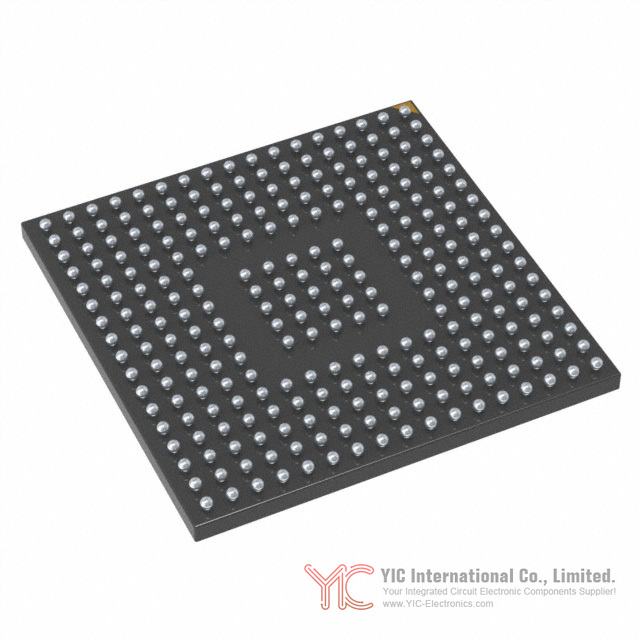
The STM32H743IIK6TR is available in eight package options ranging from 100 to 240 pins/balls. The LQFP100 package (14 x 14 mm) provides the most compact option for space-constrained applications. The TFBGA100 package (8 x 8 mm) offers the smallest footprint with 0.8 mm ball pitch. The LQFP144 (20 x 20 mm) and UFBGA169 (7 x 7 mm) packages provide intermediate pin counts. The LQFP176 (24 x 24 mm) and UFBGA176+25 (10 x 10 mm) packages offer expanded I/O availability. The LQFP208 (28 x 28 mm) and TFBGA240+25 (14 x 14 mm) packages provide maximum peripheral access.
All packages are ECOPACK2 compliant, meeting environmental and lead-free soldering requirements. The device marking includes part number, date code, and revision information for traceability. Thermal characteristics vary by package, with junction-to-ambient thermal resistance ranging from approximately 30 °C/W for BGA packages to 50 °C/W for LQFP packages.
The STM32H743IIK6TR requires proper PCB design including decoupling capacitors placed close to power pins, separate analog and digital ground planes, and controlled impedance traces for high-speed signals. The flexible memory controller and Quad-SPI interfaces require careful trace routing to maintain signal integrity at high frequencies.
Conclusion
The STM32H743IIK6TR microcontroller delivers comprehensive functionality for demanding embedded applications through its combination of high-performance processing, extensive memory resources, and diverse peripheral integration. The device's 480 MHz ARM Cortex-M7 core with floating-point unit provides computational capability for complex algorithms, while the flexible memory architecture supports both embedded and external storage requirements. The extensive communication interface portfolio enables seamless integration into networked systems, and the integrated analog peripherals support direct sensor interfacing. The sophisticated power management system enables battery-powered operation through multiple low-power modes and voltage scaling. The graphics and multimedia capabilities, including LCD-TFT controller and JPEG codec, support human-machine interface applications. The multiple package options accommodate diverse physical constraints, from compact embedded systems to feature-rich industrial controllers. Selection of the STM32H743IIK6TR should consider specific application requirements for processing performance, memory capacity, peripheral count, and power consumption characteristics.
Frequently Asked Questions (FAQ)
- Q1. What is the maximum operating frequency of the STM32H743IIK6TR, and how does it affect power consumption?
-
- A1. The STM32H743IIK6TR operates at frequencies up to 480 MHz on revision V devices. Higher operating frequencies increase computational throughput but also increase power consumption proportionally. The device supports voltage scaling with six configurable power supply levels in run mode, enabling developers to reduce supply voltage at lower frequencies to minimize power consumption. For example, at 200 MHz with reduced voltage scaling, power consumption can be reduced by approximately 60% compared to 480 MHz operation at full voltage. Applications should profile their actual computational requirements and select appropriate frequency and voltage combinations to optimize the power-performance tradeoff.
- Q2. How does the STM32H743IIK6TR support real-time applications requiring deterministic timing?
-
- A2. The STM32H743IIK6TR provides multiple features supporting real-time applications. The tightly coupled memory (TCM) subsystem with 64 Kbytes of ITCM and 128 Kbytes of DTCM offers zero-wait-state access for time-critical code and data, ensuring predictable execution timing. The high-resolution timer (HRTIM1) provides 2.1 nanosecond resolution for precise PWM generation and event timing. The nested vectored interrupt controller (NVIC) supports 16 priority levels with tail-chaining capability, reducing interrupt latency. The memory protection unit (MPU) enables isolation of real-time tasks from non-real-time code, preventing priority inversion. For applications requiring strict timing guarantees, code should be placed in ITCM and data in DTCM, with interrupt handlers optimized for minimal latency.
- Q3. What external components are required for proper STM32H743IIK6TR operation?
-
- A3. The STM32H743IIK6TR requires several external components for reliable operation. Decoupling capacitors (typically 100 nF ceramic) must be placed close to each power pin pair to suppress high-frequency noise. The VCAP pins require 2.2 µF capacitors for voltage regulator stabilization. If using external oscillators, load capacitors must be selected based on crystal specifications (typically 10-20 pF for 8 MHz HSE and 15-20 pF for 32.768 kHz LSE). The NRST pin requires a 100 nF capacitor to ground and optionally a 1 kΩ series resistor for noise immunity. For Ethernet applications, a 25 MHz clock source or crystal is required for the PHY interface. USB applications require a 48 MHz clock source, either from the internal HSI48 oscillator or an external crystal. Proper PCB layout with separate analog and digital ground planes and controlled impedance traces for high-speed signals is essential for EMC compliance.
- Q4. How can the STM32H743IIK6TR achieve extended battery operation in portable applications?
-
- A4. The STM32H743IIK6TR supports extended battery operation through multiple mechanisms. The device features six low-power modes including standby mode consuming only 2.95 µA with RTC and backup SRAM enabled, enabling multi-month battery operation in applications with infrequent activity. The VBAT domain powered by an external battery maintains RTC and backup registers during main power loss, enabling wake-on-alarm functionality. Voltage scaling reduces power consumption at lower frequencies, with scale 3 operation at 200 MHz consuming approximately 40% of scale 1 consumption at 480 MHz. The five low-power timers can operate in stop mode when clocked by LSE, enabling periodic wake-up for sensor sampling without main clock activation. Applications should profile their duty cycle and select appropriate low-power modes and clock frequencies to minimize average power consumption. For example, a device waking every 10 seconds for 100 ms of processing at 200 MHz would consume approximately 50 µA average current.
- Q5. What are the key differences between the STM32H742xI/G and STM32H743xI/G variants?
-
- A5. The STM32H742xI/G and STM32H743xI/G variants share the same core processor and most peripherals but differ in specific features. The STM32H743xI/G includes an LCD-TFT display controller supporting up to XGA resolution and a JPEG codec for image compression/decompression, features not available on the STM32H742xI/G. The STM32H743xI/G provides 512 Kbytes of AXI-SRAM compared to 384 Kbytes on the STM32H742xI/G, and includes additional SRAM3 (32 Kbytes