Product Overview of TDK CGJ Series Multilayer Ceramic Chip Capacitors
The TDK CGJ Series represents a family of multilayer ceramic chip capacitors engineered for applications demanding extended operational lifespans and consistent performance under demanding conditions. These capacitors operate within the mid-voltage range of 100 to 630 volts, positioning them as suitable components for infrastructure-level systems where reliability and longevity are paramount considerations. The CGJ Series incorporates lead-free construction and complies with RoHS directives, reflecting contemporary environmental and regulatory standards in electronics manufacturing.
The product line encompasses four distinct package sizes, each designated by a specific model number and corresponding EIA standard classification. This modular approach allows design engineers to select the appropriate physical form factor based on circuit board space constraints and electrical requirements. The series designation reflects TDK's commitment to delivering components that maintain performance stability across extended operational periods, supported by comprehensive reliability testing protocols aligned with automotive-grade standards.
Physical Form and Package Options in CGJ Series Capacitors
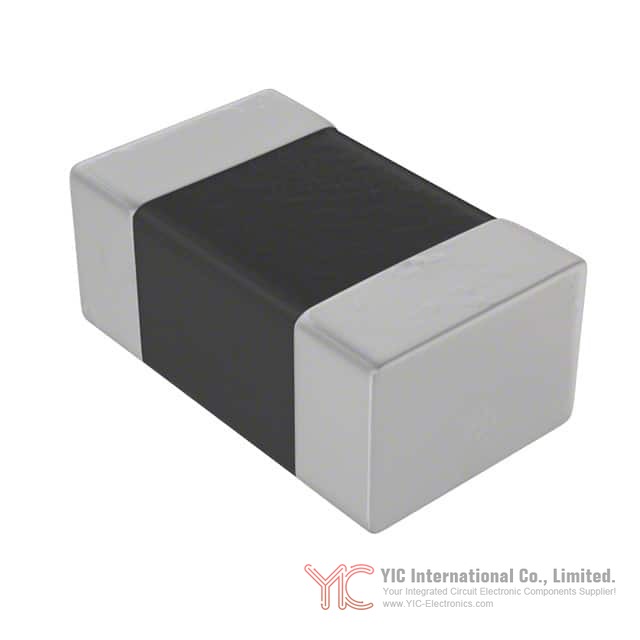
The CGJ Series offers four standardized package configurations, each optimized for different application requirements and board layout constraints. The CGJ3 model utilizes the 0603 EIA package format, measuring 1608 metric dimensions, providing the most compact footprint for space-constrained applications. The CGJ4 model employs the 0805 EIA package format with 2012 metric dimensions, offering a balance between physical size and capacitance density. The CGJ5 model features the 1206 EIA package format with 3216 metric dimensions, accommodating higher capacitance values while maintaining reasonable board area consumption. The CGJ6 model represents the largest option, utilizing the 1210 EIA package format with 3225 metric dimensions, enabling maximum capacitance storage within the mid-voltage classification.
Each package variant includes standardized thickness specifications encoded within the catalog numbering system, allowing procurement personnel to identify exact dimensional requirements without requiring supplementary documentation. The physical dimensions follow established industry standards, facilitating seamless integration into existing design workflows and manufacturing processes. Packaging specifications include provisions for standard surface-mount assembly techniques, ensuring compatibility with contemporary production methodologies.
Electrical Specifications and Performance Characteristics of CGJ Series Capacitors
The CGJ Series capacitors are specified with nominal capacitance values expressed in picofarads, with the three-digit coding system providing both significant figures and multiplier information. For example, a designation of 473 indicates 47 multiplied by 10 to the third power, yielding 47,000 picofarads or 0.047 microfarads. Capacitance tolerance is maintained at ±10%, providing predictable performance margins for circuit design calculations. This tolerance specification ensures that actual capacitance values remain within defined boundaries across manufacturing batches, supporting consistent circuit behavior.
The rated voltage specifications for CGJ Series capacitors span from 100 volts to 630 volts depending on the selected package size. The CGJ3 and CGJ4 models accommodate 100-volt and 200-volt ratings, while the CGJ5 and CGJ6 models extend to 500-volt and 630-volt capabilities. This voltage stratification enables designers to select components matched precisely to their circuit requirements, avoiding over-specification that increases component cost or under-specification that compromises system reliability.
Temperature Compensation and Stability Classes in CGJ Series Capacitors
The CGJ Series incorporates two primary temperature characteristic classifications, designated as Class 1 and Class 2, each serving distinct application requirements. Class 1 capacitors employ C0G temperature compensation, maintaining capacitance stability across the operating temperature range of -55 to +125 degrees Celsius with a drift specification of 0 ±30 parts per million per degree Celsius. This minimal drift characteristic makes Class 1 capacitors suitable for precision timing circuits, frequency-determining networks, and applications where capacitance stability directly influences circuit performance.
Class 2 capacitors provide temperature-stable characteristics across multiple variants. The X7R variant maintains capacitance within ±15% across the full operating temperature range, offering a practical balance between stability and capacitance density. The X7S variant permits ±22% capacitance variation, accommodating applications where moderate temperature-induced changes are acceptable. The X7T variant specifies asymmetrical tolerance, permitting +22% increase but -33% decrease across temperature extremes, suitable for applications where capacitance reduction presents less risk than capacitance increase.
The selection between Class 1 and Class 2 characteristics depends on circuit requirements. Precision analog circuits, phase-locked loops, and frequency-reference applications typically demand Class 1 stability. Decoupling, filtering, and energy storage applications generally tolerate Class 2 characteristics, where the higher capacitance density per unit volume provides economic advantages.
Capacitance Range and Selection Guidelines for CGJ Series Capacitors
The CGJ Series provides comprehensive capacitance coverage across the mid-voltage range, with specific ranges determined by package size and temperature characteristic classification. The CGJ3 package accommodates capacitance values from 100 picofarads to 10 microfarads, depending on voltage rating and temperature characteristic selection. The CGJ4 package extends this range, offering values from 100 picofarads to 47 microfarads. The CGJ5 package provides capacitance values spanning from 100 picofarads to 100 microfarads, while the CGJ6 package accommodates values from 100 picofarads to 220 microfards.
Selection of appropriate capacitance values requires consideration of circuit function, frequency response requirements, and voltage stress conditions. Decoupling applications typically employ capacitance values in the 0.1 to 10 microfarad range, positioned in close proximity to integrated circuit power pins to minimize high-frequency impedance. Filtering applications may require larger capacitance values, particularly in power supply circuits where energy storage and ripple voltage reduction are primary concerns. Timing and frequency-determining circuits demand precise capacitance values with minimal temperature drift, necessitating Class 1 components with appropriate tolerance specifications.
Voltage Ratings and Operating Conditions in CGJ Series Capacitors
The CGJ Series voltage ratings reflect the multilayer ceramic construction, where internal electrode configuration and dielectric material thickness determine maximum operating voltage. The 100-volt rating represents the baseline specification, suitable for low-voltage signal processing circuits and consumer electronics applications. The 200-volt rating accommodates industrial control circuits, telecom infrastructure, and intermediate-voltage applications. The 500-volt rating supports high-voltage industrial systems, renewable energy conversion equipment, and military communication infrastructure. The 630-volt rating represents the maximum specification within the CGJ Series, enabling deployment in utility-scale power conversion and specialized military applications.
Operating voltage should be selected with consideration for transient overvoltage conditions, thermal stress effects, and long-term reliability margins. Design practice typically specifies operating voltage at 50 to 75 percent of rated voltage, providing safety margin for transient events and thermal derating effects. The CGJ Series incorporates guaranteed TC bias specifications, ensuring that capacitance remains stable when voltage is applied across the operating temperature range, a characteristic particularly important in high-reliability applications where performance degradation cannot be tolerated.
Reliability Standards and Quality Assurance for CGJ Series Capacitors
The CGJ Series undergoes comprehensive reliability testing aligned with AEC-Q200 automotive-grade standards, ensuring component performance across extended operational periods and demanding environmental conditions. These testing protocols encompass thermal cycling, humidity exposure, mechanical stress, and electrical stress conditions, validating component behavior under real-world deployment scenarios. The reliability testing framework provides quantitative data regarding component failure rates and degradation mechanisms, enabling system designers to incorporate realistic component lifetime predictions into system reliability calculations.
The CGJ Series incorporates tamper-proof sealing mechanisms to facilitate identification of authentic TDK components, protecting against counterfeit products that may not meet published specifications. This authentication feature addresses supply chain integrity concerns, particularly important in military, medical, and aerospace applications where component authenticity directly impacts system safety and performance.
The high-reliability grade designation reflects TDK's commitment to extended product lifespans, supporting applications requiring decades of continuous operation without performance degradation. This reliability foundation enables deployment in smart grid infrastructure, renewable energy systems, and industrial automation equipment where component replacement represents significant operational disruption and cost.
Application Domains for CGJ Series Capacitors
The CGJ Series addresses diverse application domains spanning consumer electronics, industrial infrastructure, renewable energy systems, and military communications. Smart meter and smart grid applications employ CGJ Series capacitors in power conditioning circuits, where voltage stability and long-term reliability directly impact grid infrastructure performance. LED lighting systems utilize CGJ Series capacitors in power factor correction and harmonic filtering circuits, where thermal stability and extended operational life support continuous operation across multiple years.
Industrial applications including telecom base stations and solar micro-inverters deploy CGJ Series capacitors in power conversion and energy storage circuits. These applications demand components capable of withstanding thermal cycling, voltage transients, and extended operational periods without performance degradation. Charging station infrastructure for electric vehicles represents an emerging application domain where CGJ Series capacitors support power conversion and energy management functions.
Military communication equipment and Class 1 and Class 2 medical devices represent specialized application domains where reliability and performance consistency are non-negotiable requirements. These applications often operate in extreme environmental conditions, including temperature extremes, vibration, and electromagnetic interference, where component robustness directly impacts system mission success.
Conclusion
The TDK CGJ Series multilayer ceramic chip capacitors provide a comprehensive solution for mid-voltage applications requiring extended operational lifespans and consistent performance across demanding environmental conditions. The series encompasses four package sizes with voltage ratings spanning 100 to 630 volts, supported by both Class 1 precision and Class 2 stable temperature characteristics. Comprehensive reliability testing aligned with automotive-grade standards, combined with tamper-proof authentication features, establishes the CGJ Series as a suitable component selection for infrastructure-level systems where component failure represents unacceptable operational risk.
Frequently Asked Questions (FAQ)
- Q1. What distinguishes Class 1 and Class 2 temperature characteristics in CGJ Series capacitors, and how should this distinction influence component selection?
-
- A1. Class 1 capacitors employ C0G temperature compensation, maintaining capacitance drift within 0 ±30 parts per million per degree Celsius across -55 to +125 degrees Celsius. This minimal drift makes Class 1 suitable for precision timing circuits and frequency-determining networks where capacitance stability directly influences circuit performance. Class 2 capacitors provide temperature-stable characteristics with larger permitted capacitance variations: X7R permits ±15% variation, X7S permits ±22% variation, and X7T permits +22% to -33% asymmetrical variation. Class 2 capacitors offer higher capacitance density per unit volume, making them economically advantageous for decoupling, filtering, and energy storage applications where moderate temperature-induced changes are acceptable. Selection should prioritize Class 1 for analog precision circuits and Class 2 for power distribution and filtering applications.
- Q2. How do the four CGJ Series package sizes differ, and what considerations should guide package selection?
-
- A2. The CGJ3 package (0603 EIA format, 1608 metric) provides the most compact footprint for space-constrained applications, accommodating capacitance values up to 10 microfarads. The CGJ4 package (0805 EIA format, 2012 metric) offers a balance between physical size and capacitance density, extending to 47 microfarads. The CGJ5 package (1206 EIA format, 3216 metric) accommodates higher capacitance values up to 100 microfarads, suitable for applications requiring substantial energy storage. The CGJ6 package (1210 EIA format, 3225 metric) represents the largest option, supporting capacitance values to 220 microfarads. Package selection should consider circuit board space constraints, required capacitance value, and thermal management requirements. Larger packages generally dissipate heat more effectively, supporting higher current applications.
- Q3. What voltage rating should be selected for a specific application, and how does voltage derating affect component reliability?
-
- A3. Voltage rating selection should consider both steady-state operating voltage and transient overvoltage conditions. Design practice typically specifies operating voltage at 50 to 75 percent of rated voltage, providing safety margin for transient events and thermal derating effects. The CGJ Series offers 100-volt, 200-volt, 500-volt, and 630-volt ratings. Low-voltage signal processing circuits typically employ 100-volt ratings, industrial control and telecom applications utilize 200-volt ratings, high-voltage industrial systems employ 500-volt ratings, and utility-scale power conversion applications may require 630-volt ratings. Operating voltage below the recommended derating threshold extends component operational life and reduces failure probability, particularly important in applications where component replacement represents significant operational disruption.
- Q4. How does the CGJ Series address reliability requirements for extended-life applications?
-
- A4. The CGJ Series undergoes comprehensive reliability testing aligned with AEC-Q200 automotive-grade standards, encompassing thermal cycling, humidity exposure, mechanical stress, and electrical stress conditions. These testing protocols validate component performance across extended operational periods and demanding environmental conditions, providing quantitative data regarding component failure rates and degradation mechanisms. The high-reliability grade designation reflects TDK's commitment to extended product lifespans, supporting applications requiring decades of continuous operation without performance degradation. Tamper-proof sealing mechanisms facilitate identification of authentic TDK components, protecting against counterfeit products that may not meet published specifications. This comprehensive reliability foundation enables deployment in smart grid infrastructure, renewable energy systems, and industrial automation equipment where component replacement represents significant operational disruption.
- Q5. What capacitance values are available within the CGJ Series, and how should capacitance selection be approached for different circuit functions?
-
- A5. The CGJ Series provides comprehensive capacitance coverage across the mid-voltage range, with specific ranges determined by package size and temperature characteristic classification. The CGJ3 package accommodates values from 100 picofarads to 10 microfarads, the CGJ4 package extends to 47 microfarads, the CGJ5 package provides values to 100 microfarads, and the CGJ6 package accommodates values to 220 microfarads. Decoupling applications typically employ 0.1 to 10 microfarad values positioned in close proximity to integrated circuit power pins to minimize high-frequency impedance. Filtering applications may require larger capacitance values, particularly in power supply circuits where energy storage and ripple voltage reduction are primary concerns. Timing and frequency-determining circuits demand precise capacitance values with minimal temperature drift, necessitating Class 1 components with appropriate tolerance specifications. Capacitance tolerance of ±10% ensures that actual values remain within defined boundaries across manufacturing batches, supporting consistent circuit behavior.
- Q6. How does the CGJ Series support renewable energy and smart grid applications?
-
- A6. Smart meter and smart grid applications employ CGJ Series capacitors in power conditioning circuits, where voltage stability and long-term reliability directly impact grid infrastructure performance. LED lighting systems utilize CGJ Series capacitors in power factor correction and harmonic filtering circuits, where thermal stability and extended operational life support continuous operation across multiple years. Solar micro-inverter applications deploy CGJ Series capacitors in power conversion and energy storage circuits, where components must withstand thermal cycling and extended operational periods without performance degradation. The comprehensive voltage rating range from 100 to 630 volts accommodates diverse power conversion topologies, while the high-reliability grade designation ensures that components maintain performance specifications across decades of continuous operation. These characteristics make the CGJ Series suitable for utility-scale renewable energy infrastructure where component failure represents unacceptable operational risk.
- Q7. What environmental and regulatory compliance features does the CGJ Series incorporate?
-
- A7. The CGJ Series incorporates lead-free construction and complies with RoHS directives, reflecting contemporary environmental and regulatory standards in electronics manufacturing. This compliance enables deployment in jurisdictions with strict environmental regulations and supports corporate sustainability initiatives. The lead-free construction maintains electrical performance equivalent to traditional lead-containing formulations while eliminating environmental contamination risks associated with component disposal. RoHS compliance documentation is available through TDK technical resources, supporting procurement verification and regulatory compliance documentation requirements.
- Q8. How should CGJ Series capacitors be selected for military and medical device applications?
-
- A8. Military communication equipment and Class 1 and Class 2 medical devices represent specialized application domains where reliability and performance consistency are non-negotiable requirements. These applications often operate in extreme environmental conditions, including temperature extremes, vibration, and electromagnetic interference, where component robustness directly impacts system mission success. Selection should prioritize components with comprehensive reliability testing documentation aligned with military specifications and medical device standards. The CGJ Series high-reliability grade designation, combined with AEC-Q200 testing protocols and tamper-proof authentication features, provides the necessary assurance for these demanding applications. Procurement personnel should verify that specific component lots include appropriate certification documentation and traceability records supporting regulatory compliance requirements.
- Q9. What is the significance of guaranteed TC bias specifications in CGJ Series capacitors?
-
- A9. Guaranteed TC bias specifications ensure that capacitance remains stable when voltage is applied across the operating temperature range, a characteristic particularly important in high-reliability applications where performance degradation cannot be tolerated. This specification addresses a phenomenon where capacitance may shift when voltage is applied, particularly at temperature extremes. The guaranteed TC bias specification provides quantitative assurance that this voltage-induced shift remains within acceptable limits across the full operating temperature range. This characteristic is particularly important in precision analog circuits, frequency-determining networks, and applications where capacitance stability directly influences circuit performance. Designers should verify that component specifications include explicit TC bias guarantees when selecting components for applications where this characteristic is critical.
- Q10. How does the CGJ Series catalog numbering system facilitate component identification and procurement?
-
- A10. The CGJ Series catalog numbering system encodes multiple specification parameters, including package size, thickness, voltage rating, temperature characteristic, nominal capacitance, and capacitance tolerance. This comprehensive encoding enables procurement personnel to identify exact component specifications from the catalog number alone, without requiring supplementary documentation. The three-digit capacitance code provides both significant figures and multiplier information, allowing rapid conversion to actual capacitance values. For example, a designation of 473 indicates 47 multiplied by 10 to the third power, yielding 47,000 picofarads or 0.047 microfarads. The standardized numbering system facilitates inventory management, bill-of-materials processing, and supplier communication, reducing procurement errors and supporting efficient supply chain operations. Procurement personnel should maintain reference documentation explaining the catalog numbering system to support accurate component identification and ordering.