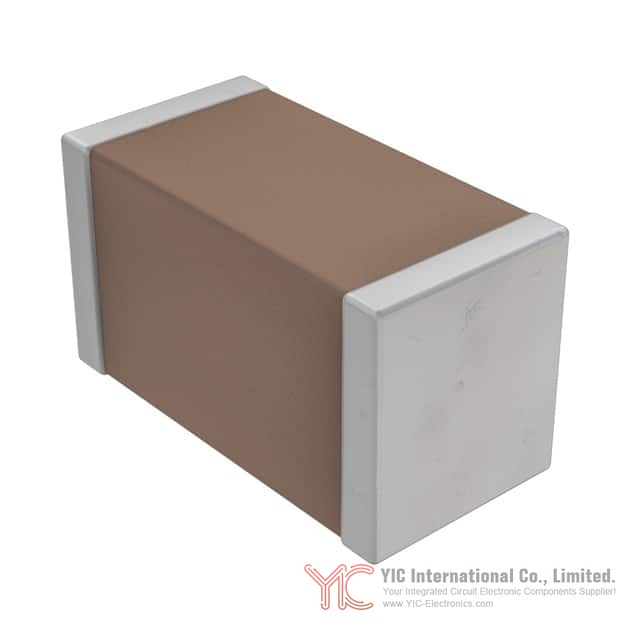
Product Overview of TDK CGA Series Multilayer Ceramic Capacitors
The CGA series represents TDK's automotive-grade multilayer ceramic chip capacitor lineup, engineered for demanding power management and signal conditioning applications in modern vehicle electronics. These surface-mounted components combine advanced dielectric materials with precision manufacturing to deliver performance characteristics suited to the stringent requirements of automotive systems. The series encompasses eight distinct package sizes, from the compact 0603 format through to the larger 5750 package, providing design flexibility across diverse circuit topologies and space constraints.
The fundamental appeal of the CGA series lies in its monolithic construction, which integrates multiple ceramic dielectric layers with internal electrodes in a single, unified structure. This architectural approach yields mechanical robustness alongside electrical performance that distinguishes ceramic capacitors from alternative technologies. The series qualifies under the AEC-Q200 automotive reliability standard, establishing its suitability for vehicle applications where component failure carries operational and safety implications.
Structural Design and Monolithic Architecture of CGA Series Capacitors
Structural Design and Monolithic Architecture of CGA Series Capacitors
Temperature Characteristics and Dielectric Material Options in CGA Series Selection
Temperature Characteristics and Dielectric Material Options in CGA Series Selection
Voltage Ratings and Capacitance Range Coverage Across CGA Series Package Sizes
Voltage Ratings and Capacitance Range Coverage Across CGA Series Package Sizes
Frequency Response Performance and Electrical Characteristics of CGA Series Devices
The CGA series exhibits frequency response characteristics that reflect the low ESR and low ESL properties inherent to the monolithic construction. At low frequencies, the capacitive reactance dominates the impedance behavior, with impedance decreasing as frequency increases according to the fundamental capacitive relationship. The impedance minimum occurs at the self-resonant frequency, where the inductive reactance of the internal connections equals the capacitive reactance of the dielectric material.
The self-resonant frequency of CGA series capacitors typically ranges from tens of megahertz to several hundred megahertz, depending on the package size and capacitance value. Smaller packages with lower capacitance values exhibit higher self-resonant frequencies, while larger packages with higher capacitance values demonstrate lower self-resonant frequencies. This frequency-dependent behavior influences the selection of capacitor values and package sizes for specific filtering and decoupling applications.
Above the self-resonant frequency, the inductive reactance dominates, and impedance increases with frequency. This behavior defines the frequency range over which the capacitor functions effectively as a capacitive element. Beyond the self-resonant frequency, the capacitor transitions toward inductive behavior, reducing its effectiveness for high-frequency filtering applications. Understanding this frequency-dependent impedance profile enables designers to select appropriate capacitor values and package sizes that maintain low impedance across the frequency spectrum relevant to the target application.
The low ESR characteristic of CGA series capacitors results in reduced power dissipation during ripple current operation. In power supply filtering applications, the ripple current flowing through the capacitor generates heat according to the relationship P = I²R, where I represents the ripple current amplitude and R represents the ESR. The low ESR values of CGA series capacitors minimize this self-heating effect, reducing the temperature rise of the capacitor during normal operation and extending the operational lifespan by reducing thermal stress on the dielectric material.
Package Dimensions and Form Factor Options for CGA Series Integration
The CGA series provides eight distinct package sizes, each designated by both metric dimensions and EIA (Electronic Industries Alliance) standard codes. The smallest package, designated CGA1 or 0603 in EIA notation, measures 0.6 mm in length and 0.3 mm in width with a standard thickness of 0.30 mm. This compact format enables integration into space-constrained applications while accommodating capacitance values suitable for high-frequency filtering and signal conditioning circuits.
The CGA2 package, designated 1005 in EIA notation, measures 1.0 mm in length and 0.5 mm in width with a standard thickness of 0.50 mm. This package size represents a common choice in automotive electronics, offering adequate capacitance density for decoupling and filtering applications while maintaining compatibility with standard surface-mount assembly processes. The slightly larger footprint compared to the 0603 package enables higher capacitance values without requiring significantly more board space.
The CGA3 package, designated 1608 in EIA notation, measures 1.6 mm in length and 0.8 mm in width with a standard thickness of 0.80 mm. This intermediate package size accommodates moderate capacitance values while remaining suitable for high-density circuit board layouts. The CGA4 package, designated 2012 in EIA notation, measures 2.0 mm in length and 1.25 mm in width, available in multiple thickness options of 0.60 mm, 0.85 mm, and 1.25 mm to accommodate varying capacitance requirements.
Catalog Number Decoding and Specification Identification for CGA Series Products
Catalog Number Decoding and Specification Identification for CGA Series Products
Application Scenarios and Reliability Qualifications for CGA Series Capacitors
Application Scenarios and Reliability Qualifications for CGA Series Capacitors
Design Considerations and Derating Guidelines for CGA Series Implementation
Design Considerations and Derating Guidelines for CGA Series Implementation
Main Body
Main Body
Product Overview of TDK CGA Series Multilayer Ceramic Capacitors
The CGA series represents TDK's automotive-grade multilayer ceramic chip capacitor lineup, engineered for demanding power management and signal conditioning applications in modern vehicle electronics. These surface-mounted components combine advanced dielectric materials with precision manufacturing to deliver performance characteristics suited to the stringent requirements of automotive systems. The series encompasses eight distinct package sizes, from the compact 0603 format through to the larger 5750 package, providing design flexibility across diverse circuit topologies and space constraints.
The fundamental appeal of the CGA series lies in its monolithic construction, which integrates multiple ceramic dielectric layers with internal electrodes in a single, unified structure. This architectural approach yields mechanical robustness alongside electrical performance that distinguishes ceramic capacitors from alternative technologies. The series qualifies under the AEC-Q200 automotive reliability standard, establishing its suitability for vehicle applications where component failure carries operational and safety implications.
Structural Design and Monolithic Architecture of CGA Series Capacitors
Structural Design and Monolithic Architecture of CGA Series Capacitors
The CGA series employs a layered construction methodology where ceramic dielectric material and internal metallic electrodes are stacked in alternating fashion. This arrangement creates a structure with multiple capacitive elements operating in parallel, effectively multiplying the capacitance density achievable within a given physical footprint. The monolithic integration eliminates the need for external connections between discrete elements, resulting in a component that exhibits superior mechanical strength compared to assemblies of separate capacitive elements.
The internal electrode configuration within CGA series capacitors generates a simplified current path architecture. Unlike more complex capacitor designs, the straightforward geometry of stacked layers and electrodes produces notably low equivalent series resistance (ESR) and equivalent series inductance (ESL). These electrical characteristics translate directly into reduced self-heating during ripple current operation and improved frequency response across the spectrum of typical automotive circuit applications. The low ESR characteristic proves particularly valuable in power supply filtering applications where thermal management of the capacitor itself influences overall system reliability.
The monolithic structure also contributes to mechanical stability under thermal cycling and mechanical stress conditions encountered in automotive environments. The unified ceramic body resists delamination and internal fracture mechanisms that can compromise capacitors with more complex internal architectures. This structural integrity supports the extended operational lifespans required in vehicle applications where component replacement involves significant labor and system downtime costs.
The monolithic structure also contributes to mechanical stability under thermal cycling and mechanical stress conditions encountered in automotive environments. The unified ceramic body resists delamination and internal fracture mechanisms that can compromise capacitors with more complex internal architectures. This structural integrity supports the extended operational lifespans required in vehicle applications where component replacement involves significant labor and system downtime costs.
Temperature Characteristics and Dielectric Material Options in CGA Series Selection
Temperature Characteristics and Dielectric Material Options in CGA Series Selection
The CGA series offers multiple dielectric material formulations, each characterized by distinct temperature coefficient specifications that define how capacitance varies across the operating temperature range. These temperature characteristics are designated using standardized codes that communicate both the temperature range and the magnitude of capacitance variation.
The COG (C0G) dielectric material provides the most stable temperature performance, maintaining capacitance within ±30 ppm per degree Celsius across the temperature range from -55°C to +125°C. This exceptional stability makes COG-based CGA capacitors the preferred choice for precision timing circuits, resonant tank circuits, and applications where capacitance drift would degrade circuit performance. The COG designation indicates that the dielectric material exhibits near-zero temperature coefficient, meaning capacitance remains essentially constant regardless of temperature fluctuations within the specified operating window.
The X5R dielectric formulation extends operation across the temperature range from -55°C to +85°C while permitting capacitance variation of ±15% across this span. This material composition offers higher capacitance density than COG materials, allowing designers to achieve greater capacitance values within identical physical package sizes. The X5R characteristic suits applications where moderate temperature stability suffices and where the higher capacitance density enables more compact circuit designs.
The X7R dielectric material operates across the broader temperature range of -55°C to +125°C while maintaining capacitance within ±15% variation limits. This combination of wide temperature range and moderate capacitance stability represents a balanced compromise between the stability of COG materials and the density advantages of X5R formulations. X7R materials dominate automotive applications where the extended high-temperature capability aligns with under-hood and near-engine mounting locations where ambient temperatures approach 125°C.
The X7S and X7T dielectric materials provide additional options for applications with specific temperature-dependent performance requirements. X7S materials maintain ±22% capacitance variation across -55°C to +125°C, while X7T materials exhibit asymmetric temperature coefficients with +22% and -33% variation limits across the same temperature range. These materials enable designers to optimize capacitance density for applications where the specific temperature coefficient characteristics align with circuit requirements.
Voltage Ratings and Capacitance Range Coverage Across CGA Series Package Sizes
Voltage Ratings and Capacitance Range Coverage Across CGA Series Package Sizes
The CGA series encompasses voltage ratings extending to 75 volts DC, with the specific voltage rating selected during the design phase to match the maximum sustained voltage in the target application circuit. The voltage rating represents the maximum continuous DC voltage that the capacitor can withstand without risk of dielectric breakdown or accelerated degradation. Automotive applications typically employ voltage ratings of 16V, 25V, 50V, or 75V, corresponding to the nominal system voltage plus safety margins that account for transient overvoltage conditions.
The capacitance range available within the CGA series extends from picofarad-level values suitable for high-frequency filtering through microfarad-level capacitances applicable to power supply smoothing functions. The specific capacitance values available depend on the selected package size, dielectric material, and voltage rating. Smaller packages such as the 0603 format (CGA1) accommodate lower capacitance values, while larger packages including the 5750 format (CGA9) enable capacitance values approaching 100 microfarads.
The 1005 package size (CGA2) represents a widely deployed format in automotive electronics, offering a practical balance between physical size and capacitance density. This package accommodates capacitance values ranging from tens of picofarads through several microfarads, depending on the dielectric material and voltage rating selected. The 1005 package dimensions of 1.0 mm length by 0.5 mm width by 0.5 mm standard thickness enable integration into densely populated circuit boards while maintaining adequate spacing for manufacturing and rework operations.
The 1608 package (CGA3) and 2012 package (CGA4) provide intermediate size options that accommodate higher capacitance values while remaining compatible with standard surface-mount assembly equipment. The 3216 package (CGA5) and 3225 package (CGA6) enable even higher capacitance densities, supporting applications requiring multiple microfarads of capacitance in power distribution networks and energy storage circuits. The largest packages, including the 4532 (CGA8) and 5750 (CGA9) formats, accommodate capacitance values in the tens of microfarads range, suitable for bulk energy storage and low-frequency filtering applications.
Frequency Response Performance and Electrical Characteristics of CGA Series Devices
The CGA series exhibits frequency response characteristics that reflect the low ESR and low ESL properties inherent to the monolithic construction. At low frequencies, the capacitive reactance dominates the impedance behavior, with impedance decreasing as frequency increases according to the fundamental capacitive relationship. The impedance minimum occurs at the self-resonant frequency, where the inductive reactance of the internal connections equals the capacitive reactance of the dielectric material.
The self-resonant frequency of CGA series capacitors typically ranges from tens of megahertz to several hundred megahertz, depending on the package size and capacitance value. Smaller packages with lower capacitance values exhibit higher self-resonant frequencies, while larger packages with higher capacitance values demonstrate lower self-resonant frequencies. This frequency-dependent behavior influences the selection of capacitor values and package sizes for specific filtering and decoupling applications.
Above the self-resonant frequency, the inductive reactance dominates, and impedance increases with frequency. This behavior defines the frequency range over which the capacitor functions effectively as a capacitive element. Beyond the self-resonant frequency, the capacitor transitions toward inductive behavior, reducing its effectiveness for high-frequency filtering applications. Understanding this frequency-dependent impedance profile enables designers to select appropriate capacitor values and package sizes that maintain low impedance across the frequency spectrum relevant to the target application.
The low ESR characteristic of CGA series capacitors results in reduced power dissipation during ripple current operation. In power supply filtering applications, the ripple current flowing through the capacitor generates heat according to the relationship P = I²R, where I represents the ripple current amplitude and R represents the ESR. The low ESR values of CGA series capacitors minimize this self-heating effect, reducing the temperature rise of the capacitor during normal operation and extending the operational lifespan by reducing thermal stress on the dielectric material.
Package Dimensions and Form Factor Options for CGA Series Integration
The CGA series provides eight distinct package sizes, each designated by both metric dimensions and EIA (Electronic Industries Alliance) standard codes. The smallest package, designated CGA1 or 0603 in EIA notation, measures 0.6 mm in length and 0.3 mm in width with a standard thickness of 0.30 mm. This compact format enables integration into space-constrained applications while accommodating capacitance values suitable for high-frequency filtering and signal conditioning circuits.
The CGA2 package, designated 1005 in EIA notation, measures 1.0 mm in length and 0.5 mm in width with a standard thickness of 0.50 mm. This package size represents a common choice in automotive electronics, offering adequate capacitance density for decoupling and filtering applications while maintaining compatibility with standard surface-mount assembly processes. The slightly larger footprint compared to the 0603 package enables higher capacitance values without requiring significantly more board space.
The CGA3 package, designated 1608 in EIA notation, measures 1.6 mm in length and 0.8 mm in width with a standard thickness of 0.80 mm. This intermediate package size accommodates moderate capacitance values while remaining suitable for high-density circuit board layouts. The CGA4 package, designated 2012 in EIA notation, measures 2.0 mm in length and 1.25 mm in width, available in multiple thickness options of 0.60 mm, 0.85 mm, and 1.25 mm to accommodate varying capacitance requirements.
The CGA5 package, designated 3216 in EIA notation, and the CGA6 package, designated 3225 in EIA notation, provide larger form factors suitable for higher capacitance values and applications requiring substantial energy storage capacity. The CGA8 package, designated 4532 in EIA notation, and the CGA9 package, designated 5750 in EIA notation, represent the largest options in the series, with the CGA9 available in multiple thickness options of 2.00 mm, 2.30 mm, and 2.50 mm to accommodate the highest capacitance values within the series.
The CGA5 package, designated 3216 in EIA notation, and the CGA6 package, designated 3225 in EIA notation, provide larger form factors suitable for higher capacitance values and applications requiring substantial energy storage capacity. The CGA8 package, designated 4532 in EIA notation, and the CGA9 package, designated 5750 in EIA notation, represent the largest options in the series, with the CGA9 available in multiple thickness options of 2.00 mm, 2.30 mm, and 2.50 mm to accommodate the highest capacitance values within the series.
Catalog Number Decoding and Specification Identification for CGA Series Products
Catalog Number Decoding and Specification Identification for CGA Series Products
The CGA series employs a structured catalog numbering system that encodes the complete specification of each capacitor variant within the part number itself. Understanding this numbering convention enables designers to extract detailed performance parameters directly from the part number without requiring reference to supplementary documentation.
The first element of the catalog number identifies the series designation, with "CGA" indicating membership in the automotive-grade multilayer ceramic capacitor family. The second element specifies the package size, with designations ranging from CGA1 through CGA9 corresponding to the eight available package formats. The third element encodes the thickness code, which indicates the physical thickness of the component and correlates with the capacitance value achievable within that package size.
The fourth element specifies the voltage condition for the life test, which relates to the rated voltage of the capacitor. The fifth element identifies the temperature characteristic of the dielectric material, with codes such as C0G, X5R, X7R, X7S, and X7T indicating the specific temperature coefficient and operating temperature range. The sixth element specifies the rated voltage in DC volts, directly indicating the maximum continuous voltage rating of the component.
The seventh element encodes the nominal capacitance value using a three-digit code where the first two digits represent the significant figures and the third digit represents the multiplier. For example, the code "221" represents 220 picofarads (22 × 10¹ pF), while "225" represents 2.2 microfarads (22 × 10⁵ pF). The letter "R" within the capacitance code designates a decimal point, enabling representation of fractional capacitance values.
The eighth element specifies the capacitance tolerance, with common designations including "K" for ±10% tolerance and "M" for ±20% tolerance. The ninth element indicates the physical thickness of the component in millimeters, providing dimensional information for circuit board layout and assembly planning. The tenth element specifies the packaging style, indicating whether the component is supplied in tape-and-reel format or alternative packaging configurations. The eleventh element represents a special reserved code for manufacturer-specific information or future specification extensions.
Application Scenarios and Reliability Qualifications for CGA Series Capacitors
Application Scenarios and Reliability Qualifications for CGA Series Capacitors
The CGA series finds primary application in automotive power management circuits, where the combination of high reliability, stable temperature performance, and low ESR characteristics addresses the demanding requirements of vehicle electrical systems. Advanced driver assistance systems (ADAS) and autonomous driving system electronic control units (ECUs) represent significant application areas where the CGA series provides decoupling and filtering functions for sensitive analog and digital circuits.
Power supply smoothing applications benefit from the low ESR characteristics of CGA series capacitors, which minimize voltage ripple on regulated power rails and reduce thermal stress on voltage regulator integrated circuits. The monolithic structure and AEC-Q200 qualification ensure that the capacitors maintain performance throughout the extended operational lifespans required in automotive applications, where component replacement involves significant labor costs and system downtime.
LC resonance circuits employing COG-type CGA series capacitors provide stable frequency-determining elements for oscillator and filter circuits where temperature stability proves essential. The ±30 ppm per degree Celsius temperature coefficient of COG materials ensures that resonant frequencies remain within acceptable tolerance bands across the full automotive temperature range, maintaining circuit performance without requiring temperature compensation techniques.
The AEC-Q200 qualification of the CGA series establishes compliance with automotive reliability standards that mandate extensive testing for temperature cycling, mechanical shock, vibration, and humidity exposure. This qualification demonstrates that the capacitors have undergone rigorous validation procedures confirming their suitability for automotive applications where component failures carry safety and reliability implications. The qualification encompasses testing protocols that simulate the thermal and mechanical stresses encountered during vehicle operation, including engine compartment temperature extremes and vibration from engine and road sources.
Design Considerations and Derating Guidelines for CGA Series Implementation
Design Considerations and Derating Guidelines for CGA Series Implementation
Designers implementing CGA series capacitors must consider the voltage derating requirements that apply when the capacitor temperature exceeds the standard operating range. Certain CGA series variants, particularly those designated as derating guarantee products, require reduced voltage operation when the component temperature rises above 125°C. The derating curve provided in the technical specifications indicates the maximum permissible voltage at elevated temperatures, ensuring that the electric field stress within the dielectric material remains within safe limits.
The self-heating effect of the capacitor during ripple current operation influences the actual operating temperature, which may exceed the ambient temperature by several degrees depending on the ripple current magnitude and the ESR of the component. Designers must account for this self-heating when calculating the actual operating temperature and determining whether voltage derating applies. In applications with substantial ripple current, such as switching power supplies or high-frequency switching circuits, the self-heating effect can be significant enough to trigger voltage derating requirements.
The selection of appropriate capacitance values and package sizes requires consideration of the frequency response characteristics and the specific filtering or decoupling function required by the circuit. For high-frequency decoupling applications, smaller packages with lower capacitance values provide lower impedance at the frequencies of interest due to their higher self-resonant frequencies. For low-frequency filtering and energy storage applications, larger packages with higher capacitance values provide the necessary capacitance while maintaining acceptable impedance at the relevant frequencies.
The temperature coefficient of the selected dielectric material influences the capacitance stability across the automotive temperature range and must be evaluated against the specific circuit requirements. Applications requiring precise capacitance values, such as timing circuits or resonant tank circuits, benefit from the superior temperature stability of COG materials despite their lower capacitance density. Applications where moderate capacitance variation is acceptable can employ X5R or X7R materials to achieve higher capacitance density and more compact circuit designs.
The mechanical stress imposed during circuit board assembly, including solder reflow temperatures and mechanical vibration during component placement, influences the long-term reliability of the capacitor. The monolithic structure of CGA series capacitors provides inherent resistance to mechanical stress, but designers should still follow standard surface-mount assembly practices to minimize mechanical damage during manufacturing. Proper solder joint formation and adequate clearance from mechanical stress points on the circuit board contribute to optimal long-term reliability.
Conclusion
The TDK CGA series multilayer ceramic capacitors represent a comprehensive solution for automotive power management and signal conditioning applications, combining the mechanical robustness of monolithic construction with the electrical performance characteristics demanded by modern vehicle electronics. The series encompasses eight package sizes and multiple dielectric material options, enabling designers to select components optimally matched to specific circuit requirements across the full spectrum of automotive applications. The AEC-Q200 qualification and proven reliability in demanding automotive environments establish the CGA series as a trusted component choice for applications where performance stability and long-term reliability prove essential to vehicle operation and safety.
Frequently Asked Questions (FAQ)
- Q1. What distinguishes the monolithic structure of CGA series capacitors from alternative capacitor designs, and how does this structure influence electrical performance?
-
- A1. The CGA series employs a monolithic construction where ceramic dielectric layers and internal electrodes are stacked in alternating fashion within a single unified structure. This architecture differs from capacitors with external connections between discrete elements. The monolithic approach yields superior mechanical strength through the integrated ceramic body and produces notably low equivalent series resistance (ESR) and equivalent series inductance (ESL) due to the simplified current path geometry. These electrical characteristics translate into reduced self-heating during ripple current operation and improved frequency response across the spectrum of automotive circuit applications.
- Q2. How do the different temperature characteristic options in the CGA series affect capacitance stability, and which applications benefit from each material type?
-
- A2. The CGA series offers multiple dielectric materials with distinct temperature coefficients. COG materials maintain capacitance within ±30 ppm per degree Celsius from -55°C to +125°C, providing exceptional stability suited for precision timing circuits and resonant tank circuits where capacitance drift would degrade performance. X5R materials permit ±15% capacitance variation from -55°C to +85°C and offer higher capacitance density, making them suitable for applications where moderate temperature stability suffices. X7R materials operate from -55°C to +125°C with ±15% variation, providing a balanced compromise between stability and capacitance density for general automotive applications. X7S and X7T materials provide additional options for applications with specific temperature-dependent performance requirements.
- Q3. What is the significance of the self-resonant frequency in CGA series capacitor selection, and how does package size influence this parameter?
-
- A3. The self-resonant frequency represents the frequency at which the inductive reactance of the internal connections equals the capacitive reactance of the dielectric material. Below this frequency, the capacitor exhibits capacitive behavior with impedance decreasing as frequency increases. Above this frequency, inductive behavior dominates and impedance increases with frequency. Smaller packages with lower capacitance values exhibit higher self-resonant frequencies, while larger packages with higher capacitance values demonstrate lower self-resonant frequencies. Designers must select package sizes and capacitance values that maintain low impedance across the frequency spectrum relevant to the target application.
- Q4. How does the low ESR characteristic of CGA series capacitors influence thermal performance in ripple current applications?
-
- A4. The low equivalent series resistance (ESR) of CGA series capacitors results in reduced power dissipation during ripple current operation according to the relationship P = I²R, where I represents the ripple current amplitude and R represents the ESR. Lower ESR values minimize self-heating effects, reducing the temperature rise of the capacitor during normal operation. This reduced thermal stress extends the operational lifespan by minimizing degradation of the dielectric material. In power supply filtering applications and high-frequency switching circuits where substantial ripple current flows, the low ESR characteristic proves particularly valuable for maintaining acceptable operating temperatures.
- Q5. What does the AEC-Q200 qualification indicate regarding the reliability of CGA series capacitors in automotive applications?
-
- A5. The AEC-Q200 qualification establishes compliance with automotive reliability standards that mandate extensive testing for temperature cycling, mechanical shock, vibration, and humidity exposure. This qualification demonstrates that CGA series capacitors have undergone rigorous validation procedures confirming their suitability for automotive applications where component failures carry safety and reliability implications. The qualification encompasses testing protocols that simulate the thermal and mechanical stresses encountered during vehicle operation, including engine compartment temperature extremes and vibration from engine and road sources. This qualification provides assurance that the capacitors will maintain performance throughout extended operational lifespans required in automotive applications.
- Q6. How should designers interpret the catalog number of a CGA series capacitor to extract complete specification information?
-
- A6. The CGA series catalog number encodes the complete specification within the part number structure. The first element identifies the series (CGA), the second specifies the package size (CGA1 through CGA9), and the third indicates the thickness code. The fourth element specifies the voltage condition for life test, the fifth identifies the temperature characteristic (C0G, X5R, X7R, X7S, X7T), and the sixth specifies the rated voltage in DC volts. The seventh element encodes the nominal capacitance using a three-digit code where the first two digits represent significant figures and the third digit represents the multiplier (for example, 221 = 220 pF, 225 = 2.2 µF). The eighth element specifies capacitance tolerance, the ninth indicates physical thickness, the tenth specifies packaging style, and the eleventh represents a special reserved code. This systematic encoding enables designers to extract detailed performance parameters directly from the part number.
- Q7. What voltage derating considerations apply to CGA series capacitors at elevated temperatures, and how does self-heating influence this requirement?
-
- A7. Certain CGA series variants designated as derating guarantee products require reduced voltage operation when the capacitor temperature exceeds 125°C. The derating curve provided in technical specifications indicates the maximum permissible voltage at elevated temperatures, ensuring that electric field stress within the dielectric material remains within safe limits. The self-heating effect during ripple current operation can raise the actual operating temperature above ambient temperature by several degrees, depending on ripple current magnitude and ESR. Designers must account for this self-heating when calculating actual operating temperature and determining whether voltage derating applies. In applications with substantial ripple current, such as switching power supplies or high-frequency switching circuits, self-heating effects can be significant enough to trigger voltage derating requirements.
- Q8. How do the eight package sizes available in the CGA series enable designers to optimize circuit performance for different application requirements?
-
- A8. The CGA series provides eight package sizes ranging from the compact 0603 format (CGA1) through the larger 5750 format (CGA9). Smaller packages such as 0603 and 1005 accommodate lower capacitance values suitable for high-frequency filtering and signal conditioning circuits, while their higher self-resonant frequencies provide low impedance at elevated frequencies. Intermediate packages including 1608, 2012, 3216, and 3225 formats accommodate moderate to higher capacitance values for general decoupling and filtering applications. The largest packages including 4532 and 5750 formats accommodate capacitance values in the tens of microfarads range, suitable for bulk energy storage and low-frequency filtering applications. Designers select package sizes based on the required capacitance value, the frequency spectrum of interest, and the available circuit board space.
- Q9. What design practices should be followed during circuit board assembly to ensure optimal long-term reliability of CGA series capacitors?
-
- A9. Although the monolithic structure of CGA series capacitors provides inherent resistance to mechanical stress, designers should follow standard surface-mount assembly practices to minimize mechanical damage during manufacturing. Proper solder joint formation ensures adequate electrical connection and mechanical support. Adequate clearance from mechanical stress points on the circuit board prevents excessive mechanical loading on the solder joints. Careful control of solder reflow temperatures within manufacturer specifications prevents thermal stress on the component. Proper handling and storage procedures before assembly prevent damage to the component. These practices, combined with the inherent robustness of the monolithic structure, contribute to optimal long-term reliability in automotive applications.
- Q10. How should designers select between different CGA series package sizes and capacitance values for power supply smoothing applications?
-
- A10. Power supply smoothing applications require capacitors that minimize voltage ripple on regulated power rails while maintaining acceptable impedance across the frequency spectrum of the switching power supply. Designers typically employ multiple capacitors of different values and package sizes to achieve optimal performance. Larger package sizes with higher capacitance values provide bulk energy storage and low-frequency filtering, reducing the DC component of voltage ripple. Smaller package sizes with lower capacitance values provide high-frequency filtering due to their higher self-resonant frequencies, reducing high-frequency ripple components. The combination of multiple capacitor values creates a distributed filtering network that maintains low impedance across a broad frequency range, resulting in superior voltage regulation and reduced thermal stress on voltage regulator integrated circuits.