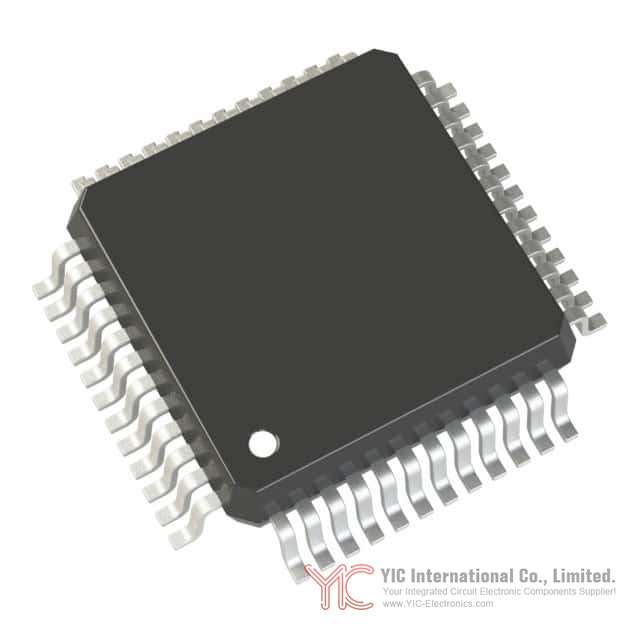
Product Overview of the S32K118 Microcontroller
The S32K118 represents a 32-bit ARM Cortex-M0+ microcontroller designed for embedded systems requiring a balance between performance and power efficiency. Manufactured by NXP USA Inc., this device integrates 256 KB of flash memory and operates at frequencies up to 48 MHz, making it suitable for a wide range of industrial control, automotive, and consumer applications. The S32K118 is available in multiple package options including 48-pin LQFP, enabling flexible board design for various form factors.
The device operates across a wide voltage range from 2.7 V to 5.5 V, accommodating both 3.3 V and 5.0 V system designs. This voltage flexibility, combined with its low-power architecture, positions the S32K118 as a versatile solution for applications where power consumption and supply voltage variation are design considerations.
Core Architecture and Processing Capabilities of the S32K118
The S32K118 employs an ARM Cortex-M0+ core, a 32-bit processor based on the Armv7 architecture with Thumb-2 instruction set support. Operating at up to 48 MHz in standard RUN mode, the processor delivers 1.25 Dhrystone MIPS per MHz, providing sufficient computational throughput for real-time control tasks. The core includes a configurable Nested Vectored Interrupt Controller (NVIC) that manages interrupt prioritization and handling, allowing applications to respond quickly to time-sensitive events.
The S32K118 integrates a single-precision Floating Point Unit (FPU), enabling efficient mathematical computations without requiring software emulation. This hardware support for floating-point operations reduces execution time for algorithms involving trigonometric functions, signal processing, or complex calculations commonly found in industrial applications.
Memory Configuration and Data Storage in the S32K118
The S32K118 provides 256 KB of program flash memory with error-correcting code (ECC) protection, ensuring data integrity during storage and retrieval. This memory capacity accommodates moderately complex firmware implementations, including real-time operating systems and application-specific control logic. The flash memory supports both program and data storage, with command execution times optimized for 25 MHz or greater flash clock frequencies.
Beyond program flash, the S32K118 includes up to 256 KB of SRAM with ECC, providing fast working memory for runtime data and stack operations. The device also features 4 KB of FlexRAM, which can be configured as either additional SRAM or EEPROM emulation storage. This flexibility allows developers to implement non-volatile data storage for configuration parameters, calibration values, or operational logs without requiring external memory components.
The FlexNVM feature provides 64 KB of data flash memory with ECC and EEPROM emulation capability. This allows the S32K118 to store persistent data that survives power cycles, with automatic wear-leveling to extend memory endurance. The EEPROM emulation scheme supports up to 1,000 write cycles per sector, suitable for applications requiring frequent parameter updates.
Clock Generation and Frequency Management for the S32K118
The S32K118 incorporates multiple clock sources to support diverse operating scenarios and power management strategies. The Fast Internal RC Oscillator (FIRC) provides a 48 MHz clock with typical accuracy suitable for general-purpose timing, while the Slow Internal RC Oscillator (SIRC) offers an 8 MHz option for reduced-power operation. These internal oscillators eliminate the need for external crystal components in applications where timing precision is not critical.
For applications requiring higher frequency stability, the S32K118 supports an external System Oscillator (SOSC) accepting 4 to 40 MHz crystal inputs. The device also includes a Low Power Oscillator (LPO) operating at 128 kHz, designed for ultra-low-power modes where minimal clock frequency suffices. A 32 kHz Real Time Counter external clock input enables precise timekeeping for applications requiring calendar or scheduling functions.
The System Clock Generation (SCG) module manages clock distribution and frequency scaling. Clock gating on specific peripherals reduces power consumption by disabling unused module clocks, while the flexible clock architecture supports dynamic frequency scaling during runtime mode transitions.
Power Management Modes and Energy Efficiency in the S32K118
The S32K118 implements a comprehensive power management architecture with multiple operating modes optimized for different application requirements. The RUN mode operates at up to 48 MHz with full peripheral functionality, providing the baseline performance level for active processing. VLPR (Very Low Power Run) mode reduces frequency and disables non-essential peripherals, lowering power consumption while maintaining limited functionality for background tasks.
The STOP mode halts the core clock while maintaining power to memory and select peripherals, enabling rapid wake-up through interrupt signals. VLPS (Very Low Power Stop) mode further reduces power consumption by disabling most peripherals and reducing memory retention, suitable for extended idle periods where occasional wake-up events are anticipated.
The Power Management Controller (PMC) orchestrates transitions between modes, managing voltage regulation and clock switching to ensure stable operation during mode changes. Low Voltage Reset (LVR), Low Voltage Detect (LVD), and Power-On Reset (POR) circuits monitor supply voltage, triggering automatic resets if voltage drops below safe operating thresholds. This protection prevents data corruption and system instability during power supply transients.
Analog Signal Processing with the S32K118 ADC and Comparator
The S32K118 integrates a 12-bit Analog-to-Digital Converter (ADC) with up to 32 analog input channels, enabling direct measurement of sensor signals and analog control inputs. The ADC operates at conversion rates up to 40 MHz clock frequency, supporting sampling times from 275 nanoseconds, allowing rapid signal acquisition for time-sensitive measurements. Hardware averaging capability reduces noise in measurements by accumulating multiple conversions, improving signal-to-noise ratio for noisy analog inputs.
The ADC features configurable resolution from 8 to 12 bits, allowing trade-offs between conversion speed and measurement precision. Single-ended and differential input modes accommodate various sensor configurations, while internal reference voltage options simplify circuit design by eliminating external reference components in some applications.
Complementing the ADC, the S32K118 includes an Analog Comparator (CMP) with an integrated 8-bit Digital-to-Analog Converter (DAC). This comparator enables threshold detection and window comparison functions, triggering interrupts when analog signals cross programmed voltage levels. The internal DAC generates reference voltages for comparison, eliminating external reference circuits in many applications. Programmable hysteresis reduces false triggering from noisy signals near comparison thresholds.
Communication Interfaces Supported by the S32K118
The S32K118 provides multiple communication interfaces supporting diverse connectivity requirements. Up to three Low Power UART (LPUART) modules enable serial communication with standard baud rates, with DMA support for efficient data transfer without core intervention. These modules operate in low-power modes, maintaining communication capability during reduced-power states.
Three Low Power SPI (LPSPI) modules support synchronous serial communication with configurable clock polarity and phase, accommodating various peripheral devices. The LPSPI modules include DMA support and operate at frequencies up to 12 MHz, suitable for sensor interfaces and memory devices. Two Low Power I2C (LPI2C) modules provide two-wire serial communication for sensor networks and peripheral control, with DMA capability for efficient multi-byte transfers.
The S32K118 supports up to three FlexCAN modules for CAN bus communication, enabling automotive and industrial networking applications. Optional CAN-FD support extends the protocol to higher data rates and larger payload sizes for modern automotive systems. A FlexIO module provides flexible I/O emulation, allowing software implementation of additional communication protocols including UART, I2C, SPI, I2S, LIN, and PWM functions when hardware modules are insufficient.
Timing and Control Peripherals in the S32K118
The S32K118 incorporates eight independent 16-bit FlexTimer (FTM) modules, each offering up to eight channels for input capture, output compare, and PWM generation. These timers support frequencies up to the system clock rate, enabling precise timing control for motor control, power conversion, and signal generation applications. The FTM modules can operate independently or be synchronized for coordinated multi-channel control.
A 16-bit Low Power Timer (LPTMR) provides timing functions during low-power modes, with flexible wake-up control enabling the device to exit sleep states at programmed intervals. Two Programmable Delay Blocks (PDB) offer flexible trigger systems for coordinating ADC sampling with external events or timer outputs, enabling synchronized data acquisition in multi-channel measurement systems.
A 32-bit Low Power Interrupt Timer (LPIT) with four independent channels provides additional timing flexibility for applications requiring multiple concurrent timing functions. The 32-bit Real Time Counter (RTC) maintains time-of-day information with battery-backed operation capability, supporting calendar functions and scheduled events.
Security and Safety Features of the S32K118
The S32K118 implements comprehensive security mechanisms through the Cryptographic Services Engine (CSEc), which provides hardware acceleration for cryptographic operations defined in the Secure Hardware Extension (SHE) specification. This engine supports encryption, decryption, and key management functions, protecting sensitive data and enabling secure communication in connected applications.
Each S32K118 device includes a 128-bit unique identification number, enabling device-specific authentication and tracking. Error-Correcting Code (ECC) protection on flash and SRAM memories detects and corrects single-bit errors, improving reliability in environments with electromagnetic interference or radiation exposure.
The System Memory Protection Unit (System MPU) implements memory access control at the crossbar switch level, preventing unauthorized access to protected memory regions. This protection operates independently of the core, providing system-level security even if application code is compromised. A Cyclic Redundancy Check (CRC) module enables software verification of data integrity, while an internal watchdog timer automatically resets the device if software execution stalls. An external watchdog monitor module provides additional reset capability for applications requiring redundant watchdog protection.
Debug and Development Support for the S32K118
The S32K118 integrates comprehensive debug functionality through a Serial Wire JTAG Debug Port (SWJ-DP) combining Serial Wire Debug (SWD) and JTAG interfaces. This dual-interface approach accommodates various development tools and debugging scenarios. The Debug Watchpoint and Trace (DWT) module enables non-intrusive breakpoint setting and data watchpoint monitoring, allowing developers to observe program execution without halting the processor.
The Instrumentation Trace Macrocell (ITM) provides real-time program trace capability, capturing instruction execution flow for performance analysis and debugging. The Test Port Interface Unit (TPIU) manages trace data formatting and output, while the Flash Patch and Breakpoint (FPB) Unit enables software breakpoints and instruction patching without modifying flash memory contents.
These debug features support development workflows from initial firmware development through production testing, enabling rapid iteration and troubleshooting of embedded applications.
Thermal Management and Operating Conditions for the S32K118
The S32K118 operates across an ambient temperature range from -40°C to 105°C in standard RUN mode, supporting applications in harsh industrial environments. The device maintains specified electrical performance across this temperature range, with thermal characteristics documented for various package options.
Thermal resistance values enable designers to calculate junction temperature based on power dissipation and board thermal design. The 48-pin LQFP package provides thermal resistance values for both natural convection and forced-air cooling scenarios, allowing thermal analysis for different deployment environments. Proper PCB layout with adequate ground planes and thermal vias minimizes junction temperature rise, extending device reliability and performance margins.
The device includes internal temperature monitoring capability through the temperature sensor, enabling firmware-based thermal management and throttling if junction temperature approaches maximum ratings. This self-protection mechanism prevents thermal runaway in applications with variable power dissipation.
Electrical Specifications and I/O Characteristics of the S32K118
The S32K118 provides up to 156 GPIO pins with interrupt functionality, supporting diverse I/O requirements. GPIO pins operate at both 3.3 V and 5.0 V logic levels, with configurable drive strength and slew rate control. Standard GPIO pins support up to 40 MHz switching frequency with 50 pF load, while high-drive pins provide increased current capability for driving external loads.
Input pins feature configurable pull-up and pull-down resistors, eliminating external resistor components for switch inputs and unused pins. Schmitt trigger inputs on select pins provide noise immunity for signals with slow rise times. Output pins support both push-pull and open-drain configurations, accommodating various circuit topologies.
The device implements ESD protection on all I/O pins, with latch-up protection preventing parasitic thyristor activation from voltage transients. Specified ESD withstand levels ensure robust operation in industrial environments with potential electrostatic discharge hazards.
Package Options and Physical Implementation of the S32K118
The S32K118 is available in multiple package options including 32-pin QFN, 48-pin LQFP, 64-pin LQFP, 100-pin LQFP, 100-pin MAPBGA, 144-pin LQFP, and 176-pin LQFP configurations. The 48-pin LQFP package, specified for the FS32K118LAT0MLFT variant, provides a balance between pin count and board space requirements, suitable for moderate-complexity applications.
All devices within a common package are pin-to-pin compatible, enabling design flexibility and potential migration to higher-pin-count variants if application requirements expand. Package selection depends on peripheral requirements, with higher pin counts providing access to additional communication interfaces and I/O functions.
Proper PCB layout following NXP design guidelines ensures optimal device performance. Decoupling capacitors must be placed close to power pins, with recommended values of 10 µF, 0.1 µF, and 1 nF in parallel to filter noise across multiple frequency ranges. Ground planes and proper trace routing minimize impedance and reduce electromagnetic interference.
Conclusion
The S32K118 microcontroller delivers a comprehensive embedded processing solution combining ARM Cortex-M0+ performance with extensive peripheral integration and power management flexibility. The 256 KB flash memory, multiple communication interfaces, and analog signal processing capabilities address requirements across industrial control, automotive, and consumer applications. Robust security features, comprehensive debug support, and wide operating temperature range enable deployment in demanding environments. The device's flexible power management modes and low-power operation support battery-powered and energy-constrained applications. Multiple package options and pin-compatible variants provide design scalability as application requirements evolve.
Frequently Asked Questions (FAQ)
- Q1. What is the maximum operating frequency of the S32K118, and how does it affect power consumption?
-
- A1. The S32K118 operates at up to 48 MHz in standard RUN mode. Higher frequencies increase power consumption proportionally, as dynamic power dissipation scales with clock frequency. Applications can reduce power consumption by operating at lower frequencies when full performance is not required, or by transitioning to lower-power modes during idle periods. The device supports dynamic frequency scaling, allowing runtime adjustment of clock frequency based on workload demands.
- Q2. How much flash memory does the S32K118 provide, and is it sufficient for typical embedded applications?
-
- A2. The S32K118 provides 256 KB of program flash memory with ECC protection. This capacity accommodates moderately complex firmware including real-time operating systems, application logic, and data tables. For applications requiring larger code footprints, higher-capacity variants within the S32K family offer up to 2 MB of flash memory. The 64 KB FlexNVM provides additional data storage for configuration parameters and operational logs.
- Q3. What communication interfaces does the S32K118 support for connecting to external devices?
-
- A3. The S32K118 integrates three LPUART modules for serial communication, three LPSPI modules for synchronous serial interfaces, two LPI2C modules for two-wire communication, and three FlexCAN modules for CAN bus networking. A FlexIO module enables software implementation of additional protocols. This comprehensive interface set supports connectivity to sensors, displays, memory devices, and network nodes in embedded systems.
- Q4. How does the S32K118 protect against power supply variations and voltage transients?
-
- A4. The S32K118 includes Low Voltage Reset (LVR), Low Voltage Detect (LVD), and Power-On Reset (POR) circuits that monitor supply voltage and trigger automatic resets if voltage drops below safe operating thresholds. The device operates across a 2.7 V to 5.5 V supply range, accommodating both 3.3 V and 5.0 V systems. Proper decoupling capacitors on power pins filter high-frequency noise and stabilize supply voltage during transient current demands.
- Q5. What power management modes are available in the S32K118, and when should each be used?
-
- A5. The S32K118 provides RUN mode for active processing at full frequency, VLPR mode for reduced-power background tasks, STOP mode for rapid wake-up from idle states, and VLPS mode for extended low-power operation. RUN mode is used during active processing. VLPR mode suits applications requiring occasional processing with minimal power consumption. STOP mode enables rapid response to interrupts while reducing idle power. VLPS mode minimizes power consumption during extended idle periods where occasional wake-up events are acceptable.
- Q6. How does the ADC in the S32K118 perform with noisy analog signals?
-
- A6. The S32K118 ADC includes hardware averaging capability that accumulates multiple conversions to reduce noise effects. Programmable averaging from 4 to 32 samples improves signal-to-noise ratio for noisy inputs. External filtering with capacitors on analog input pins further reduces high-frequency noise. Proper PCB layout with separate analog and digital ground planes minimizes coupling of digital switching noise into analog signal paths. The comparator's programmable hysteresis prevents false triggering from signals near comparison thresholds.
- Q7. What security features does the S32K118 provide for protecting sensitive data?
-
- A7. The S32K118 includes a Cryptographic Services Engine (CSEc) implementing hardware-accelerated encryption and decryption functions per the Secure Hardware Extension specification. Each device has a unique 128-bit identification number for device-specific authentication. Error-Correcting Code (ECC) on flash and SRAM detects and corrects single-bit errors. The System Memory Protection Unit prevents unauthorized access to protected memory regions. These features collectively enable secure data storage and communication in connected applications.
- Q8. How does the S32K118 support real-time control applications requiring precise timing?
-
- A8. The S32K118 provides eight independent 16-bit FlexTimer modules with up to eight channels each for input capture, output compare, and PWM generation. These timers operate at system clock frequency, enabling nanosecond-level timing precision. Two Programmable Delay Blocks coordinate ADC sampling with external events. A 32-bit Real Time Counter maintains time-of-day information. The configurable NVIC prioritizes interrupt handling for time-sensitive events. This comprehensive timing infrastructure supports motor control, power conversion, and synchronized multi-channel applications.
- Q9. What package options are available for the S32K118, and how do they affect design flexibility?
-
- A9. The S32K118 is available in 32-pin QFN, 48-pin LQFP, 64-pin LQFP, 100-pin LQFP, 100-pin MAPBGA, 144-pin LQFP, and 176-pin LQFP packages. The 48-pin LQFP variant balances pin count and board space for moderate-complexity applications. Higher pin-count packages provide access to additional communication interfaces and I/O functions. All devices within a common package are pin-to-pin compatible, enabling migration to higher-capacity variants if application requirements expand without redesigning the PCB.
- Q10. How should the S32K118 be decoupled on the PCB to ensure stable operation?
-
- A10. Decoupling capacitors must be placed as close as possible to power pins, with recommended values of 10 µF, 0.1 µF, and 1 nF in parallel to filter noise across multiple frequency ranges. All capacitors should be low-ESR ceramic types (X7R). Trace lengths from capacitors to pins should not exceed 2 mm. Ground connections should be as short as possible to the ground plane beneath the device. Separate analog and digital ground planes with a single connection point minimize coupling of digital switching noise into analog circuits. Following these practices ensures power supply stability and optimal device performance.
- Q11. What is the typical power consumption of the S32K118 in different operating modes?
-
- A11. Power consumption varies significantly with operating mode and frequency. In RUN mode at 48 MHz with peripherals disabled, typical consumption is approximately 15-20 mA. VLPR mode reduces consumption to 2-5 mA with limited functionality. STOP mode consumes 100-500 µA depending on peripheral retention requirements. VLPS mode achieves ultra-low consumption below 100 µA. Actual consumption depends on specific peripheral usage, clock frequency, and silicon process variation. Developers should measure power consumption in their specific application configuration for accurate power budget calculations.
- Q12. How does the S32K118 support debugging during firmware development?
-
- A12. The S32K118 integrates a Serial Wire JTAG Debug Port supporting both SWD and JTAG interfaces for connection to development tools. The Debug Watchpoint and Trace module enables non-intrusive breakpoint setting and data watchpoint monitoring. The Instrumentation Trace Macrocell captures real-time program execution flow for performance analysis. The Flash Patch and Breakpoint Unit enables software breakpoints without modifying flash memory. These features support rapid firmware development, debugging, and optimization workflows from initial development through production testing.