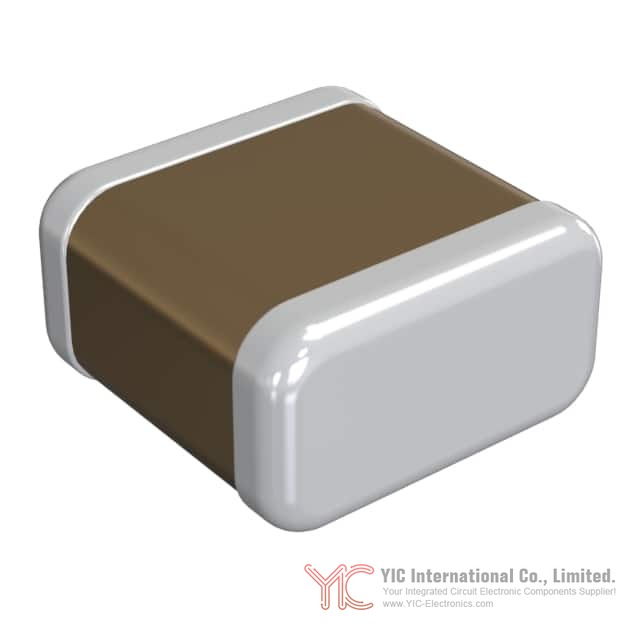
Product overview of GRM033R71H152KA12J
GRM033R71H152KA12J from Murata Electronics is a chip monolithic ceramic capacitor intended for general electronic equipment. It combines a relatively high capacitance value with an ultra‑miniature footprint:
- Capacitance: 1500 pF
- Capacitance tolerance: ±10% (code “K”)
- Rated voltage: 50 V DC
- Dielectric: X7R (EIA R7 characteristic)
- Size: 0201 inch (0603 metric) GRM033 series
As a general‑purpose MLCC in the GRM series, GRM033R71H152KA12J is suited for decoupling, coupling, filtering and timing support in dense, high‑frequency PCB layouts. The X7R dielectric offers a balanced combination of volumetric efficiency and stability over a broad operating temperature range, while the 0201 package allows placement in compact portable and high‑density designs.
The device is supplied on carrier tape and reel for automated surface‑mount production, with Murata’s standard termination system and packaging codes that support a variety of tape formats for different GRM types.
2.
Electrical characteristics and rating considerations of GRM033R71H152KA12J
GRM033R71H152KA12J is a DC‑rated 50 V capacitor designed for use within the limits established in the Murata rating guidance.
Key rating aspects include:
- Operating voltage:
- The applied DC voltage between the terminations must be less than or equal to 50 V.
- Abnormal voltages such as surges, ESD, or pulses must also remain below the rated DC value to avoid dielectric breakdown and short‑circuit risk.
- Type of applied voltage:
- GRM033R71H152KA12J is specified as a DC capacitor. When used in AC or pulse circuits, the effective current and self‑heating must be checked.
- Self‑heating should be limited such that the surface temperature including temperature rise remains within the maximum operating temperature, and at 25 °C ambient the self‑heating component should stay below 20 °C.
- Capacitance measurement:
- Capacitance must be measured at the voltage and frequency specified for the product series (standard MLCC conditions).
- For higher capacitance MLCCs, the measuring instrument output voltage can drop; it is necessary to confirm that the specified measurement voltage is actually applied.
Real‑world example: in a 24 V DC line filter, GRM033R71H152KA12J would be operated well below its 50 V rating. However, surge events from inductive loads can momentarily raise the line voltage; keeping even these surges below the rated 50 V and assessing the effective ripple current ensures that the self‑heating stays within recommended limits.
3.
Temperature, voltage, and aging behavior of GRM033R71H152KA12J
As an X7R high‑dielectric‑constant MLCC, GRM033R71H152KA12J exhibits characteristic dependencies on temperature, applied voltage, and time. Understanding these dependencies supports accurate capacitance budgeting in the final application.
Temperature characteristics of GRM033R71H152KA12J
- X7R (R7) temperature characteristic:
- Typical X7R behavior provides relatively stable capacitance over a wide operating temperature range (commonly −55 °C to +125 °C), with a defined tolerance band.
- Capacitance changes with temperature are present; for circuits requiring tight time constants or frequency response, the change across the full operating range should be evaluated under actual conditions.
- Recommendations:
- Select GRM033R71H152KA12J after checking that the temperature‑dependent capacitance variation is acceptable within the intended operating range.
- In temperature‑sensitive applications (for example, RC timing or frequency‑selective filters) prototype measurements over temperature are recommended.
DC and AC voltage characteristics of GRM033R71H152KA12J
- DC voltage dependence:
- High dielectric constant ceramics such as X7R show capacitance reduction with increasing DC bias.
- Even below the 50 V rating, the rate of capacitance change increases as DC voltage rises.
- For circuits that rely on tight capacitance tolerance, such as timing networks, the DC bias effect must be taken into account.
- AC voltage dependence:
- Capacitance also depends on the AC voltage amplitude in AC applications.
- Where GRM033R71H152KA12J is used for AC coupling or filtering with substantial AC swing, AC‑voltage‑dependent behavior should be considered.
Real‑world example: in a 50 V‑rated sensor interface where GRM033R71H152KA12J is used as a timing capacitor at 20 V DC bias, the effective capacitance can be lower than the nominal 1500 pF. The design margin for timing must absorb this reduction plus the temperature and aging effects.
Capacitance aging of GRM033R71H152KA12J
- Aging behavior:
- High dielectric constant MLCCs exhibit a logarithmic decrease in capacitance over time (aging).
- The change is gradual and depends on the time elapsed after the last heat treatment (such as solder reflow).
- Design implications:
- In time‑constant or precision filter circuits, the combination of aging, DC bias, and temperature drift should be factored into the initial capacitance selection.
- For accurate measurement of as‑mounted capacitance after long storage, a heat treatment step may be used before measurement to reset the aging state.
4.
Mechanical robustness, vibration and shock behavior of GRM033R71H152KA12J
GRM033R71H152KA12J, like other chip MLCCs, can be affected by mechanical stress, vibration, and shock due to its brittle ceramic body and the absence of compliant leads.
Vibration and shock considerations for GRM033R71H152KA12J
- GRM033R71H152KA12J must not be exposed to vibration or shock beyond the specified conditions.
- Resonance between the capacitor and the board can cause mechanical strain; the mounting orientation and board structure should minimize such effects.
- Dropping the capacitor or boards populated with GRM033R71H152KA12J can produce micro‑cracks in the dielectric, potentially degrading insulation resistance and causing latent failure; dropped components should not be used.
Board handling during testing and processing
- Mechanical shock from test probes, cropping tools, or assembly jigs can bend the board and stress GRM033R71H152KA12J.
- During in‑circuit or functional test, support pins should be placed near the probe points to avoid board flexing.
- In washing processes, excessive ultrasonic energy can cause PCB resonance, leading to cracked MLCCs, including GRM033R71H152KA12J.
A practical example is an ICT fixture where a strong spring‑loaded probe presses near a dense cluster of 0201 capacitors; without a backing support pin under the board, local bending can crack GRM033R71H152KA12J devices.
5.
PCB design and land pattern optimization for GRM033R71H152KA12J
Because GRM033R71H152KA12J is a 0201 chip without leads, stresses from PCB bending and solder fillet geometry are directly transmitted into the ceramic.
Pattern forms and land dimensions for GRM033R71H152KA12J
- General guidance:
- Chip components are more sensitive than leaded parts to flexing and thermal stresses.
- Excess solder fillet height, especially with large land pads, increases the mechanical leverage on GRM033R71H152KA12J during board bending and temperature cycling.
- Land dimensions:
- Murata provides recommended land dimensions for reflow soldering applicable to 0201 parts such as GRM033R71H152KA12J.
- For flow soldering, only larger chip sizes (1.6 × 0.8 mm to 3.2 × 1.6 mm) are supported; 0201 components like GRM033R71H152KA12J are therefore intended for reflow soldering only.
Board design and strain control for GRM033R71H152KA12J
- Mechanical strain model:
- The strain ε at the board center under load P is given approximately by:
ε = 3PL / (2Ewh²)
where L is the span between supports, w is board width, h is board thickness, and E is the board’s elastic modulus.
- Increasing span L, reducing thickness h, or using a lower‑modulus board material all increase strain on GRM033R71H152KA12J.
- Design measures:
- Reduce the distance between supporting points wherever possible.
- Increase board thickness and/or width in regions populated with GRM033R71H152KA12J.
- Consider the thermal expansion coefficient of the board; large mismatch to the MLCC can contribute to cracking, especially on special substrates such as fluorine resin or single‑layer glass epoxy.
Adhesive application for GRM033R71H152KA12J
- Where adhesive is used before soldering:
- The adhesive thickness and coverage must be sufficient to secure GRM033R71H152KA12J during flow processes on mixed‑size assemblies.
- Low viscosity adhesive can allow chips to slip; a viscosity of at least 5000 Pa·s at 25 °C is recommended.
- Adhesive must be fully cured to avoid disconnection during soldering and to prevent insulation deterioration due to moisture absorption.
6.
Soldering processes and rework guidelines for GRM033R71H152KA12J
Soldering is a key phase in the application of GRM033R71H152KA12J; thermal shock, leaching, and excessive solder mass are primary concerns.
Reflow soldering of GRM033R71H152KA12J
- Applicable method:
- GRM033R71H152KA12J is designed for reflow soldering with lead‑free alloys such as Sn‑3.0Ag‑0.5Cu.
- Flow soldering is not recommended for chip sizes like GRM033R71H152KA12J; such methods are restricted to larger packages.
- Preheating and thermal shock:
- Sudden heating must be avoided; both the PCB and GRM033R71H152KA12J should be preheated according to Murata’s recommended profiles.
- The temperature difference ΔT between the solder and the capacitor surface should be minimized.
- When immersed in solvent after reflow, the temperature difference between GRM033R71H152KA12J and the solvent should be controlled within the specified range.
- Reflow profile:
- Standard reflow conditions limit peak temperature and time above liquidus; repeated reflow cycles must keep the cumulative high‑temperature time within the allowable range.
Optimum solder amount for GRM033R71H152KA12J in reflow
- Excess solder:
- An overly thick solder layer causes a high fillet, increasing mechanical and thermal stress on GRM033R71H152KA12J and raising the risk of cracking.
- Insufficient solder:
- Too little solder reduces joint strength and can allow the capacitor to detach.
- The solder fillet should be smoothly formed and reach the chip end but not exceed the component thickness.
Flow soldering and GRM033R71H152KA12J
- Flow soldering guidance in the documentation applies only to larger GRM types; 0201 components like GRM033R71H152KA12J are not included in the allowable flow‑solder list.
- For mixed‑technology boards, GRM033R71H152KA12J should be reflow soldered and protected from flow‑solder thermal stress.
Rework of GRM033R71H152KA12J with soldering iron or spot heater
- Soldering iron:
- Preheat the board and GRM033R71H152KA12J to a recommended temperature range before applying the iron.
- Minimize contact time to prevent solder leaching and loss of adhesion.
- Manage the temperature difference ΔT between the iron tip and preheated board as specified.
- Use a small‑diameter tip (≈3 mm or less) and avoid contacting the ceramic body.
- Use fine solder wire (≈0.5 mm) for accurate control of solder volume.
- Spot heater:
- Hot‑air spot heaters tend to reduce thermal shock by heating both component and board more uniformly.
- The distance from the hot air outlet to GRM033R71H152KA12J and the air temperature must follow specified limits (Table 4 in the documentation).
- Hot air should be applied at an appropriate angle to form proper fillets.
- Solder amount during rework:
- The same principles as in initial reflow apply: sufficient solder for mechanical strength but not so much that fillet height makes GRM033R71H152KA12J vulnerable to board bending.
Flux and solder paste considerations for GRM033R71H152KA12J
- Strong acidic or water‑soluble fluxes are not recommended for soldering GRM033R71H152KA12J.
- Flux with high halide content can corrode terminations unless cleaning is thorough; halide content should be limited to 0.1% max.
- Solder pastes and coating materials containing halogen substances and organic acids can corrode chips and should be carefully selected or avoided.
7.
Mounting, board handling and assembly practices for GRM033R71H152KA12J
Mounting position and orientation of GRM033R71H152KA12J
- Mounting direction:
- GRM033R71H152KA12J should be oriented such that the long dimension is perpendicular to the primary board bending direction, reducing stress concentration.
- Near board separation points (V‑grooves, perforations), layouts should be optimized to minimize stress on the capacitor during depanelization.
- Near screw holes:
- When GRM033R71H152KA12J is located near mechanical mounting holes, board deflection during screw tightening can stress the capacitor.
- The capacitor should be placed as far from screw holes as practical.
Pick and place conditions for GRM033R71H152KA12J
- Placement force:
- Nozzle pressure should be controlled within a static load of about 1 N to 3 N during mounting.
- The lowest position of the pickup nozzle should avoid bending the PCB.
- Equipment maintenance:
- Dirt between the suction nozzle and cylinder can cause uneven motion and excess force on GRM033R71H152KA12J.
- Worn locating claws and nozzles can apply uneven stresses; regular inspection and replacement are recommended.
Board cropping and depanelization with GRM033R71H152KA12J
- Bending and twisting:
- Cropping methods that bend or twist the board after GRM033R71H152KA12J has been mounted can cause cracks.
- Jigs, disc separators, or ideally router type separators should be used to minimize mechanical strain.
- Single‑side mounting:
- When GRM033R71H152KA12J is on one side only, support and bending direction should be arranged so that stress is minimized at the component locations.
- Double‑side mounting:
- With components on both sides, it is more difficult to avoid stress. Measures include:
- Mounting GRM033R71H152KA12J parallel to the board separation surface.
- Adding slits near separation points.
- Keeping capacitors away from board edges.
Assembly with other components around GRM033R71H152KA12J
- Mounting components on the opposite side:
- Nozzle bottom‑dead‑point for top‑side placement must be adjusted to avoid bending the board and stressing bottom‑side GRM033R71H152KA12J.
- Leaded component insertion:
- Inserting through‑hole parts may bend the board; holes can be enlarged and support pins or jigs used to limit board deflection.
- Connector and socket operations:
- Attaching or removing connectors that use the PCB as a mating element can flex the board; work procedures should be arranged to keep the board flat.
- Screw tightening:
- Use torque‑controlled drivers to limit screw force.
- Avoid forcing a warped board flat during screw installation, which would stress GRM033R71H152KA12J.
8.
Environmental conditions, storage and transportation of GRM033R71H152KA12J
Storage conditions for GRM033R71H152KA12J
- Recommended storage:
- Temperature: +5 °C to +40 °C
- Relative humidity: 20% to 70%
- Environment:
- Avoid direct sunlight, dust, rapid temperature changes, corrosive gases (H₂S, SO₂, Cl₂, NH₃, etc.), and high humidity.
- Store GRM033R71H152KA12J in its original unopened packaging and use within six months to prevent termination oxidation.
- After long storage:
- Solderability should be confirmed before use when storage exceeds six months.
- A heat treatment step before capacitance measurement is recommended for parts that have been stored long‑term.
Operating environment for GRM033R71H152KA12J
- Unsuitable operating conditions include:
- Exposure to water, oil, or conductive liquids.
- Direct sunlight, ozone, UV, or radiation.
- Corrosive or toxic gases.
- Vibration and mechanical shock beyond specified limits.
- Condensing moisture environments without countermeasures.
- Damp‑proofing measures are recommended when condensation is possible.
Transportation of GRM033R71H152KA12J
- Climate conditions during transport:
- Minimum air temperature: −40 °C
- Air temperature changes: −25 °C / +25 °C
- Minimum air pressure: 30 kPa
- Pressure change rate: 6 kPa/min
- Mechanical conditions:
- Boxes must not be deformed; internal packaging should protect reels and tapes.
- Excess vibration, shock, or pressure can chip or crack GRM033R71H152KA12J; dropped components or boxes should be regarded as potentially damaged.
9.
Circuit design, fail‑safe concepts and application limits of GRM033R71H152KA12J
Operating temperature of GRM033R71H152KA12J
- The maximum operating temperature is defined by the X7R dielectric rating.
- The surface temperature of GRM033R71H152KA12J, including self‑heating, must not exceed the maximum operating temperature.
- Temperature distribution within the end equipment, seasonal variation, and local hot spots need to be considered when selecting GRM033R71H152KA12J.
Atmosphere and corrosion considerations for GRM033R71H152KA12J
- Long‑term exposure to corrosive or volatile gases and solvents can oxidize or corrode terminations, reducing insulation and causing breakdown.
- Condensation can accelerate these effects, requiring enclosure design and protective measures if used in harsh atmospheres.
Piezoelectric phenomenon of GRM033R71H152KA12J
- High dielectric constant MLCCs exhibit piezoelectric behavior:
- When AC or pulse voltage is applied, GRM033R71H152KA12J can physically vibrate and produce audible noise under certain frequencies.
- Mechanical vibration or shock from the environment can also cause noise.
Real‑world example: in audio circuits or compact consumer products, multiple X7R capacitors including GRM033R71H152KA12J may generate faint “singing” under high‑frequency switching voltages. Board stiffening or alternative placement may reduce perceived noise.
Fail‑safe design with GRM033R71H152KA12J
- If GRM033R71H152KA12J is cracked (for example by board bending), insulation resistance can deteriorate and lead to a short‑circuit.
- In circuits where a capacitor short could cause electric shock, smoke or fire, external fail‑safe functions such as fuses should be added.
- The GRM033R71H152KA12J series is not described as safety‑standard certified; designs should not rely on it as a single safety barrier.
Application limitations of GRM033R71H152KA12J
- For applications requiring particularly high reliability to protect life, body or third‑party property, consultation with the manufacturer is recommended before use. Such applications include:
- Aircraft and aerospace equipment
- Undersea equipment
- Power plant control systems
- Medical equipment
- Transportation systems (vehicles, trains, ships)
- Traffic signaling, disaster prevention and crime prevention systems
- High‑reliability data‑processing equipment
- Any application with comparable complexity and reliability demands
10.
Packaging, taping and automated placement of GRM033R71H152KA12J
Taping formats for GRM033R71H152KA12J
- GRM033R71H152KA12J is supplied on tape and reel using Murata’s GRM carrier packaging standards.
- Packaging codes (D/E/W/L/J/F/K) define tape width, pitch and format across the GRM family, including the 0201 GRM033 type.
Carrier tape characteristics for GRM033R71H152KA12J
- Tape winding:
- Tapes for GRM033R71H152KA12J are wound clockwise; with the tape pulled toward the user, sprocket holes are located on the right side.
- Leader and vacant section:
- Leader and empty pockets are provided at the start of the tape to allow pick‑and‑place machines to stabilize before encountering components.
- Cavity conditions:
- No fuzz or foreign material is permitted in cavities that house GRM033R71H152KA12J.
- Chips are enclosed between top and bottom tapes; the top/base tape is not attached for at least five empty pitches at the tape end.
Mechanical properties of the tape for GRM033R71H152KA12J
- Breaking force:
- Top tape: at least 5 N
- Bottom tape (when present): at least 5 N
- Peeling force:
- Typically 0.1 N to 0.6 N in the specified peeling direction; for very small GRM types like GRM033R71H152KA12J, the range may be 0.05 N to 0.5 N.
Reel characteristics for GRM033R71H152KA12J
- Reels are made from resin; dimensions follow Murata’s standard (Fig. 2 in the documentation).
- Labels on each reel include customer part number, Murata part number, quantity, and inspection information to support traceability in production.
In automated assembly, these packaging features make GRM033R71H152KA12J compatible with high‑speed pick‑and‑place equipment, supporting high‑volume, fine‑pitch assembly in compact designs.
Conclusion
GRM033R71H152KA12J is a compact 1500 pF, 50 V X7R chip monolithic ceramic capacitor in a 0201 package, designed for general electronic equipment that demands high component density and stable performance over a broad temperature range. Its behavior under temperature variation, DC/AC bias, and aging follows the typical profile of high‑dielectric‑constant X7R MLCCs, and its performance in a finished product depends strongly on soldering conditions, PCB design, mechanical handling, and environmental exposure.
Appropriate land pattern selection, control of solder volume, avoidance of excessive mechanical stress, and adherence to recommended storage and operating conditions help maintain the reliability of GRM033R71H152KA12J in service. For circuits where capacitor failure could have serious consequences, external protection and fail‑safe design measures remain necessary, since the device itself is not a safety‑certified component.
Frequently Asked Questions (FAQ)
- Q1. What are the basic electrical specifications of GRM033R71H152KA12J?
-
- A1. GRM033R71H152KA12J is a Murata chip monolithic ceramic capacitor with 1500 pF nominal capacitance, ±10% tolerance, 50 V DC rated voltage, X7R dielectric and 0201 (0603 metric) package size. It is intended for general electronic equipment applications, such as decoupling, coupling, filtering and timing support.
- Q2. Can GRM033R71H152KA12J be used at its full 50 V rating with DC bias in all cases?
-
- A2. The applied DC voltage across GRM033R71H152KA12J must not exceed 50 V, including surges and pulses. However, as the DC bias increases, the effective capacitance decreases due to the voltage dependence typical of high‑dielectric‑constant ceramics. In circuits that require a narrow capacitance tolerance, it is advisable to operate well below 50 V and to confirm the capacitance under actual operating bias.
- Q3. How does temperature affect the capacitance of GRM033R71H152KA12J?
-
- A3. With its X7R characteristic, GRM033R71H152KA12J exhibits moderate capacitance variation over its operating temperature range (commonly −55 °C to +125 °C). Capacitance changes with temperature but remains within the defined X7R tolerance band. For temperature‑sensitive circuits, this variation should be evaluated under real conditions to ensure timing, filtering or tuning requirements are met.
- Q4. Does GRM033R71H152KA12J experience capacitance aging, and how should this be handled?
-
- A4. Yes. As a high dielectric constant MLCC, GRM033R71H152KA12J exhibits logarithmic capacitance aging, where the capacitance gradually decreases with time after the last heat event (such as reflow soldering). When used in precision timing or filtering, the design should allocate enough margin to account for aging, along with DC bias and temperature effects. For characterization after long storage, a heat treatment can be applied before measurement to reset the aging state.
- Q5. Is GRM033R71H152KA12J suitable for AC or pulse applications?
-
- A5. GRM033R71H152KA12J is specified with a DC rated voltage but can be used in AC or pulse applications provided that the resultant RMS and peak voltages do not exceed the 50 V rating, and self‑heating is controlled. The capacitive current in AC or pulse operation generates heat; the surface temperature of the capacitor, including self‑heating, must remain within the maximum operating temperature, and self‑heating at 25 °C ambient should remain below 20 °C.
- Q6. Can GRM033R71H152KA12J be used for flow soldering processes?
-
- A6. Flow soldering is allowed only for larger chip sizes (1.6 × 0.8 mm and above) in the GRM series. GRM033R71H152KA12J, being 0201 size, is intended for reflow soldering. Using flow soldering on such small chips can result in excessive thermal and mechanical stress and is not recommended by the provided documentation.
- Q7. What soldering profile should be used for GRM033R71H152KA12J?
-
- A7. GRM033R71H152KA12J should be soldered with a reflow profile that follows Murata’s recommended peak temperature and time above liquidus for lead‑free solder (Sn‑3.0Ag‑0.5Cu). Preheating is required to minimize temperature difference between the solder and the capacitor, and cumulative exposure to high temperature during multiple reflows must stay within the specified limits. Profiles that keep the peak below the melting point of tin can degrade solderability of tin‑plated terminations and should be evaluated carefully.
- Q8. What flux types are recommended when soldering GRM033R71H152KA12J?
-
- A8. For GRM033R71H152KA12J, flux with low halide content (0.1% max) is recommended. Strong acidic flux and water‑soluble flux are not advised, as they can lead to corrosion of terminations and deterioration of electrical characteristics, especially if cleaning is insufficient. Similar restrictions apply to solder pastes and coating materials that may contain halogen systems and organic acids.
- Q9. How much solder should be used around GRM033R71H152KA12J?
-
- A9. The solder fillet around GRM033R71H152KA12J should be sufficient to ensure mechanical strength but not so large that fillet height approaches or exceeds the component thickness. Excessive solder increases the leverage of thermal and mechanical stress and can lead to cracking during board bending or thermal cycling. Too little solder can result in weak joints and potential detachment. Visual inspection should confirm a smooth fillet that rises to the chip end but not excessively above it.
- Q10. What mounting orientation is recommended for GRM033R71H152KA12J relative to board bending?
-
- A10. GRM033R71H152KA12J should be oriented such that its length is horizontal relative to the primary direction of mechanical stress (e.g., board bending). This orientation reduces stress concentration across the ceramic body. When placed near depanelization lines or perforated zones, placement and orientation should be chosen to minimize stress during board separation.
- Q11. What precautions are needed when depanelizing PCBs that carry GRM033R71H152KA12J?
-
- A11. During depanelization, bending and twisting of the PCB can crack GRM033R71H152KA12J. Jigs, disc separators, or router‑type separators should be used to minimize mechanical strain. Router‑type separators are particularly effective because they cut without bending the board. For boards with components on both sides, capacitor placement parallel to the separation line, additional slits near edges, and generous distance from the board edge for GRM033R71H152KA12J all help reduce stress.
- Q12. How should GRM033R71H152KA12J be handled during electrical testing on the assembled board?
-
- A12. During in‑circuit or functional tests, test probes can flex the board if their force is not properly supported. Support pins or jigs should be placed as close as possible to the probing points to prevent board bending. Shock when probes contact the PCB must be minimized to avoid cracking GRM033R71H152KA12J or opening solder joints.
- Q13. What storage conditions are recommended for GRM033R71H152KA12J reels?
-
- A13. Reels containing GRM033R71H152KA12J should be stored at +5 °C to +40 °C and 20% to 70% relative humidity, in their original sealed packaging, without exposure to direct sunlight, corrosive gases, dust, or excessive humidity. The recommended usage window is within six months of delivery to prevent termination oxidation. If storage exceeds this period, solderability should be reconfirmed before use.
- Q14. Is GRM033R71H152KA12J suitable for use in highly reliable applications such as medical or aerospace?
-
- A14. The documentation specifies that for equipment requiring particularly high reliability (e.g., aircraft, aerospace, undersea, power plant control, medical, transportation, traffic signal, disaster prevention, crime prevention and similar applications), consultation with the manufacturer is required before use. GRM033R71H152KA12J is not characterized as a safety‑certified component, so designs in such domains must use appropriate derating, redundancy and fail‑safe measures if the device is adopted.
- Q15. Does GRM033R71H152KA12J generate audible noise in operation?
-
- A15. GRM033R71H152KA12J, as a high dielectric constant MLCC, can exhibit piezoelectric behavior: when driven by AC or pulse voltages at certain frequencies, the device can vibrate and emit audible noise. Mechanical vibrations or shocks can also induce noise. In noise‑sensitive applications (such as audio equipment), layout, mechanical support of the PCB, and drive conditions should be evaluated to ensure any resulting noise is acceptable.
- Q16. What should be done if a board carrying GRM033R71H152KA12J is dropped during assembly?
-
- A16. If a PCB populated with GRM033R71H152KA12J is dropped, micro‑cracks may form in the ceramic body, which may not be visible yet can degrade reliability and lead to short‑circuits. The documentation advises that dropped capacitors or boards not be used, as their quality and reliability can no longer be guaranteed.
- Q17. How should GRM033R71H152KA12J be protected in circuits where a short could be hazardous?
-
- A17. If a short‑circuit of GRM033R71H152KA12J due to cracking or other failure could lead to electric shock, smoke, or fire, the circuit should incorporate fail‑safe elements such as fuses or other protective devices. This ensures that even if the capacitor fails short, the system remains safe. The capacitor itself is not a safety‑certified protection component.
- Q18. What are the recommended cleaning and coating practices for GRM033R71H152KA12J?
-
- A18. Cleaning should use solvents and processes evaluated on the actual PCB assembly to avoid leaving residues that could degrade dielectric or insulation properties. Excessive ultrasonic energy should be avoided to prevent PCB resonance and MLCC cracking. For coating, resins with low curing contraction and thermal expansion coefficients close to that of the capacitor are recommended. Silicone resin can be used as an under‑coating to buffer stress, while epoxy resins offer lower hygroscopicity. Coating materials containing strong acids, halogens or aggressive organic acids should be avoided to prevent corrosion of GRM033R71H152KA12J.