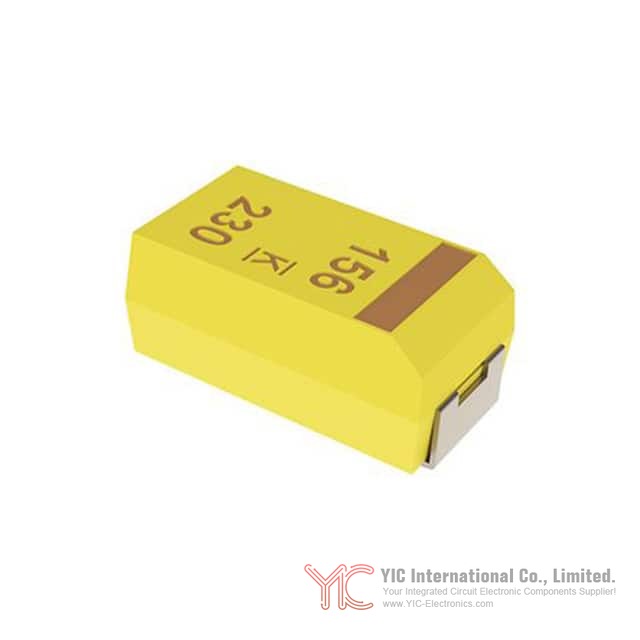
Product Overview – KEMET T495C686K010ZTE250
The KEMET T495C686K010ZTE250 is a surface-mount molded tantalum capacitor designed for applications requiring stable capacitance, controlled ESR, and a compact footprint. It offers a nominal capacitance of 68 μF with a tolerance of ±10% and operates at a rated voltage of 10 V.
This device belongs to KEMET’s T495 series of MnO₂ (manganese dioxide) solid tantalum capacitors, optimized for low ESR and enhanced surge robustness. The T495C686K010ZTE250 is packaged in a 2312 (6032 metric) molded SMD case with a maximum height of 2.8 mm, enabling dense board layouts in power and signal conditioning circuits.
With a specified ESR of 250 mΩ at 100 kHz, the KEMET T495C686K010ZTE250 supports relatively high ripple currents and effective decoupling in the lower-voltage portion of power rails, while maintaining the long-term stability associated with tantalum technology.
---
Key Electrical Specifications of KEMET T495C686K010ZTE250
The KEMET T495C686K010ZTE250 defines its performance through a set of core electrical parameters:
• Capacitance: 68 μF
• Capacitance tolerance: ±10% (K code)
• Rated voltage: 10 V DC
• Technology: Solid tantalum capacitor with MnO₂ electrolyte
• ESR: 250 mΩ at 100 kHz
In typical low-voltage DC rails, a 68 μF value at 10 V supports localized energy storage and transient suppression near IC power pins or small DC/DC converters. The ±10% tolerance allows reasonably tight capacitance planning in filter networks and timing circuits, compared with wider tolerance aluminum electrolytics.
The 10 V rating positions the KEMET T495C686K010ZTE250 for use on 3.3 V, 5 V, and other low-voltage rails with adequate derating. A common design example is placing this capacitor on a 5 V rail with around 50%–60% voltage derating, reducing electrical stress and supporting long service life.
The specified ESR of 250 mΩ at 100 kHz (a standard characterization frequency) characterizes how the device behaves in switching regulator output filters and high-frequency bypass networks, where ESR influences output ripple and regulator stability.
---
Package, Dimensions and Mounting Characteristics of KEMET T495C686K010ZTE250
The KEMET T495C686K010ZTE250 uses a molded SMD form factor, designated 2312 (6032 metric). Key physical aspects include:
• Case size: 2312 (6032 metric)
• Maximum height: 2.8 mm
• Style: Molded plastic encapsulation
• Mounting: SMD compatible with reflow processes
The 6032 footprint accommodates mid-range capacitance values like 68 μF while keeping the profile low. This enables placement under shielding cans, near connectors, or between densely packed ICs where vertical clearance is limited.
In a practical layout, the KEMET T495C686K010ZTE250 can be used as an output capacitor for a small buck converter delivering 5 V at moderate current. The 6032 footprint allows tight routing from the inductor and diode/rectifier node to minimize loop area and improve transient response.
The molded package provides mechanical robustness on the PCB and protects the internal tantalum pellet and MnO₂ system from environmental influences, contributing to stable long-term characteristics when mounted according to standard SMD practices.
---
ESR and Frequency Behavior of KEMET T495C686K010ZTE250
The KEMET T495C686K010ZTE250 specifies an ESR of 250 mΩ at 100 kHz. This value reflects the effective series resistance that contributes to power loss and voltage ripple when the capacitor is subjected to AC components.
In switching power supplies operating in the tens or hundreds of kilohertz, this ESR level enables:
• Ripple voltage control: The ripple contribution from ESR is ΔV ≈ I_ripple × ESR. For example, with 0.3 A ripple current at 100 kHz, the ESR component of ripple is approximately 0.3 A × 0.25 Ω = 75 mV.
• Damping in LC filters: Some ESR is beneficial to avoid excessive Q-factor and oscillation in output filters, supporting stable regulator operation.
Because the KEMET T495C686K010ZTE250 is a tantalum MnO₂ device, its ESR is generally lower and more stable than many traditional aluminum electrolytics of similar size. This combination of low ESR and solid dielectric behavior helps achieve predictable impedance over frequency and temperature.
In practical decoupling networks, designers often combine the KEMET T495C686K010ZTE250 with small-value ceramic capacitors. The tantalum device provides bulk energy with controlled ESR, while ceramics handle very high-frequency components. This approach uses the 250 mΩ ESR of the K495C686K010ZTE250 to shape the overall impedance profile and avoid resonance peaks.
---
Dielectric System and Construction of KEMET T495C686K010ZTE250
The KEMET T495C686K010ZTE250 uses a MnO₂-based solid tantalum construction:
• Base electrode: Sintered tantalum pellet
• Dielectric: Tantalum pentoxide formed on the pellet surface
• Solid electrolyte: MnO₂
• Encapsulation: Molded plastic case
This structure yields:
• Stable capacitance over time and with voltage, compared to electrolytics with liquid electrolytes.
• Good volumetric efficiency, achieving 68 μF at 10 V in the 6032 case.
• Solid-state construction without liquid electrolyte evaporation.
The use of MnO₂ as a solid electrolyte supports reliability and consistent ESR behavior. It also underpins the surge robustness characteristics claimed for the T495 series, including the KEMET T495C686K010ZTE250.
A typical real-world example is a system where equipment may see periodic inrush events—such as hot-plugging a board into a live backplane. A MnO₂-based solid tantalum capacitor like the KEMET T495C686K010ZTE250, when properly derated and used within specified conditions, can manage such events with controlled failure modes and predictable electrical response.
---
Application Considerations for KEMET T495C686K010ZTE250 in Power and Signal Circuits
The KEMET T495C686K010ZTE250 fits a range of low-voltage applications that benefit from 68 μF bulk capacitance, 10 V rating, and low ESR:
Typical use cases include:
• Output filtering in low-power DC/DC converters running on 3.3 V or 5 V rails
• Local decoupling for digital and mixed-signal ICs requiring stable supply rails
• Bypass and smoothing in low-voltage analog circuits
In a microcontroller-based system powered at 5 V, a typical implementation could place the KEMET T495C686K010ZTE250 near the regulator output to provide bulk decoupling, while several smaller ceramics (e.g., 0.1 μF and 1 μF) are placed near individual IC pins. The 68 μF value stabilizes the rail during load transients, while the 250 mΩ ESR offers a controlled damping characteristic.
Voltage derating and environment:
Since the rated voltage of the KEMET T495C686K010ZTE250 is 10 V, usage at lower voltages (such as 3.3 V or 5 V) typically improves long-term reliability by reducing electric field stress in the dielectric. This aligns with common design practice of operating tantalum capacitors well below their nameplate voltage.
When designing filters or timing networks, the ±10% capacitance tolerance of the KEMET T495C686K010ZTE250 supports relatively predictable behavior. For example, in a low-frequency RC filter on a 5 V rail, the 68 μF value can be used to set a specific cutoff frequency, with tolerance windows accounted for in the design.
---
Reliability, Surge Robustness and Design Margin with KEMET T495C686K010ZTE250
The KEMET T495C686K010ZTE250 is described as a low-ESR, surge robust molded tantalum capacitor. Surge robustness relates to how the capacitor tolerates current surges or voltage transients such as:
• Power-up and inrush events
• Load steps in switching regulators
• Short-duration overvoltage conditions within defined limits
In engineering practice, surge robustness of the KEMET T495C686K010ZTE250 can be enhanced by:
• Operating the capacitor at a derated voltage (for example, using it on a 5 V rail rather than approaching 10 V).
• Ensuring series resistance or impedance in the power path to limit surge current.
• Observing layout practices that avoid high dV/dt directly across the capacitor.
Because the device is a tantalum MnO₂ capacitor, its behavior under stress is influenced by the solid electrolyte and the construction of the T495 series. This makes it suitable for use in power domains where startup conditions and transient load steps are well understood and managed.
A practical example is a communication module powered from a 5 V supply with frequent on/off cycling. Placing a KEMET T495C686K010ZTE250 at the input, with the module’s upstream source limited by a series trace resistance or small inductor, can help manage inrush while still providing adequate local energy storage.
---
Lifecycle and Second-Source Considerations for KEMET T495C686K010ZTE250
The KEMET T495C686K010ZTE250 is identified as an obsolete part number. While its electrical and mechanical characteristics remain relevant for understanding existing designs and possible equivalents, new designs must consider:
• Lifecycle status: KEMET marks T495C686K010ZTE250 as obsolete, which affects long-term availability.
• Cross-references: Descriptions reference related tantalum MnO₂ technology and comparable capacitors such as B45197A-type devices with 68 μF, 10%, 10 V, SMD, molded, low ESR, surge robust, 250 mΩ, 6032, height max 2.8 mm.
For existing assemblies that currently use the KEMET T495C686K010ZTE250, qualification of a second source or alternative part with:
• 68 μF nominal capacitance
• 10 V rating with comparable voltage derating practices
• 2312 (6032) case size and ≤ 2.8 mm height
• Low ESR near 250 mΩ at 100 kHz
• MnO₂-based solid tantalum construction
helps maintain electrical performance and minimize redesign effort. Mechanical footprint and pad layout compatibility are key factors in enabling drop-in replacement on existing PCBs.
---
Conclusion – Integrating the KEMET T495C686K010ZTE250 into Modern Designs
The KEMET T495C686K010ZTE250 is a molded SMD tantalum capacitor tailored to low-voltage, space-constrained designs that require 68 μF capacitance, 10 V rating, controlled low ESR of 250 mΩ at 100 kHz, and a 6032 case with 2.8 mm maximum height. Its MnO₂ solid tantalum construction offers stable electrical behavior and supports surge robustness when used with appropriate voltage derating and current-limiting practices.
Although the KEMET T495C686K010ZTE250 is now obsolete, understanding its characteristics helps maintain legacy designs, evaluate form-fit-function replacements, and guide new component selection where similar performance is needed in DC/DC converter outputs, bulk decoupling nodes, and low-voltage filter networks.
---
Frequently Asked Questions (FAQ)
- Q1. What are the main electrical ratings of the KEMET T495C686K010ZTE250?
-
- A1. The KEMET T495C686K010ZTE250 has a capacitance of 68 μF with ±10% tolerance and a rated voltage of 10 V DC. Its ESR is specified as 250 mΩ at 100 kHz. These parameters define its use in low-voltage power rails, bulk decoupling, and filtering applications.
- Q2. What package and size does the KEMET T495C686K010ZTE250 use?
-
- A2. The KEMET T495C686K010ZTE250 is supplied in a molded SMD package with a 2312 (6032 metric) footprint and a maximum height of 2.8 mm. This enables use in compact layouts and low-profile assemblies where vertical clearance is restricted.
- Q3. Is the KEMET T495C686K010ZTE250 still in production?
-
- A3. The KEMET T495C686K010ZTE250 is identified as an obsolete part number. For ongoing or new projects, alternatives with equivalent capacitance (68 μF), voltage rating (10 V), case size (6032), and similar ESR (~250 mΩ at 100 kHz) should be evaluated to ensure continuity of supply and performance.
- Q4. What dielectric and electrolyte system does the KEMET T495C686K010ZTE250 use?
-
- A4. The KEMET T495C686K010ZTE250 is a solid tantalum capacitor using a tantalum pentoxide dielectric and MnO₂ solid electrolyte. This MnO₂-based construction contributes to stable capacitance, solid-state reliability, and low ESR in a molded SMD package.
- Q5. How does the ESR of the KEMET T495C686K010ZTE250 affect power supply design?
-
- A5. With an ESR of 250 mΩ at 100 kHz, the KEMET T495C686K010ZTE250 influences output ripple and damping in power supply filters. In a switching regulator, the ESR determines the resistive component of ripple (ΔV ≈ I_ripple × ESR) and helps avoid excessive resonance in the LC network. This makes it suitable for output filtering where both ripple control and stability are required.
- Q6. Can the KEMET T495C686K010ZTE250 be used on a 5 V rail?
-
- A6. Yes. The KEMET T495C686K010ZTE250 is rated at 10 V, so operation on a 5 V rail represents a derated condition that typically supports improved long-term reliability. Designers commonly apply such voltage derating for tantalum capacitors to reduce electrical stress, provided all other application conditions (such as surge current and temperature) are respected.
- Q7. What types of applications are suitable for the KEMET T495C686K010ZTE250?
-
- A7. The KEMET T495C686K010ZTE250 is suitable for bulk decoupling on low-voltage rails, output filtering in DC/DC converters, bypassing and smoothing in digital and analog circuits, and local energy storage near loads. Its 68 μF value and low ESR fit applications needing moderate capacitance in a compact SMD 6032 package.
- Q8. How does the KEMET T495C686K010ZTE250 handle surge conditions?
-
- A8. The KEMET T495C686K010ZTE250 is part of a low-ESR, surge robust molded tantalum series. Surge robustness refers to the capacitor’s ability to tolerate inrush and transient events within specified conditions. In practice, using voltage derating (e.g., operating below 10 V), controlling surge currents through series impedance, and following recommended layout practices enhances performance during power-up and transient load events.
- Q9. What considerations apply when replacing the KEMET T495C686K010ZTE250 in an existing design?
-
- A9. When replacing the KEMET T495C686K010ZTE250, it is advisable to match key parameters: 68 μF capacitance, 10 V rating, 2312 (6032) footprint, maximum height around 2.8 mm, low ESR near 250 mΩ at 100 kHz, and MnO₂-based solid tantalum technology. Maintaining these attributes helps preserve electrical behavior, mechanical compatibility, and surge performance with minimal redesign.
- Q10. Is the KEMET T495C686K010ZTE250 suitable for timing circuits or only for power applications?
-
- A10. The KEMET T495C686K010ZTE250 is primarily targeted at power-related functions such as bulk decoupling and filtering. However, its 68 μF capacitance and ±10% tolerance can also be used in low-frequency timing or RC filtering circuits where its value, tolerance, and 10 V rating align with the required time constants and voltage levels.
- Q11. How does the molded construction of the KEMET T495C686K010ZTE250 benefit PCB assembly?
-
- A11. The molded construction of the KEMET T495C686K010ZTE250 provides mechanical protection for the internal tantalum pellet and MnO₂ material, while offering a robust SMD form compatible with reflow soldering. The defined 6032 outline helps automated pick-and-place processes and supports reliable mounting in high-density boards.
- Q12. What is the maximum profile height of the KEMET T495C686K010ZTE250, and why does it matter?
-
- A12. The KEMET T495C686K010ZTE250 has a maximum height of 2.8 mm. This low profile allows placement under mechanical constraints such as shielding cans, enclosures, or stacked boards. In compact systems, maintaining a low component height simplifies mechanical integration without sacrificing the required 68 μF capacitance at 10 V.