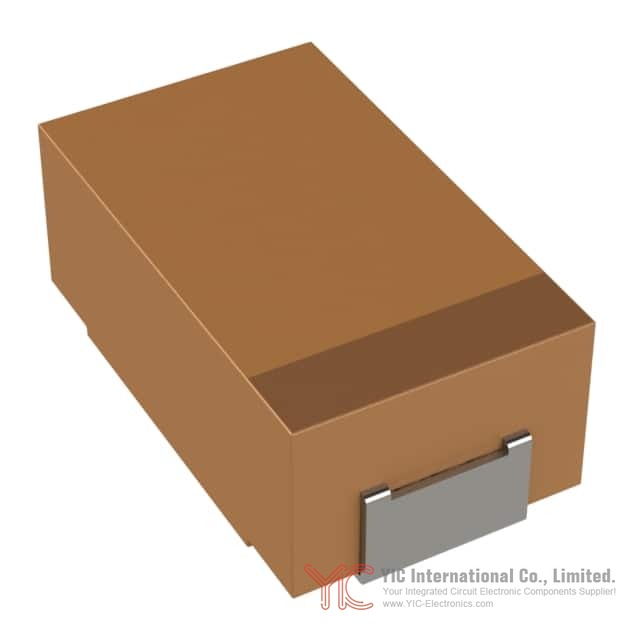
Product Overview of the TPS Series Low ESR Tantalum Capacitors
The KYOCERA AVX TPS Series represents a family of molded tantalum capacitors engineered specifically for applications demanding low equivalent series resistance (ESR) performance. These solid electrolyte capacitors combine robust manganese dioxide (MnO₂) technology with advanced manufacturing processes to deliver reliable energy storage across a broad range of industrial and commercial applications. The TPS Series addresses the growing need for compact, high-performance capacitive components in modern electronic systems where power efficiency and thermal management are paramount considerations.
Core Technology and Construction of TPS Series Capacitors
The TPS Series employs a conventional tantalum capacitor architecture built around a tantalum anode material paired with a manganese dioxide cathode system. This construction methodology has been refined through decades of development to achieve the low ESR characteristics that define the series. The manganese dioxide electrolyte provides stable electrical performance across temperature ranges while maintaining predictable aging characteristics throughout the component's operational lifetime.
The solid electrolyte design eliminates the liquid electrolyte found in older capacitor technologies, resulting in improved reliability and extended operational life. Each TPS Series capacitor undergoes 100% surge current testing during manufacturing, ensuring that individual units can withstand transient voltage spikes and current surges without degradation. This comprehensive testing protocol provides confidence in field performance across diverse operating conditions.
The molded construction of TPS Series capacitors encapsulates the internal electrode structure within a protective polymer body, shielding the sensitive tantalum core from environmental contamination and mechanical stress. This approach enables the compact form factors that characterize the series while maintaining structural integrity through thermal cycling and mechanical vibration.
Electrical Performance Characteristics of TPS Series Devices
The defining characteristic of the TPS Series is its low ESR performance, which directly impacts the thermal behavior and efficiency of power conversion circuits. ESR represents the resistive losses inherent in any real capacitor, and minimizing these losses becomes increasingly important as switching frequencies in modern power supplies increase. The TPS Series achieves ESR values measured in milliohms, enabling efficient energy transfer with minimal heat generation.
The low ESR characteristic of TPS Series capacitors translates to reduced voltage ripple in power supply output stages, improved transient response in voltage regulation circuits, and decreased thermal stress on the capacitor itself. In practical terms, a power supply designer using TPS Series capacitors can achieve tighter output voltage regulation with fewer parallel components compared to conventional tantalum capacitor designs, reducing overall board space and component count.
Capacitance values within the TPS Series range from 0.15 microfarads to 1500 microfarads, accommodating applications from high-frequency filtering to bulk energy storage. This broad capacitance range, combined with voltage ratings spanning 2.5 volts to 50 volts, enables designers to select TPS Series components for virtually any DC power application. The specific model TPSD107K016R0100 represents a 100 microfarad capacitor rated at 16 volts, positioned within the mid-range of the series for general-purpose power supply applications.
Capacitance and Voltage Rating Options in the TPS Series Portfolio
The TPS Series encompasses 14 distinct case sizes, each available in multiple capacitance and voltage combinations. This modular approach allows designers to optimize component selection based on specific circuit requirements without compromising performance or introducing unnecessary design complexity. The voltage ratings specified for each case size represent minimum values; KYOCERA AVX reserves the right to supply higher voltage ratings within the same physical package, providing additional design flexibility.
The capacitance tolerance for TPS Series components is specified at ±10%, a standard specification for tantalum capacitors that reflects the manufacturing tolerances inherent in solid electrolyte technology. This tolerance band accommodates the natural variation in electrode geometry and electrolyte properties while maintaining predictable circuit performance. Designers accustomed to working with tantalum capacitors understand that this tolerance specification requires appropriate circuit design practices, such as using multiple capacitors in parallel for applications demanding tighter capacitance accuracy.
The relationship between case size, capacitance value, and voltage rating follows established patterns within the TPS Series. Larger case sizes accommodate higher capacitance values at given voltage ratings, while smaller packages provide lower capacitance values. This scaling relationship enables designers to balance board space constraints against capacitance requirements through informed component selection.
Physical Specifications and Package Dimensions for TPS Series Components
The TPS Series employs the 2917 case size designation (also referenced as 7343 in metric notation), representing a molded rectangular package measuring 7.3 millimeters in length and 4.3 millimeters in width. This compact form factor enables high-density circuit board layouts while maintaining adequate spacing for manufacturing processes and thermal management. The height of TPS Series components varies slightly depending on capacitance value and internal construction, but remains within the range typical for surface-mount tantalum capacitors.
The termination width specification for TPS Series components defines the contact area between the capacitor leads and the circuit board solder pads. Proper pad design matching the specified termination width ensures reliable solder joint formation and mechanical stability throughout the component's operational life. The dimensional specifications provided in the TPS Series datasheet enable designers to develop accurate footprints for computer-aided design systems and manufacturing equipment.
Reliability and Quality Assurance Standards for TPS Series Capacitors
KYOCERA AVX subjects TPS Series capacitors to comprehensive qualification testing protocols that verify performance across extended temperature ranges, voltage stress conditions, and operational duty cycles. The qualification table within the TPS Series documentation specifies the test conditions, duration, and acceptance criteria for each validation procedure. These tests confirm that TPS Series components meet or exceed industry standards for solid tantalum capacitors.
The 100% surge current testing applied to every TPS Series capacitor ensures that manufacturing variations do not result in components with reduced surge current capability. This universal testing approach eliminates the statistical risk associated with sampling-based quality assurance, providing confidence that each individual component meets the published specifications.
The TPS Series achieves RoHS compliance, confirming that the manufacturing process eliminates hazardous substances such as lead, cadmium, and hexavalent chromium. This compliance status enables TPS Series components to be incorporated into products destined for markets with environmental regulations restricting hazardous material usage. The lead-free compatible designation indicates that TPS Series components can be successfully soldered using lead-free solder alloys without degradation of electrical performance or mechanical reliability.
Application Scenarios and Use Cases for TPS Series Capacitors
The TPS Series finds primary application in power supply circuits where low ESR performance directly enhances system efficiency and thermal management. DC-to-DC converter applications represent a significant use case, where TPS Series capacitors serve as output filters to reduce voltage ripple and as input filters to suppress conducted emissions. The low ESR characteristic enables these converters to achieve higher efficiency ratings by minimizing resistive losses in the energy conversion process.
General medium-power DC-to-DC converter applications benefit from the TPS Series' combination of low ESR and robust construction. In these circuits, the capacitor must withstand repetitive charging and discharging cycles at switching frequencies typically ranging from hundreds of kilohertz to several megahertz. The solid electrolyte construction of TPS Series capacitors provides stable performance across this frequency range without the performance degradation observed in some alternative capacitor technologies.
Power supply applications extending beyond simple voltage regulation also benefit from TPS Series characteristics. Uninterruptible power supply systems, battery charging circuits, and industrial power distribution equipment all incorporate TPS Series capacitors to achieve the performance and reliability demanded by continuous-duty operation. The thermal stability of TPS Series components enables reliable operation in environments where ambient temperatures fluctuate or where the capacitor itself generates heat through normal operation.
Environmental Compliance and Material Composition of TPS Series Products
The TPS Series manufacturing process incorporates environmentally responsible practices that minimize waste and reduce the environmental impact of component production. The RoHS compliance certification confirms that TPS Series components meet the Restriction of Hazardous Substances directive requirements, eliminating lead and other restricted materials from the manufacturing process.
The material composition of TPS Series capacitors reflects the fundamental construction of solid tantalum capacitors: a tantalum anode material, a tantalum pentoxide dielectric layer, and a manganese dioxide cathode system. These materials have been selected through decades of development to provide the optimal balance of electrical performance, reliability, and environmental compatibility. The specific weight and composition details for TPS Series components are documented in the manufacturer's comprehensive technical literature.
Moisture Sensitivity and Storage Considerations for TPS Series Capacitors
TPS Series capacitors are classified according to Moisture Sensitivity Level (MSL) specifications defined by the J-STD-020 standard. This classification system indicates the maximum time that a component can be exposed to ambient humidity conditions before soldering without requiring baking to remove absorbed moisture. The MSL rating for TPS Series components reflects the molded construction and internal material composition.
Dry pack packaging options are available for TPS Series components, providing an alternative to standard moisture-barrier packaging. Dry pack treatment reduces stress during the soldering process by minimizing the moisture content within the component at the time of assembly. This option proves particularly valuable in high-volume manufacturing environments where components may experience extended storage periods or exposure to humid conditions before assembly.
The moisture sensitivity specification for TPS Series components should be considered during procurement planning and inventory management. Components stored in controlled humidity environments require less frequent baking procedures, reducing manufacturing complexity and associated costs. Conversely, components exposed to high-humidity conditions may require baking before soldering to ensure reliable solder joint formation and long-term reliability.
Conclusion
The KYOCERA AVX TPS Series Low ESR Tantalum Capacitors represent a mature, well-established technology for demanding power supply applications. The combination of low ESR performance, robust solid electrolyte construction, comprehensive quality assurance, and environmental compliance positions the TPS Series as a reliable choice for designers and procurement professionals seeking high-performance capacitive components. The broad range of capacitance and voltage options, coupled with multiple case sizes, enables flexible system design while maintaining consistent performance characteristics across the product family.
Frequently Asked Questions (FAQ)
- Q1. What does ESR mean, and why is low ESR important in the TPS Series?
-
- A1. ESR stands for Equivalent Series Resistance, representing the resistive losses inherent in any real capacitor. Low ESR in the TPS Series means less energy is wasted as heat during charging and discharging cycles. In power supply applications, this translates to improved efficiency, reduced thermal stress on the capacitor, and tighter output voltage regulation. For example, in a DC-to-DC converter operating at high switching frequencies, a low-ESR capacitor like the TPS Series generates significantly less heat than a conventional tantalum capacitor, enabling more compact thermal designs.
- Q2. How does the TPS Series compare to other tantalum capacitor technologies?
-
- A2. The TPS Series employs manganese dioxide (MnO₂) solid electrolyte technology, which has been refined over decades to provide stable, predictable performance. This conventional approach differs from conductive polymer tantalum capacitors, which offer even lower ESR but may have different aging characteristics and cost profiles. The TPS Series represents an optimal balance between performance, reliability, cost, and availability for general-purpose power supply applications.
- Q3. What is the significance of the 100% surge current testing mentioned in the TPS Series specifications?
-
- A3. Surge current testing verifies that each capacitor can withstand transient voltage spikes without degradation. By testing every individual component rather than relying on statistical sampling, KYOCERA AVX ensures that no defective units reach the field. This universal testing approach provides confidence that each TPS Series capacitor will perform reliably even when subjected to unexpected voltage transients in real-world applications.
- Q4. Can TPS Series capacitors be used in lead-free soldering processes?
-
- A4. Yes, the TPS Series is designated as lead-free compatible, confirming that these capacitors can be successfully soldered using lead-free solder alloys without degradation of electrical performance or mechanical reliability. This compatibility enables TPS Series components to be incorporated into products manufactured using modern lead-free assembly processes required by environmental regulations.
- Q5. What does the ±10% capacitance tolerance mean for circuit design?
-
- A5. The ±10% tolerance indicates that the actual capacitance value of a TPS Series component may vary by up to 10% from the nominal value specified on the part number. For applications requiring tighter capacitance accuracy, designers typically connect multiple TPS Series capacitors in parallel, which reduces the effective tolerance through statistical averaging. For example, connecting two 100 microfarad capacitors in parallel provides approximately 200 microfarads with improved tolerance characteristics compared to a single component.
- Q6. How should TPS Series capacitors be stored to maintain reliability?
-
- A6. TPS Series capacitors should be stored in controlled humidity environments to minimize moisture absorption. The Moisture Sensitivity Level (MSL) classification indicates the maximum storage time before soldering without requiring baking. Dry pack packaging options are available for components that may experience extended storage or humid conditions. Before soldering components that have exceeded their MSL time limit, baking procedures should be performed according to J-STD-020 standards to remove absorbed moisture.
- Q7. What case sizes are available in the TPS Series, and how do I select the appropriate size?
-
- A7. The TPS Series encompasses 14 distinct case sizes, each available in multiple capacitance and voltage combinations. The specific model TPSD107K016R0100 uses the 2917 case size (7343 metric), a compact package suitable for high-density circuit boards. Selection depends on the required capacitance value, voltage rating, and available board space. Larger case sizes accommodate higher capacitance values, while smaller packages provide lower capacitance values. Designers should consult the comprehensive ratings table to identify the optimal case size for their specific application requirements.
- Q8. Are higher voltage ratings available within the same case size as the TPSD107K016R0100?
-
- A8. Yes, KYOCERA AVX reserves the right to supply higher voltage ratings within the same physical package. The voltage ratings specified in the datasheet represent minimum values. This flexibility enables designers to specify higher voltage-rated components if needed for additional design margin, without requiring a larger physical package. Designers should contact the manufacturer or authorized distributors to confirm availability of specific voltage ratings within desired case sizes.
- Q9. What applications are best suited for the TPS Series?
-
- A9. The TPS Series excels in power supply applications where low ESR performance directly enhances system efficiency and thermal management. Primary applications include DC-to-DC converters, uninterruptible power supplies, battery charging circuits, and industrial power distribution equipment. The robust solid electrolyte construction enables reliable operation in continuous-duty applications where the capacitor must withstand repetitive charging and discharging cycles at high switching frequencies.
- Q10. How does moisture sensitivity affect the manufacturing process for products using TPS Series capacitors?
-
- A10. Moisture sensitivity requires careful handling during component storage and assembly. Components exposed to humidity for extended periods may absorb moisture, which can cause solder joint defects or internal damage during the high-temperature soldering process. Dry pack packaging options reduce this risk by minimizing moisture content at the time of assembly. Manufacturers must track component storage time and perform baking procedures when necessary to ensure reliable solder joint formation and long-term product reliability.
- Q11. What does RoHS compliance mean for TPS Series capacitors?
-
- A11. RoHS (Restriction of Hazardous Substances) compliance confirms that TPS Series capacitors are manufactured without lead, cadmium, hexavalent chromium, and other restricted materials. This compliance status enables TPS Series components to be incorporated into products destined for markets with environmental regulations restricting hazardous material usage, including the European Union and many other regions worldwide.
- Q12. How do I interpret the part number TPSD107K016R0100?
-
- A12. The part number encodes key specifications: TPS indicates the series designation, D specifies the case size, 107 represents the capacitance value (100 microfarads, with the final digit indicating the multiplier), K denotes the tolerance (±10%), 016 specifies the voltage rating (16 volts), and R0100 provides additional manufacturing and packaging information. Understanding this coding system enables designers to quickly identify component specifications and locate alternative ratings within the TPS Series portfolio.