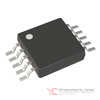
Product overview of the LTC7004EMSE#PBF
The LTC7004EMSE#PBF is a fast high side N‑channel MOSFET gate driver designed to control an external N‑channel MOSFET with source voltage up to 60 V. It accepts a ground‑referenced, low‑voltage CMOS‑compatible input signal and translates it into a high side gate drive suitable for static or high‑frequency switching.
A key feature of the LTC7004EMSE#PBF is its internal charge pump, which generates and regulates a 12 V bootstrapped supply (BST–TS) for the external MOSFET gate. This enables 100% duty‑cycle operation: the external MOSFET can remain fully enhanced continuously, supporting both static switch and high‑frequency topologies.
The LTC7004EMSE#PBF integrates strong gate drivers (1 Ω pull‑down, 2.2 Ω pull‑up) for fast turn‑on and turn‑off of large MOSFET gate capacitances, helping reduce switching losses and minimize transition times. It is housed in a thermally enhanced 10‑lead MSOP package with exposed pad and is AEC‑Q100 qualified in designated automotive versions.
2.
Key performance characteristics of the LTC7004EMSE#PBF
The LTC7004EMSE#PBF is specified to operate with:
- High side source (TS) voltage range: 0 V to 60 V
- Gate driver (VCC) supply range: 3.5 V to 15 V
- Bootstrapped gate supply (BST–TS) regulated at approximately 10–12 V (typical) over a wide TS range up to 60 V
Dynamic and timing performance:
- Input‑to‑output propagation delay: typically 35 ns (for both rising and falling transitions, with 1 nF load)
- Output rise time (10%–90%):
- 13 ns typical with 1 nF load
- 90 ns typical with 10 nF load
- Output fall time (10%–90%):
- 13 ns typical with 1 nF load
- 40 ns typical with 10 nF load
Drive strength and gate control:
- TGUP pull‑up resistance: 2.2 Ω typical at VCC = VBST = 12 V
- TGDN pull‑down resistance: 1 Ω typical at VCC = VBST = 12 V
These values allow the LTC7004EMSE#PBF to quickly charge and discharge external MOSFET gates, which is beneficial when minimizing switching losses in high‑frequency designs, or when achieving fast edges in static switching applications (for instance, driving a large N‑MOSFET used as a high side solid‑state relay).
Input and threshold characteristics:
- CMOS‑compatible INP threshold:
- Rising: ~2.0 V nominal (1.7–2.2 V over tolerance)
- Falling: ~1.6 V nominal (1.3–1.8 V)
- Hysteresis: ~0.4 V
- Internal pull‑down on INP: ~1 MΩ to GND
Operating temperature and reliability:
- Operating junction temperature grades:
- LTC7004E/ LTC7004I: −40 °C to 125 °C
- LTC7004H: −40 °C to 150 °C
- LTC7004MP: −55 °C to 150 °C
- High‑temperature operation is supported with derating of operating lifetime as junction temperature increases.
3.
Internal architecture and operating principles of the LTC7004EMSE#PBF
Internally, the LTC7004EMSE#PBF provides:
- A level‑shifted high side gate driver referenced to TS
- An internal charge pump that generates the BST–TS voltage for the gate driver
- Input logic and protection circuitry (UVLO, OVLO, and thermal shutdown)
Functional flow:
1) A ground‑referenced CMOS input (INP) is received and interpreted by the internal logic.
2) The logic drives a level‑shift stage that controls the high side gate driver pair (TGUP and TGDN), referenced between BST and TS.
3) The charge pump uses the higher of TS or VCC as a source, regulates BST–TS to approximately 12 V, and maintains that level for 100% duty‑cycle operation.
4) Protection circuitry monitors VCC, BST–TS, OVLO, and internal temperature, forcing TGDN to TS in fault or undervoltage conditions, thereby turning off the external MOSFET.
This architecture allows the LTC7004EMSE#PBF to drive an N‑channel MOSFET on the high side similar to how a low‑side driver would control a ground‑referenced MOSFET, but extended to input source potentials up to 60 V.
Example: In a 48 V distribution bus, TS can be tied to the bus, the drain of the external N‑MOSFET to the incoming supply, and the load from source to ground. The LTC7004EMSE#PBF, powered from a 10–12 V VCC rail, provides the bootstrapped gate drive (BST at roughly TS + 12 V), fully enhancing the MOSFET even when TS is at 48 V.
4.
Supply, charge pump, and UVLO behavior of the LTC7004EMSE#PBF
Supply pins and operating ranges for the LTC7004EMSE#PBF:
- VCC: main supply for the gate driver, 3.5 V to 15 V
- Bypass with at least 0.1 µF to GND close to the pin
- TS: high side source node (0–60 V), or ground when used in ground‑referenced configurations
- BST: bootstrapped node providing the gate drive supply relative to TS
Charge pump characteristics of the LTC7004EMSE#PBF:
- The internal charge pump regulates BST–TS to about 10–12 V depending on conditions, e.g.:
- VCC = VTS = 7 V: BST–TS ≈ 9–11 V
- VCC = VTS = 10 V: BST–TS ≈ 10–12 V
- VTS = 60 V: BST–TS ≈ 10–12 V
- Charge pump output current example: at VTS = 20 V and BST–TS = 10 V, typical output is around −30 µA (negative indicating charge being supplied to the bootstrap capacitor and load).
The LTC7004EMSE#PBF uses either VCC or TS (whichever is higher) as a source for the charge pump, maintaining the gate drive voltage when the MOSFET is held on continuously.
Undervoltage lockout (UVLO) for VCC on the LTC7004EMSE#PBF:
The VCC UVLO threshold is programmable via the VCCUV pin:
- VCCUV shorted to GND:
- VCC rising UVLO ≈ 3.5 V (3.1–3.7 V)
- VCC falling UVLO ≈ 3.2 V (2.8–3.4 V)
- VCCUV open:
- VCC rising UVLO ≈ 7.0 V (6.5–7.5 V)
- VCC falling UVLO ≈ 6.4 V (5.8–6.9 V)
- VCCUV at 1.5 V:
- VCC rising UVLO ≈ 10.5 V (9.7–10.9 V)
- VCC falling UVLO ≈ 9.9 V (9.1–10.3 V)
Internally, the voltage on VCCUV (0.5–1.5 V) is multiplied by 7 to generate the VCC UVLO rising threshold. This allows tailoring the minimum operating VCC in systems with varying gate drive supply rails.
Floating BST–TS UVLO:
- BST–TS rising UVLO ≈ 3.1 V (typical)
- BST–TS falling UVLO ≈ 2.8 V (typical)
If BST–TS falls below the internal threshold, the LTC7004EMSE#PBF pulls TGDN to TS, preventing operation with insufficient gate voltage.
Total supply current of the LTC7004EMSE#PBF:
- With charge pump regulating, TS = 12 V, BST open: total supply current ≈ 225 µA
- With charge pump overdriven (BST–TS externally driven to 13 V):
- ON mode, INP high: VCC current ≈ 27–50 µA
- Sleep mode, INP low: similar current range
Real‑world implication: low quiescent currents help support always‑on static switches in battery‑powered or automotive environments, where the external MOSFET might remain ON for long periods.
5.
Gate drive behavior and timing of the LTC7004EMSE#PBF
The LTC7004EMSE#PBF provides a two‑node gate drive interface (TGUP and TGDN) referenced to TS:
- TGUP: pulls the gate upwards towards BST
- TGDN: pulls the gate downwards towards TS
Typical usage:
- For fastest switching, TGUP and TGDN are shorted together and connected directly to the MOSFET gate.
- For controlled slew rate (e.g., to limit inrush current or reduce EMI), a resistor can be placed between TGUP and the gate, while TGDN remains connected directly to the gate.
Input–output correlation:
- INP high (above VIH, ~2.0 V typical):
- TGUP = high (gate pulled to BST)
- TGDN = high relative to TS (held such that gate is driven high; in practice, TGUP/TGDN pair drives the gate to BST)
- INP low (below VIL, ~1.6 V typical):
- TGDN strongly pulls the gate to TS (MOSFET off)
- TGUP is off
Timing characteristics of the LTC7004EMSE#PBF (with 1 nF load, VCC = BST = 10 V):
- Propagation delay (tPLH and tPHL): ~35 ns typical, up to 70 ns max
- Rise time (10–90%): ~13 ns
- Fall time (10–90%): ~13 ns
These fast transitions allow the LTC7004EMSE#PBF to support high‑frequency operation or rapid static switching edges. For example, when switching a 1 nF gate at tens or hundreds of kHz, the driver’s low resistance and low propagation delay limit switching losses and transition distortions.
6.
Protection functions of the LTC7004EMSE#PBF
The LTC7004EMSE#PBF incorporates several protection mechanisms designed to keep the external MOSFET in a safe state under adverse conditions:
1) VCC undervoltage lockout (programmable via VCCUV):
- If VCC is below the programmed UVLO threshold, TGDN is pulled to TS, turning the MOSFET off.
- This avoids partially enhanced gate states that would increase MOSFET dissipation.
2) BST–TS undervoltage lockout:
- If the bootstrapped gate supply (BST–TS) is below ~3.1 V rising (2.8 V falling), TGDN is pulled to TS.
- Prevents operation with insufficient gate drive.
3) OVLO (overvoltage lockout) on the LTC7004EMSE#PBF:
- OVLO pin threshold:
- Rising ≈ 1.21 V (1.16–1.26 V)
- Falling ≈ 1.10 V (1.05–1.15 V)
- Hysteresis ≈ 110 mV
- When OVLO exceeds the rising threshold, TGDN is forced to TS, keeping the MOSFET off.
- OVLO can be tied to GND if not used.
- A resistor divider from the input supply to OVLO sets an overvoltage cutoff. For example, to disconnect a load when a 48 V bus exceeds a limit, the divider can be scaled so that the desired bus threshold produces 1.21 V at OVLO.
4) Thermal shutdown in the LTC7004EMSE#PBF:
- When junction temperature approaches ~180 °C, TGDN is pulled to TS, turning off the MOSFET.
- Normal operation resumes once the die temperature falls below ~160 °C.
- The exact thermal shutdown level is not production tested, but the device is guaranteed to start at junction temperatures below 150 °C.
These protection blocks act in combination: if any monitored condition is out of range, the LTC7004EMSE#PBF forces the external MOSFET gate low (off), limiting fault propagation to the load or upstream supply.
7.
Pin functions and PCB design considerations for the LTC7004EMSE#PBF
The LTC7004EMSE#PBF uses a 10‑lead MSOP package with an exposed pad. Key pins and recommended practices:
- VCC (Pin 1): main supply for driver
- Connect to a 3.5–15 V rail.
- Place a 0.1 µF (or larger) ceramic capacitor from VCC to GND as close as possible to the pin.
- VCCUV (Pin 2): programmable VCC undervoltage lockout
- Tie to GND for minimum 3.5 V UVLO.
- Leave open for ~7 V default UVLO.
- Use a resistor to GND to set a custom UVLO in the 3.5–10.5 V range.
- Internal ~10 µA pull‑up current (−11.3 to −8.7 µA typical) flows from VCCUV, so external resistor values must account for this source current when setting the threshold.
- GND (Pin 3) and Exposed Pad (Pin 11):
- System ground reference.
- The exposed pad must be soldered to the PCB GND copper for thermal and electrical performance.
- INP (Pin 4): ground‑referenced CMOS logic input
- Drives internal logic that controls TGUP/TGDN.
- Has an internal 1 MΩ pull‑down to GND to keep TGDN at TS during startup if the input source is high‑impedance.
- OVLO (Pin 5): overvoltage lockout input
- Connect a resistor divider from the monitored input supply to OVLO and GND.
- When OVLO > 1.21 V, TGDN is forced to TS.
- Tie to GND if OVLO is not needed.
- TGDN (Pin 6): gate driver pull‑down
- Connect to the MOSFET gate, usually shorted to TGUP for maximum speed.
- Pulls the gate to TS with ~1 Ω typical resistance.
- TGUP (Pin 7): gate driver pull‑up
- Connect to the MOSFET gate, typically tied directly to TGDN.
- Pulls gate towards BST with ~2.2 Ω typical resistance.
- For controlled turn‑on slew rate, insert a resistor between TGUP and the gate while keeping TGDN directly at the gate.
- TS (Pin 8): high side source node (or GND in ground‑referenced use)
- Connect to the source of the external high side N‑MOSFET.
- Will swing between 0 and up to 60 V, so routing and clearance must respect the maximum system voltage.
- BST (Pin 9): bootstrapped high side supply
- Connect a 0.1 µF (minimum) capacitor from BST to TS.
- BST swings between roughly VCC and TS + ~12 V, depending on operating mode.
- The capacitor should be placed very close to the pins to minimize parasitics.
- NC (Pin 10): no connect
- Leave floating; do not tie to any signal.
PCB layout guidance for the LTC7004EMSE#PBF:
- Keep high‑di/dt gate drive loops between TGUP/TGDN, MOSFET gate, and TS as short and wide as possible to reduce inductive ringing.
- Place the BST–TS capacitor adjacent to the LTC7004EMSE#PBF leads.
- Use a solid ground plane beneath the driver; tie the exposed pad to this plane with multiple vias for thermal spreading.
- Route sensitive pins (INP, OVLO, VCCUV) away from the high‑voltage switching nodes (TS, MOSFET drain) to minimize coupling.
8.
Package, thermal ratings, and automotive variants of the LTC7004EMSE#PBF
The LTC7004EMSE#PBF is provided in a 10‑lead plastic MSOP package with an exposed pad (10‑MSOP‑EP). Package highlights:
- Compact 3.00 mm width body
- Exposed thermal pad (Pin 11) must be soldered to PCB GND for heat dissipation
- Typical thermal resistance:
- θJA ≈ 45 °C/W
- θJC ≈ 10 °C/W
Absolute maximum ratings for the LTC7004EMSE#PBF:
- Supply and node limits:
- VCC: −0.3 to 15 V
- BST–TS: −0.3 to 15 V
- TS: −6 to 65 V
- BST: −0.3 to 80 V
- INP: −6 to 15 V
- VCCUV: −0.3 to 6 V
- OVLO: −0.3 to 6 V
- Storage temperature: −65 °C to 150 °C
- Maximum junction temperature: 150 °C
- Soldering temp (MSOP, 10 s): 300 °C
Environmental and compliance aspects:
- RoHS: RoHS3 compliant
- REACH: unaffected
- ECCN: EAR99
- HTSUS: 8542.39.0001
Automotive‑qualified variants of the LTC7004EMSE#PBF:
- Automotive‑grade models are identified with a “#W” suffix (e.g., LTC7004IMSE#WPBF, LTC7004JMSE#WPBF) and are AEC‑Q100 qualified.
- These variants support the quality and reliability requirements of automotive applications over defined temperature ranges, for example:
- LTC7004IMSE#WPBF: −40 °C to 125 °C
- LTC7004JMSE#WPBF: −40 °C to 150 °C
9.
Typical applications and use cases of the LTC7004EMSE#PBF
The LTC7004EMSE#PBF is suitable for a variety of high side N‑MOSFET control roles:
1) Static switch driver using the LTC7004EMSE#PBF
- Acts as a solid‑state high side switch controller on bus voltages up to 60 V.
- The external MOSFET can remain continuously on due to the internal 100% duty‑cycle charge pump.
- Example: battery disconnect or power path control in industrial or telecom systems.
2) Load and supply switch driver with the LTC7004EMSE#PBF
- Drives MOSFETs for load or supply switching in DC distribution networks.
- OVLO pin can be used to cut off the load at a defined overvoltage on the input supply.
- VCCUV can ensure gate drive is only enabled when the driver supply is in the required range.
3) Electronic valve driver with the LTC7004EMSE#PBF
- Drives inductive loads (e.g., solenoid valves) connected between source and ground when the MOSFET is used as a high side switch.
- Fast gate transitions support rapid energization/de‑energization of the valve, while robust drive strength helps manage inductive load transients.
4) High‑frequency high side gate driver using the LTC7004EMSE#PBF
- Supports high‑frequency switching by driving MOSFET gate capacitances with short propagation delays and strong pull‑up/pull‑down capability.
- The internal charge pump maintains gate overdrive even at high duty cycles.
Example application: high‑voltage high side switch with LTC7004EMSE#PBF:
- VIN (0–60 V) is connected to the external N‑MOSFET drain.
- MOSFET source is tied to TS and then to the load.
- VCC is supplied at 3.5–15 V (e.g., 10 V).
- BST is tied to TS via a 0.1 µF capacitor, forming the bootstrapped node.
- OVLO monitors VIN via a resistor divider.
- INP receives a logic signal to control ON/OFF.
In this configuration, when INP is high, the LTC7004EMSE#PBF raises the gate via TGUP/TGDN relative to TS, turning the MOSFET on and connecting VIN to the load. When INP is low, TGDN pulls the gate to TS, turning the MOSFET off.
10.
Conclusion for the LTC7004EMSE#PBF
The LTC7004EMSE#PBF is a high side N‑MOSFET gate driver capable of operating up to 60 V on the source node, with an internal charge pump that supports 100% duty cycle and a regulated ~12 V bootstrapped gate supply. Its strong gate drive, fast propagation delays, programmable VCC UVLO, OVLO input, and integrated thermal and gate supply undervoltage protection form a robust solution for static and high‑frequency high side switching.
The compact 10‑MSOP‑EP package, wide temperature range options (including −55 °C to 150 °C), and AEC‑Q100 qualified variants make the LTC7004EMSE#PBF suitable for industrial, automotive, and other demanding environments where reliable high side N‑MOS control is required.
11.
Frequently Asked Questions (FAQ)
- Q1. What supply voltages does the LTC7004EMSE#PBF support for the driver and high side node?
-
- A1. The LTC7004EMSE#PBF uses two distinct voltage ranges:
- - VCC (gate driver supply): 3.5 V to 15 V, with programmable undervoltage lockout via VCCUV.
-
- - TS (high side source): 0 V to 60 V.
- The bootstrapped gate supply BST can go as high as 80 V (BST absolute max), with BST–TS regulated internally to about 10–12 V to drive the MOSFET gate.
-
- Q2. How does the LTC7004EMSE#PBF achieve 100% duty‑cycle operation?
- A2. The LTC7004EMSE#PBF includes an internal charge pump that regulates the BST–TS voltage at approximately 12 V even when the high side MOSFET is kept continuously on. It uses the higher of TS or VCC as a charge source, allowing the external gate to remain fully enhanced without relying solely on traditional bootstrap switching from a low‑side node. This enables 100% duty cycle in static or continuous conduction applications.
-
- Q3. What is the typical gate drive strength of the LTC7004EMSE#PBF and what load can it drive?
- A3. With VCC = VBST = 12 V, the LTC7004EMSE#PBF has a typical TGUP pull‑up resistance of 2.2 Ω and a TGDN pull‑down resistance of 1 Ω. It is characterized for driving capacitive loads up to at least 10 nF with fast rise/fall times (e.g., 13 ns for 1 nF). This enables efficient driving of medium to large N‑MOSFETs in high side configurations.
-
- Q4. How fast is the LTC7004EMSE#PBF in terms of propagation delay and transition times?
- A4. For a 1 nF load, typical values are:
-
- - Propagation delay (input to gate): ~35 ns for both rising and falling edges
- - Rise time (10–90%): ~13 ns
-
- - Fall time (10–90%): ~13 ns
- These figures allow the LTC7004EMSE#PBF to be used in high‑frequency applications or where rapid switching transitions are required.
-
- Q5. How is the VCC undervoltage lockout threshold set on the LTC7004EMSE#PBF?
- A5. The VCCUV pin defines the VCC UVLO in the LTC7004EMSE#PBF:
-
- - If VCCUV is shorted to GND, VCC rising UVLO is about 3.5 V.
- - If VCCUV is left open, VCC rising UVLO is about 7.0 V.
-
- - If VCCUV is driven to another voltage (0.5–1.5 V), the rising UVLO is approximately 7 × VCCUV.
- Internally there is a pull‑up current of about 10 µA at VCCUV, so external resistor networks should be designed considering this current.
-
- Q6. What happens if the bootstrapped voltage BST–TS is too low on the LTC7004EMSE#PBF?
- A6. The LTC7004EMSE#PBF includes a BST–TS undervoltage lockout. If BST–TS is below about 3.1 V (typical rising threshold, 2.8 V falling), TGDN is forced to TS, turning off the external MOSFET. This prevents operation with insufficient gate overdrive, which would increase MOSFET conduction losses.
-
- Q7. How does the OVLO function work on the LTC7004EMSE#PBF and how is it used?
- A7. OVLO is an overvoltage lockout input. By connecting a resistor divider from the monitored supply (e.g., VIN) to OVLO and GND, the LTC7004EMSE#PBF can be configured to disconnect the load when the supply exceeds a certain level. When OVLO rises above about 1.21 V, TGDN is pulled to TS and the MOSFET is turned off. Once OVLO falls below about 1.10 V, operation can resume. If overvoltage protection is not required, OVLO can be tied to GND.
-
- Q8. What is the typical quiescent current of the LTC7004EMSE#PBF?
- A8. With TS = 12 V and BST open while the charge pump is regulating, the total supply current (sum of currents into VCC and TS) is about 225 µA. If the BST–TS voltage is overdriven externally to 13 V, VCC current is about 27–50 µA in ON mode (INP high) and 27–50 µA in sleep mode (INP low). These low quiescent currents are beneficial for systems that keep the driver ready for long periods with minimal power consumption.
-
- Q9. Can the LTC7004EMSE#PBF be used in automotive applications?
- A9. Yes. There are automotive‑qualified versions of the LTC7004EMSE#PBF identified by a #W suffix (e.g., LTC7004IMSE#WPBF, LTC7004JMSE#WPBF). These are AEC‑Q100 qualified and support specified operating temperature ranges such as −40 °C to 125 °C and −40 °C to 150 °C, respectively.
-
- Q10. What gate slew rate control options exist with the LTC7004EMSE#PBF?
- A10. For fastest transitions, TGUP and TGDN are tied directly together and to the MOSFET gate. If controlled turn‑on slew rate is required (for example, to limit inrush current or reduce EMI), a resistor can be inserted between TGUP and the gate, while TGDN remains directly connected to the gate. This allows the LTC7004EMSE#PBF to maintain strong turn‑off capability while slowing the turn‑on edge.
-
- Q11. What are the absolute maximum ratings that must be respected when using the LTC7004EMSE#PBF?
- A11. Key absolute maximum ratings include:
-
- - VCC: −0.3 to 15 V
- - BST–TS: −0.3 to 15 V
-
- - TS: −6 to 65 V
- - BST: −0.3 to 80 V
-
- - INP: −6 to 15 V
- - VCCUV, OVLO: −0.3 to 6 V
-
- - Junction temperature: up to 150 °C
- - Storage temperature: −65 to 150 °C
-
- Exceeding these ratings may cause permanent damage or affect the reliability of the LTC7004EMSE#PBF.
- Q12. How should the exposed pad of the LTC7004EMSE#PBF be connected?
-
- A12. The exposed pad (Pin 11) of the LTC7004EMSE#PBF is internally connected to GND and must be soldered to the PCB ground plane. This connection is required for both electrical reference and thermal performance. Multiple vias from the exposed pad to internal ground planes can help lower thermal resistance and improve heat spreading.
- Q13. What operating temperature ranges are available for the LTC7004EMSE#PBF family?
-
- A13. Different temperature‑grade options exist in the LTC7004 family:
- - LTC7004E and LTC7004I: −40 °C to 125 °C
-
- - LTC7004H: −40 °C to 150 °C
- - LTC7004MP: −55 °C to 150 °C
-
- Automotive versions provide similar temperature coverage with quality and reliability controls aligned with automotive standards.
- Q14. Can the LTC7004EMSE#PBF drive a MOSFET in a ground‑referenced configuration?
-
- A14. Yes. While optimized as a high side driver with TS up to 60 V, the LTC7004EMSE#PBF can also be used with TS tied to ground when driving an N‑MOSFET used as a low‑side or ground‑referenced switch. In that case, TS is at 0 V, BST is approximately 10–12 V, and the general gate drive and protection behavior remains the same, referenced to ground.