- English
-
EnglishDeutschItaliaFrançais한국의русскийSvenskaNederlandespañolPortuguêspolski繁体中文SuomiGaeilgeSlovenskáSlovenijaČeštinaMelayuMagyarországHrvatskaDanskromânescIndonesiaΕλλάδαБългарски езикGalegolietuviųMaoriRepublika e ShqipërisëالعربيةአማርኛAzərbaycanEesti VabariikEuskeraБеларусьLëtzebuergeschAyitiAfrikaansBosnaíslenskaCambodiaမြန်မာМонголулсМакедонскиmalaɡasʲພາສາລາວKurdîსაქართველოIsiXhosaفارسیisiZuluPilipinoසිංහලTürk diliTiếng ViệtहिंदीТоҷикӣاردوภาษาไทยO'zbekKongeriketবাংলা ভাষারChicheŵaSamoa日本語SesothoCрпскиKiswahiliУкраїнаनेपालीעִבְרִיתپښتوКыргыз тилиҚазақшаCatalàCorsaLatviešuHausaગુજરાતીಕನ್ನಡkannaḍaमराठी

Toshiba 2SA1943 PNP Transistor Equivalents, Specs, Application Circuit
The 2SA1943

2SA1943
TOSHIBA
2SA1943 TOSHIBA
In Stock: 10100 pcs
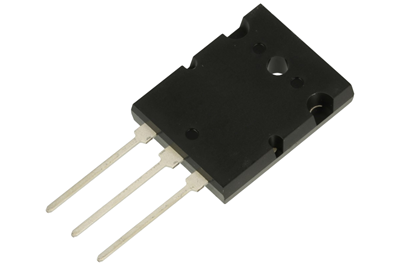
is a rugged, high-power PNP transistor originally developed by Toshiba. This article will discuss 2SA1943’s specifications, pinout and CAD models, common equivalents, electrical and thermal limits, typical application circuits, wide-ranging uses, and practical advantages and limitations.
Catalog
2SA1943 PNP Transistor Basic
The 2SA1943
2SA1943
TOSHIBA
2SA1943 TOSHIBA
In Stock: 10100 pcs
is a high-power PNP transistor originally developed by Toshiba for demanding audio applications. Known for its excellent linearity, low distortion, and strong current-handling capability, it became a preferred choice in high-fidelity amplifier output stages. Its rugged TO-3P package provides superior heat dissipation, making it reliable in high-power Class AB and Class H amplifier designs. The device is typically paired with its complementary NPN partner, the 2SC5200, to form a balanced push-pull output stage.
With a –230 V Vceo, –15 A collector current, and up to 150 W power dissipation, the 2SA1943 is well-suited for both professional and consumer audio systems. If you are interested in purchasing the 2SA1943 transistor, feel free to contact us for pricing and availability.
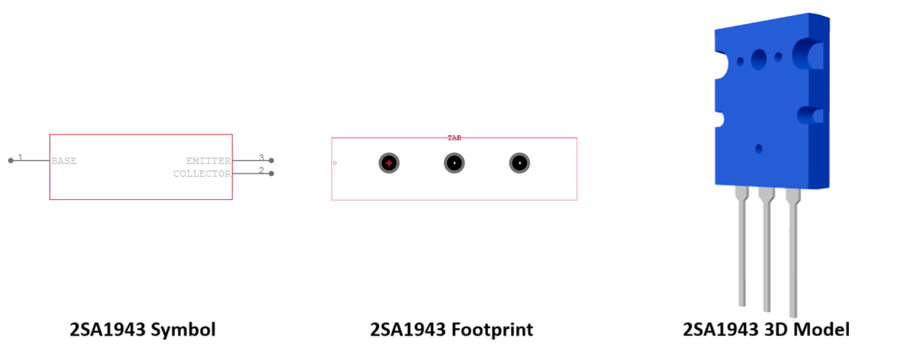
2SA1943 CAD Models
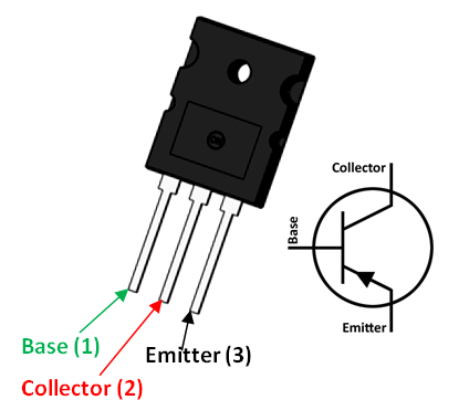
2SA1943 Pinout Configuration
|
Pin
Number |
Pin
Name |
Description |
|
1 |
Base (B) |
Controls the
transistor’s operation by receiving the input signal. |
|
2 |
Collector (C) |
Main
current-carrying terminal; connected to the load in amplifier circuits. |
|
3 |
Emitter (E) |
Current output
terminal; typically connected to the negative rail in PNP configurations. |
Alternatives & Equivalents
|
Parameter |
TTA1943
|
FJL4315 |
NJW0302G
 |
2SA2121
|
|
Polarity |
PNP |
PNP |
PNP |
PNP |
|
Vceo |
–230 V |
–230 V |
–160 V |
–200 V |
|
Ic (Max) |
–15 A |
–15 A |
–15 A |
–15 A |
|
Pd (Max) |
150 W |
150 W |
200 W |
130 W |
|
hFE Range |
55–160 |
60–140 |
50–160 |
60–200 |
|
fT |
30 MHz |
30 MHz |
30 MHz |
20 MHz |
|
Package |
TO-3P |
TO-3P |
TO-3P |
TO-3P |
|
Complement |
TTC5200
|
FJL4215 |
NJW0281G
|
2SC5949
|
2SA1943 Transistor Specifications
|
Parameter |
Value |
|
Transistor Type |
PNP |
|
Package / Case |
TO-3PL / TO-3P |
|
Mounting Type |
Through Hole |
|
Number of Pins |
3 |
|
Collector-Emitter
Breakdown Voltage (VCEO) |
–230 V |
|
Collector-Base
Voltage (VCBO) |
–230 V |
|
Emitter-Base
Voltage (VEBO) |
–5 V |
|
Collector
Current (IC max) |
–15 A |
|
Collector Cutoff
Current (ICBO) |
5 µA max |
|
Max Power
Dissipation (Pd) |
150 W |
|
Collector-Emitter
Saturation Voltage (VCE(sat)) |
–3 V @ 8 A |
|
DC Current Gain
(hFE) |
80 min @ IC = 5
A |
|
Gain Bandwidth
Product (fT) |
30 MHz |
|
Frequency Rating |
30 MHz |
|
Operating
Junction Temperature |
150°C (Tj) |
|
Element
Configuration |
Single |
|
Moisture
Sensitivity Level (MSL) |
Not Applicable |
|
Published /
Release Year |
2000 |
|
Lead Finish |
Lead-free |
|
RoHS Status |
Compliant |
|
Height |
26 mm |
|
Length |
20.5 mm |
|
Width |
5.2 mm |
|
Contact Plating |
Copper, Silver,
Tin |
2SA1943 Absolute Maximum Ratings
|
Characteristics |
Symbol |
Rating |
Unit |
|
Collector–base
voltage |
VCBO |
–230 |
V |
|
Collector–emitter
voltage |
VCEO |
–230 |
V |
|
Emitter–base
voltage |
VEBO |
–5 |
V |
|
Collector
current |
IC |
–15 |
A |
|
Base current |
IB |
–1.5 |
A |
|
Collector power
dissipation (Tc = 25°C) |
PC |
150 |
W |
|
Junction
temperature |
Tj |
150 |
°C |
|
Storage
temperature range |
Tstg |
–55 to 150 |
°C |
2SA1943 Electrical Characteristics
|
Characteristics |
Symbol |
Test
Condition |
Min |
Typ |
Max |
Unit |
|
Collector
cut-off current |
ICBO |
VCB = –230 V, IE
= 0 |
- |
- |
–5.0 |
µA |
|
Emitter cut-off
current |
IEBO |
VEB = –5 V, IC =
0 |
- |
- |
–5.0 |
µA |
|
Collector-emitter
breakdown voltage |
V(BR)CEO |
IC = –50 mA, IB
= 0 |
–230 |
- |
- |
V |
|
DC current gain |
hFE(1) |
VCE = –5 V, IC =
–1 A |
55 |
- |
160 |
- |
|
DC current gain |
hFE(2) |
VCE = –5 V, IC =
–7 A |
35 |
60 |
- |
- |
|
Collector-emitter
saturation voltage |
VCE(sat) |
IC = –8 A, IB =
–0.8 A |
- |
–1.5 |
–3.0 |
V |
|
Base-emitter
voltage |
VBE |
VCE = –5 V, IC =
–7 A |
- |
–1.0 |
–1.5 |
V |
|
Transition
frequency |
fT |
VCE = –5 V, IC =
–1 A |
- |
30 |
- |
MHz |
|
Collector output
capacitance |
Cob |
VCB = –10 V, IE
= 0, f = 1 MHz |
- |
360 |
- |
pF |
2SA1943 Transistor Application Circuit

The circuit is a class-AB audio amplifier that uses the complementary pair 2SC5200 (NPN) and 2SA1943
2SA1943
TOSHIBA
2SA1943 TOSHIBA
In Stock: 10100 pcs
(PNP) to deliver high-power audio to a speaker. The small-signal transistors (A1015, TIP41

TIP41
Central Semiconductor
THROUGH-HOLE TRANSISTOR BIPOLAR
In Stock: 37779 pcs
, TIP42

TIP42
onsemi
TRANS PNP 40V 6A TO220-3
In Stock: 5990 pcs
) handle voltage amplification and bias control, ensuring the output stage turns on smoothly with minimal distortion. The diodes in the center set the correct bias voltage so the amplifier avoids crossover distortion.
In the output stage, the 2SA1943 PNP transistors handle the negative half of the audio waveform, pulling current from the –46 V rail through the speaker when the input signal goes negative. The 2SC5200 NPN transistors handle the positive half, creating a balanced push-pull output. The 0.47 Ω resistors stabilize current sharing and improve reliability.
The power supply below shows how the amplifier generates +46 V and –46 V rails using a bridge rectifier and filter capacitors, providing the voltage needed for the 2SA1943 to drive the load with high power and clean audio.
2SA1943 Wide Applications
-High-power audio amplifier output stages
-Class-AB and Class-H audio power amplifiers
-Professional sound reinforcement systems
-Home theater and Hi-Fi stereo amplifiers
-Subwoofer and bass amplifier output stages
-Power booster modules for musical instruments
-Car audio power amplifiers
-Push-pull complementary stages with 2SC5200
-Linear power supplies requiring high-current switching
-DC motor drivers for medium-power control
-Inverter circuits and power switching applications
-UPS systems (output stage regulation)
-Industrial control equipment requiring high-voltage PNP devices
Comparison: 2SA1943 vs TTA1943
|
Parameter |
2SA1943
|
TTA1943
|
|
Polarity |
PNP |
PNP |
|
Complementary
Pair |
2SC5200 |
TTC5200
|
|
Collector-Emitter
Voltage (VCEO) |
–230 V |
–230 V |
|
Collector-Base
Voltage (VCBO) |
–230 V |
–230 V |
|
Emitter-Base
Voltage (VEBO) |
–5 V |
–5 V |
|
Collector
Current (IC max) |
–15 A |
–15 A |
|
Base Current (IB
max) |
–1.5 A |
–1.5 A |
|
Power
Dissipation (Pd) |
150 W |
150 W |
|
Junction
Temperature (Tj) |
150°C |
150°C |
|
Storage
Temperature |
–55 to 150°C |
–55 to 150°C |
|
Collector Cutoff
Current (ICBO) |
5 µA max |
5 µA max |
|
Emitter Cutoff
Current (IEBO) |
5 µA max |
5 µA max |
|
DC Current Gain
hFE (1A test) |
55 – 160 |
55 – 160 |
|
DC Current Gain
hFE (7A test) |
35 – 60 |
35 – 60 |
|
Transition
Frequency (fT) |
30 MHz typ |
30 MHz typ |
|
Collector
Saturation Voltage (VCE(sat)) |
–1.5 to –3.0 V |
–1.5 to –3.0 V |
|
Base-Emitter
Voltage (VBE) |
–1.0 to –1.5 V |
–1.0 to –1.5 V |
|
Collector Output
Capacitance (Cob) |
~360 pF |
~360 pF |
|
Package Type |
TO-3P (TO-3PL) |
TO-3P |
|
Lead Material /
Finish |
Copper /
Lead-free |
Copper /
Lead-free |
|
Manufacturer
Status |
Discontinued by
Toshiba |
Active
production |
|
Typical
Application |
Audio power
amplifiers |
Audio power
amplifiers |
|
Quality &
Consistency |
Varies (many
clones in market) |
High
consistency, stable supply |
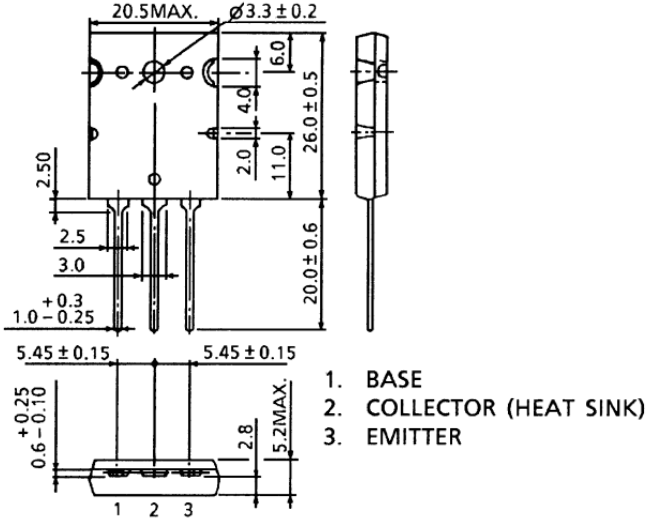
2SA1943 Transistor Mechanical Dimensions
Advantages & Limitations
|
Advantages |
Limitations |
|
High power
handling (up to 150 W) |
Requires large
heat sink for full power use |
|
High collector
current capability (15 A) |
Not suitable for
very high-frequency applications (>30 MHz) |
|
Excellent
linearity for audio use |
Performance
depends heavily on correct biasing |
|
Low distortion
in class-AB stages |
Counterfeits
common (especially 2SA1943
|
|
Widely used in
Hi-Fi and pro-audio amplifiers |
Needs dual ±
supply rails for typical amplifier designs |
|
Works perfectly
with complementary NPN device (2SC5200 / TTC5200
|
Large physical
package (TO-3P) not ideal where compact size is required |
|
Stable gain
characteristics (hFE) |
Limited voltage
rating compared to some newer power transistors |
|
Reliable and
rugged in push-pull output stages |
Thermal runaway
possible without proper emitter resistors |
Manufacturer
Toshiba is a globally recognized leader in semiconductor technology, known for producing high-reliability components for consumer electronics, industrial systems, and power applications. With decades of expertise in transistor development, Toshiba established strong capabilities in designing high-power, low-distortion devices like the 2SA1943
2SA1943
TOSHIBA
2SA1943 TOSHIBA
In Stock: 10100 pcs
, which became industry standards in audio amplification. Their manufacturing emphasizes precision, quality control, and advanced silicon processes, enabling consistent performance and long-term durability across their product lines.
Conclusion
The 2SA1943
2SA1943
TOSHIBA
2SA1943 TOSHIBA
In Stock: 10100 pcs
remains a discrete PNP power transistor for audio and medium-power applications thanks to its combination of high voltage, high current capability, and audio-grade linearity. Properly applied, the 2SA1943 (or its vetted substitutes) delivers durable, low-distortion performance in amplifiers, power modules, and other high-current, high-voltage circuits.
Datasheet PDF
2SA1943 Datasheet:
Frequently Asked Questions [FAQ]
1. What is the 2SA1943 transistor used for in audio amplifiers?
The 2SA1943 is used as the PNP output device in push-pull amplifier stages, delivering high current during the negative half of the waveform for clean, powerful audio reproduction.
2. How to tell if a 2SA1943 is fake or counterfeit?
Check for inconsistent printing, poor casing quality, incorrect weight, unusually low price, and mismatched hFE readings. Buying from reputable suppliers is essential.
3. Can 2SA1943 be used in place of other PNP power transistors?
Yes, as long as the replacement has equal or higher voltage, current, gain, and power ratings. Always verify pinout and package compatibility.
4. What makes the 2SA1943 suitable for high-power amplifiers?
Its 150 W dissipation, 15 A collector current, and strong linearity allow it to drive heavy loads with low distortion and stable output performance.
5. What is the ideal complementary pair for the 2SA1943?
The NPN 2SC5200 (or modern TTC5200) is the standard complementary partner for balanced push-pull amplifier designs.
6. What power supply voltage is recommended for circuits using the 2SA1943?
Most amplifier designs using this transistor run on dual ±35 V to ±50 V rails, depending on output power requirements.
Related Blog
-
How Many Zeros in a Million, Billion, Trillion?
![How Many Zeros in a Million, Billion, Trillion?]()
July 29th, 2024
Million represents 106, an easily graspable figure when compared to everyday items or annual salaries. Billion, equivalent to 109, starts to stretch t... -
IRLZ44N MOSFET Datasheet, Circuit, Equivalent, Pinout
![IRLZ44N MOSFET Datasheet, Circuit, Equivalent, Pinout]()
August 28th, 2024
The IRLZ44N is a widely-used N-Channel Power MOSFET. Renowned for its excellent switching capabilities, it is highly suited for numerous applications,... -
Battery Temperature Too Low, Charging Stopped. How to Fix It?
![Battery Temperature Too Low, Charging Stopped. How to Fix It?]()
October 6th, 2024
Mobile phone battery charging issues are common but can be effectively managed. Temperature plays a big role in battery efficiency, as smartphone batt... -
BC547 Transistor Comprehensive Guide
![BC547 Transistor Comprehensive Guide]()
July 4th, 2024
The BC547 transistor is commonly used in a variety of electronic applications, ranging from basic signal amplifiers to complex oscillator circuits and... -
Comprehensive Guide to SCR (Silicon Controlled Rectifier)
![Comprehensive Guide to SCR (Silicon Controlled Rectifier)]()
April 22th, 2024
Silicon Controlled Rectifiers (SCR), or thyristors, play a pivotal role in power electronics technology because of their performance and reliability. ... -
LR621, SR621SW, 364, AG1 Battery Equivalents and Replacements
![LR621, SR621SW, 364, AG1 Battery Equivalents and Replacements]()
July 15th, 2024
LR621 and SR621SW button batteries are prevalent in compact electronic devices like watches, small toys, calculators, and remote keys. Multiple manufa... -
A Complete Guide to Multiplexers and Their Role in Digital Systems
![A Complete Guide to Multiplexers and Their Role in Digital Systems]()
September 20th, 2025
Multiplexers are components in digital systems, designed to channel multiple input signals into a single output line using binary logic and control si... -
Fundamentals of Op-Amp Circuits
![Fundamentals of Op-Amp Circuits]()
December 28th, 2023
In the intricate world of electronics, a journey into its mysteries invariably leads us to a kaleidoscope of circuit components, both exquisite and co... -
Comparing NMOS and PMOS Differences and Applications
![Comparing NMOS and PMOS Differences and Applications]()
November 15th, 2024
Understanding the differences between NMOS and PMOS transistors is important in designing efficient circuits. NMOS (N-type Metal-Oxide-Semiconductor) ... -
CR2450 vs CR2032 Comparison: All You Need to Know
![CR2450 vs CR2032 Comparison: All You Need to Know]()
September 15th, 2025
Button batteries like CR2450 and CR2032 power many everyday electronics, from watches and remotes to medical and industrial devices. Though small, the...




Hot Parts
- GRM1556P1H6R9CZ01D
- 06031A270KAJ2A
- TNETD3200GJC
- C1005X6S1C334M050BC
- EPF6016ATC144-2N
- TPS40090QPWRQ1
- ADS5483IRGCT
- RK73H1ETTP3901F
- ZUS251205
- GRJ31BR73A471KWJ1L
- AP2132MP-1.5TRG1
- MF40200V3-1000U-A99
- CZRU52C3V3-HF
- 08055A390JAT2A
- LPC1768FET100Y
- ICL3238EIV
- HMJ107BB7223KAHT
- GRM1555C2A7R1DA01D
- ERA-2ARB6490X
- TMS320DM355ZCE135
- TMS320F28065PZT
- TPCR226M006R1500
- MAX207CWG
- LM211MDREP
- MX30LF2G28AB-TI
- XC2S400E-6FT256C
- MIC3975-2.5YMM
- ECA-1HM4R7B
- TRSF3243CDWR
- VE-J6Z-MY
- LNBH23LQTR
- T491C475K020ZTZL11
- HD74LV2GT34AUSE
- PM3390-BC-P
- MT8685ABAA
- M13S128324A-5BGT
- XC6213B292GR
- ISL5216KI-1
- PCIMX51EVKB
- M35055-052FP
- CXD2515Q
- ELJPC6R8KF
- ICS95090BF
- R5F211B3D53SP#U0
- TXL-04002-BIPL
- SX6222PKEG
- T7531CML
- AD7441ABSTZ-5P
- H5TQ8G63AMR-PBC
- MC12439FN

