- English
-
EnglishDeutschItaliaFrançais한국의русскийSvenskaNederlandespañolPortuguêspolski繁体中文SuomiGaeilgeSlovenskáSlovenijaČeštinaMelayuMagyarországHrvatskaDanskromânescIndonesiaΕλλάδαБългарски езикGalegolietuviųMaoriRepublika e ShqipërisëالعربيةአማርኛAzərbaycanEesti VabariikEuskeraБеларусьLëtzebuergeschAyitiAfrikaansBosnaíslenskaCambodiaမြန်မာМонголулсМакедонскиmalaɡasʲພາສາລາວKurdîსაქართველოIsiXhosaفارسیisiZuluPilipinoසිංහලTürk diliTiếng ViệtहिंदीТоҷикӣاردوภาษาไทยO'zbekKongeriketবাংলা ভাষারChicheŵaSamoa日本語SesothoCрпскиKiswahiliУкраїнаनेपालीעִבְרִיתپښتوКыргыз тилиҚазақшаCatalàCorsaLatviešuHausaગુજરાતીಕನ್ನಡkannaḍaमराठी

Schmitt Trigger Explained, Working Principle, Circuit Types, and Applications
Catalog
Introduction to Schmitt Trigger
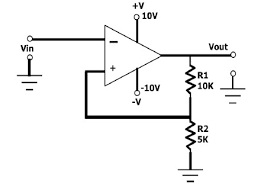
The Schmitt trigger stands out as a unique comparator circuit characterized by its dual-threshold mechanism, achieved through positive feedback. This feature, referred to as hysteresis, grants it significant advantages in signal stability and precision. Unlike conventional comparator circuits, which might produce unpredictable responses to minor input voltage fluctuations, the Schmitt trigger employs two distinct thresholds: one positive and one negative. When the input voltage exceeds the positive threshold, the circuit transitions to a high state. Conversely, falling below the negative threshold triggers a shift to a low state. Between these thresholds, the output remains stable, giving the circuit a memory-like property that enhances operational reliability.
This bistable multivibrator serves main functions in analog-to-digital signal conversion, noise filtration, and waveform shaping. By transforming unstable analog signals into clean digital outputs, the Schmitt trigger helps mitigate the disruptions caused by fluctuating voltages, particularly in noisy electrical environments. Applications for the circuit range widely, from foundational logic systems to intricate feedback loops in multivibrators, demonstrating its adaptability and indispensable role across diverse aspects of electronic design.
The Role of Positive Feedback
The Schmitt trigger owes its dependable performance to the positive feedback mechanism integrated into its design. Positive feedback magnifies the disparity between the input voltage and threshold levels, ensuring the circuit makes clear-cut switching decisions, even under challenging conditions. Instead of relying on absolute input voltage values, this dynamic reinforces the circuit's ability to resist input noise and transient fluctuations.
In environments subjected to fluctuating voltages, such as those caused by inconsistent power sources or electromagnetic interference, the Schmitt trigger remains robust in maintaining consistent outputs. The mechanism removes errors caused by short noise spikes, supporting stable and reliable operation in practical applications.
Hysteresis: Stabilizing Through Dual Thresholds
At the heart of the Schmitt trigger lies the concept of hysteresis, which ensures precise switching by requiring the input voltage to cross distinct thresholds. This dual-threshold design minimizes uncertainty and creates a clear demarcation between signal states. Hysteresis enables the circuit to prioritize steady performance over reactiveness to minor fluctuations.
A practical example can be found in industrial sensors monitoring parameters like temperature or pressure. By leveraging hysteresis, the sensor can differentiate meaningful data from transient fluctuations introduced by electrical interference, ensuring accurate digital outputs for subsequent analysis. The Schmitt trigger's design reflects a commitment to reliability and precision, which aligns with engineering needs.
Balancing Sensitivity and Stability
Designing a Schmitt trigger requires careful consideration of its thresholds to ensure proper balance between sensitivity and stability. This balance enables it to address diverse operational needs without compromising performance.
• Tight thresholds can detect small signal variations but might lead to susceptibility to noise, diminishing the circuit's ability to filter transient disruptions.
• On the other hand, overly relaxed thresholds could delay signal processing or result in inaccuracies.
In audio squelch circuits, for instance, an optimally tuned Schmitt trigger filters out low-level noise while preserving the integrity of desired audio signals. These design choices show the trade-offs involved in matching circuit behavior with specific application needs.
The Schmitt trigger combines theoretical circuit design with practical functionality by using hysteresis, positive feedback, and threshold-based switching to improve signal stability and noise rejection. This design allows circuits to operate reliably even in environments affected by voltage fluctuations and electrical interference that could otherwise disrupt performance.
Schmitt triggers are used in systems that require clean and stable signal transitions for reliable operation in analog and digital electronics. Their flexible use supports applications ranging from basic learning circuits to advanced electronic and industrial systems.
Understanding how Schmitt triggers work provides valuable insight into signal processing and shows the importance of designing circuits that maintain stability, accuracy, and reliability under unpredictable operating conditions.
Techniques in Implementing Schmitt Triggers
Tunnel Diode-Based Implementation
The implementation of Schmitt triggers using a tunnel diode is based on the component's distinct "N"-shaped volt-ampere curve, which facilitates sharp transitions in switching applications. This curve enables the circuit to change states rapidly as the input signal oscillates beyond specified voltage thresholds, leading to crisp output flips. However, this approach often falls short in terms of achieving high precision and operational efficiency, making it more appropriate for systems that prioritize simplicity over high performance.
To overcome these limitations, an alternative design leverages the basic principles of tunnel diodes while incorporating transistor-based circuits. In these configurations, transistors are paired with positive feedback loops to enable faster switching speeds and tighter control over hysteresis effects. Transistors are frequently chosen over tunnel diodes in practical applications due to their wider availability, customizable design options, and ability to handle a larger variety of scenarios.
Comparator-Based Design for Enhanced Versatility
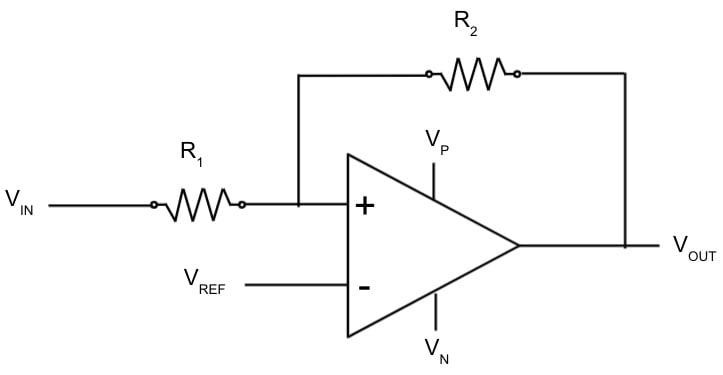
Comparator-based Schmitt triggers provide a highly adaptable and precise solution, relying on positive feedback loops to establish hysteresis. These circuits toggle between high (+Vs) and low (−Vs) output levels based on the differential behavior of the input signals. Two critical feedback resistors, R1 and R2, define the hysteresis voltage range, ensuring the output remains stable and impervious to minor input fluctuations, an ideal feature for noise reduction and consistent switching performance.
The operational mechanism includes the following:
• When the non-inverting input (+) exceeds the voltage at the inverting input (−), the comparator switches to a high output state.• If the inverting input surpasses the non-inverting input, the output transitions to low.
• Feedback resistors create a voltage divider, instituting discrete thresholds for upward and downward transitions.
• The hysteresis band is mathematically expressed as ±(R1×Vs)/R2, allowing adjustments to sensitivity or noise resistance through resistor modifications.
Further refinements enhance the circuit’s reliability:
• Zener Diodes: Strengthen immunity to power supply variations, maintaining consistent output in dynamic conditions.• Current-Limiting Resistors (e.g., R3, R4): Minimize offset errors and allow for precise fine-tuning to meet operational demands.
These additions can greatly improve performance, making the circuit more stable and suitable for complex applications.
Optimized Transistor-Based Schmitt Trigger
A widely used design involves two transistors configured in a regenerative positive feedback loop. This setup establishes hysteresis functionality through the interplay of transistors, ensuring distinct voltage thresholds for transitions between high and low states. Typically employing NPN transistors:
• One transistor (T1) remains inactive at low input levels, enabling the second transistor (T2) to conduct, resulting in a low output state.• When the input voltage exceeds a critical threshold, T1 activates, leading to T2's deactivation and flipping the output to high.
Essential modifications in this design enhance its operation:
• Resistor RE: Acts as a pull-down component to maintain low output voltages when necessary.• Feedback Networks: Adjustable resistors optimize hysteresis and switching behavior, to customize functionality based on requirements.
For applications that require flexibility, resistor tuning is used to balance logic accuracy and high-speed switching while meeting specific system requirements and operating standards. This transistor-based design accommodates analog and digital configurations, such as inverting circuits, where hysteresis helps filter noise and stabilize performance in fluctuating environments.
The discussed techniques emphasize the adaptability of Schmitt triggers in diverse contexts. Tunnel diodes, comparators, and transistors provide different design options for matching system requirements. Recent advancements in circuit simulation tools and the application of iterative feedback ensure that designs continue to evolve, meeting modern performance requirements in dynamic engineering challenges.
Schmitt Triggers Applications
Waveform Transformation
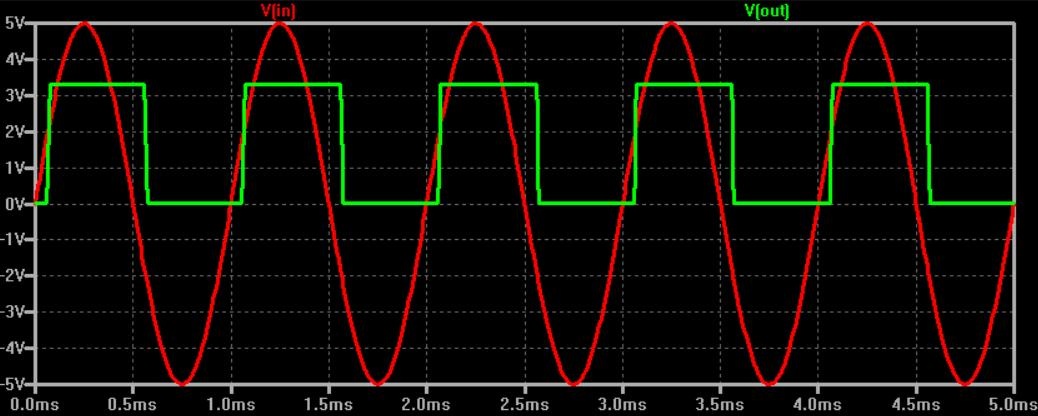
The Schmitt trigger holds a significant function in converting unpredictable or smoothly oscillating analog signals, such as sinusoidal or triangular waveforms, into distinctly defined rectangular pulses suitable for digital systems. These rectangular pulses enable binary signal processing, enhancing the usability of analog data streams in digital platforms. Analog-to-digital conversion often encounters hurdles such as threshold instability or noise-induced signal interference. The hysteresis mechanism inherent in Schmitt triggers promotes signal consistency by establishing clear upper and lower activation thresholds. This ensures precise signal differentiation, mitigating erratic switching behaviors. This function is used in sensor networks, data acquisition modules, and environmental monitoring systems to support stable and accurate digital integration.
Refining Pulse Edges
In modern digital architectures, signal integrity directly influences system reliability, especially in scenarios involving high-speed data transmission or complex communication channels. Issues like uneven rise-and-fall times or impedance mismatch-induced overshoots can compromise critical operations. Schmitt triggers demonstrate their utility by refining distorted pulses into symmetrical waveforms, thereby maintaining signal coherence. This signal refinement aids engineers in ensuring performance uniformity across diverse environmental and operational conditions. For instance, microcontroller-based communication designs benefit from the precise edge shaping offered by Schmitt trigger circuits, which contributes to seamless data synchronization and minimizes miscommunication with interfacing components.
Filtering Low-Amplitude Noise
Electronic systems frequently contend with persistent noise, which introduces subtle fluctuations that obscure meaningful data processing. The Schmitt trigger's configurability to set distinct amplitude thresholds serves as a practical filter, enabling the selective passage of signals above a specific amplitude. This feature reduces minor perturbations while safeguarding pulse signals to system operation. Applications relying on this amplitude filtering range from audio processing platforms that prioritize speech clarity over ambient interference to automation systems where distinguishing genuine input commands from extraneous signals fundamentally impacts performance. Schmitt triggers are commonly used in applications that require clear separation between useful data and background noise.
Timing and Signal Generation
When combined with capacitors and resistors in feedback loops, Schmitt triggers can generate stable rectangular signals and clock pulses. Astable, monostable, and bistable multivibrator circuits are widely used for timing and sequence control. These circuits support counters, oscillators, and timer systems used in microprocessors and digital signal processing. Schmitt trigger-based multivibrators are also configured to provide reliable timing sources for stable synchronized operation in demanding conditions.
Common Integrated Circuits with Schmitt Trigger Functionality
Integrated circuits with Schmitt trigger mechanisms serve numerous practical roles, enabling improved signal conditioning, reducing noise susceptibility, and streamlining circuit designs. These ICs are embedded with features that facilitate stable signal processing, translate erratic transitions into consistent pulses, and enhance reliability in electronic systems. Optimized performance can be achieved without extra external components, supporting simpler circuit design and stable operation. Below are commonly used ICs with Schmitt trigger features.
Prominent ICs Utilizing Schmitt Trigger Features
Several integrated circuits are designed with built-in Schmitt trigger functionalities, offering diverse applications across a range of fields. Their inherent characteristics and practical benefits are outlined here to illustrate their significance in modern electronic design:
Dual Four-input NAND Gate (74LS18)
• The 74LS18 incorporates Schmitt trigger inputs to reliably manage noisy or unstable signals.
• Its dual four-input configuration facilitates complex logical operations in compact designs.
• Applications include debounce circuits, logic control mechanisms, and stability-critical systems for digital transitions.
Hex Inverter Gates (74LS14)
• The 74LS14 comprises six independent inverter gates equipped with Schmitt trigger functionality.
• Ideal for cases requiring clean inversion of signals with slow transition rates or erratic edges.
• Common usage scenarios include analog-to-digital conversions, waveform shaping, and precise timing systems in clock signal generation.
Two-input NOR Gates (74132/74HC132)
• The 74132 and 74HC132 feature NOR gates enhanced with hysteresis for robust signal discrimination.
• Designed to mitigate fluctuating input signals and emphasize output consistency.
• Utilized in digital control applications, ensuring noise rejection and maintaining operational reliability.
Dual Monostable Multivibrators (74221/74LS221)
• These ICs integrate Schmitt trigger characteristics to reliably produce pulses even under noisy input scenarios.
• Widely employed in timing-focused tasks such as delay generation and pulse-width modulation systems.
• Contribute to circuit performance stabilization under variable operational conditions.
Versatile Timer ICs (555 Timer)
• The renowned 555 Timer can be configured as a Schmitt trigger circuit for tasks like waveform generation or signal stabilization.
• Extensively applied across projects such as oscillator circuits, clock modulation systems, and bridging analog-digital design gaps.
• Its adaptability reinforces its position as a critical component in diverse electronic designs.
Quad Two-input NAND Schmitt Triggers (CD4093)
• The CD4093 integrates four NAND gates with inherent Schmitt trigger properties for handling nonlinear signals.
• Finds utility in power-on reset systems, frequency generation tasks, and debounce applications requiring precision and stability.
• Suitable for applications demanding resilience to noise and erratic inputs.
Exploring Practical System Enhancements
The embedded Schmitt trigger functionality in these ICs promotes reliable system behavior and elevates circuit dependability.
• Observations reveal their role in signal conditioning for microcontroller inputs, where stable signals are important.
• Foundational applications include stabilizing oscillators and addressing issues related to variability in signal inputs or transitions.
• Practical insights gained through hands-on implementations demonstrate the transformative potential of Schmitt triggers in refining circuit designs and addressing noise-related challenges.
Conclusion
Schmitt triggers are valuable because they improve signal stability, noise immunity, and switching reliability in both analog and digital circuits. Their hysteresis action allows circuits to respond only to meaningful input changes, making them useful for sensors, oscillators, debounce circuits, clock generation, and noisy signal conversion. With different implementation options and widely available Schmitt trigger ICs, they remain a practical solution for creating clean, reliable, and well-defined digital signals from unstable inputs.
Frequently Asked Questions [FAQ]
1. How does hysteresis improve the stability of a Schmitt trigger circuit?
Hysteresis improves stability by using two separate switching thresjholds instead of one. This prevents the output from rapidly changing when small voltage fluctuations or electrical noise are present. As a result, the Schmitt trigger produces clean and stable switching behavior, especially in noisy environments.
2. Why is positive feedback important in Schmitt trigger operation?
Positive feedback strengthens the difference between the input signal and the switching thresholds. This allows the circuit to make clear transitions between high and low states without hesitation. It also improves noise immunity and helps maintain reliable output signals.
3. How does a Schmitt trigger convert noisy analog signals into clean digital signals?
A Schmitt trigger filters unwanted fluctuations by allowing switching only when the input crosses defined voltage thresholds. Small variations between these thresholds are ignored, which removes unstable behavior and converts noisy analog inputs into stable digital pulses.
4. Why are Schmitt triggers commonly used in waveform shaping circuits?
Schmitt triggers are used in waveform shaping because they can transform weak or distorted waveforms into clean square waves. This improves signal quality and ensures accurate timing in digital systems, communication circuits, and clock generation applications.
5. How does threshold adjustment affect Schmitt trigger performance?
Threshold adjustment changes how sensitive the circuit is to input signals. Narrow thresholds make the circuit respond to smaller changes, while wider thresholds improve resistance to noise. Proper adjustment helps balance responsiveness and signal stability.
6. Why are Schmitt triggers valuable in sensor and automation systems?
Sensors often produce unstable signals because of electrical interference or environmental conditions. A Schmitt trigger removes these unwanted fluctuations and provides stable outputs, allowing automation systems and controllers to respond more accurately and reliably.
7. How do comparator-based Schmitt triggers improve switching reliability?
Comparator-based Schmitt triggers use feedback resistors to create controlled hysteresis levels. This ensures stable switching between high and low states even when the input signal changes slowly or contains noise, making the circuit more reliable in practical applications.
8. What advantages do transistor-based Schmitt triggers provide?
Transistor-based Schmitt triggers provide fast switching speed, adjustable hysteresis, and strong noise filtering capability. Their design also allows engineers to customize switching behavior for different analog and digital circuit applications.
9. Why are Schmitt triggers important in timing and pulse generation circuits?
Schmitt triggers help generate stable clock pulses and timing signals by producing clean transitions between output states. This makes them useful in oscillators, counters, and multivibrator circuits where accurate timing is required for synchronized operation.
10. How do ICs with built-in Schmitt trigger functionality improve circuit design?
Integrated circuits with built-in Schmitt triggers simplify circuit design by reducing the need for extra noise-filtering components. They improve signal stability, enhance switching reliability, and help maintain clean digital signals in systems affected by slow or noisy inputs.
Related Blog
-
How Many Zeros in a Million, Billion, Trillion?
![How Many Zeros in a Million, Billion, Trillion?]()
July 29th, 2024
Million represents 106, an easily graspable figure when compared to everyday items or annual salaries. Billion, equivalent to 109, starts to stretch t... -
IRLZ44N MOSFET Datasheet, Circuit, Equivalent, Pinout
![IRLZ44N MOSFET Datasheet, Circuit, Equivalent, Pinout]()
August 28th, 2024
The IRLZ44N is a widely-used N-Channel Power MOSFET. Renowned for its excellent switching capabilities, it is highly suited for numerous applications,... -
Battery Temperature Too Low, Charging Stopped. How to Fix It?
![Battery Temperature Too Low, Charging Stopped. How to Fix It?]()
October 6th, 2024
Mobile phone battery charging issues are common but can be effectively managed. Temperature plays a big role in battery efficiency, as smartphone batt... -
BC547 Transistor Comprehensive Guide
![BC547 Transistor Comprehensive Guide]()
July 4th, 2024
The BC547 transistor is commonly used in a variety of electronic applications, ranging from basic signal amplifiers to complex oscillator circuits and... -
Comprehensive Guide to SCR (Silicon Controlled Rectifier)
![Comprehensive Guide to SCR (Silicon Controlled Rectifier)]()
April 22th, 2024
Silicon Controlled Rectifiers (SCR), or thyristors, play a pivotal role in power electronics technology because of their performance and reliability. ... -
LR621, SR621SW, 364, AG1 Battery Equivalents and Replacements
![LR621, SR621SW, 364, AG1 Battery Equivalents and Replacements]()
July 15th, 2024
LR621 and SR621SW button batteries are prevalent in compact electronic devices like watches, small toys, calculators, and remote keys. Multiple manufa... -
Fundamentals of Op-Amp Circuits
![Fundamentals of Op-Amp Circuits]()
December 28th, 2023
In the intricate world of electronics, a journey into its mysteries invariably leads us to a kaleidoscope of circuit components, both exquisite and co... -
Comparing NMOS and PMOS Differences and Applications
![Comparing NMOS and PMOS Differences and Applications]()
November 15th, 2024
Understanding the differences between NMOS and PMOS transistors is important in designing efficient circuits. NMOS (N-type Metal-Oxide-Semiconductor) ... -
A Complete Guide to Multiplexers and Their Role in Digital Systems
![A Complete Guide to Multiplexers and Their Role in Digital Systems]()
September 20th, 2025
Multiplexers are components in digital systems, designed to channel multiple input signals into a single output line using binary logic and control si... -
What Do STD, AGM, and Gel Mean On a Battery Charger
![What Do STD, AGM, and Gel Mean On a Battery Charger]()
July 10th, 2024
Traditional lead-acid battery chargers are known for their simplicity and reliability. They have been serving their purpose effectively for years, lar...



Hot Parts
- TPS7A4533DCQT
- MAX14654EWC+T
- GCM2195G1H822JA16D
- CGJ5L2C0G1H683J160AA
- TAJC106M035Y
- PMB6823-DECT
- DAC8571IDGKRG4
- CQ0603ARNPOYBNR80
- SN761681DBT
- BA5972AFP-E2
- UCC28514DWR
- NSIC2030BT3G
- MC7905CD2TG
- RT0402BRE072K2L
- ICS2495M
- 74HC138AP
- LM2907MX/NOPB
- LMK042B7331KC-W
- C5750X7R2J224M230KA
- BQ2060SS
- HCTL-2001-A00
- MB90097PFV-G-126-BND-ER
- PIC16C54CT-04/SO
- SC667298C
- SE555JGB
- TPS544B20RVFR
- CM200TU-12F
- PL2303RA
- PTZTE253.9B
- CC2590RGVR
- BR6265BF-N10SLE2
- TC74HCT04AFN
- 1812CA101JAT2A
- AS150-59LF
- TR1003-3E
- T491B685M016AT7280
- T491C336K016AT2478
- T491A106M010ATAUTO7280
- MAX127AEAI
- MT5381AR
- ZLNB2003
- ZXLD1370QESTTC
- CS5360KS
- IRF4905SPBF-ND
- ADS7138QRTERQ1
- R5F2136CGKFP
- UPD61167F1-KA5
- CAT 700-TBR24
- DS1021-15
- MDR-40-24 40W