- English
-
EnglishDeutschItaliaFrançais한국의русскийSvenskaNederlandespañolPortuguêspolski繁体中文SuomiGaeilgeSlovenskáSlovenijaČeštinaMelayuMagyarországHrvatskaDanskromânescIndonesiaΕλλάδαБългарски езикGalegolietuviųMaoriRepublika e ShqipërisëالعربيةአማርኛAzərbaycanEesti VabariikEuskeraБеларусьLëtzebuergeschAyitiAfrikaansBosnaíslenskaCambodiaမြန်မာМонголулсМакедонскиmalaɡasʲພາສາລາວKurdîსაქართველოIsiXhosaفارسیisiZuluPilipinoසිංහලTürk diliTiếng ViệtहिंदीТоҷикӣاردوภาษาไทยO'zbekKongeriketবাংলা ভাষারChicheŵaSamoa日本語SesothoCрпскиKiswahiliУкраїнаनेपालीעִבְרִיתپښتوКыргыз тилиҚазақшаCatalàCorsaLatviešuHausaગુજરાતીಕನ್ನಡkannaḍaमराठी

Ohmic Resistors Explained: Working, Uses, and Selection Guide
Catalog

What Is an Ohmic Resistor?
An ohmic resistor is an electrical component with a constant resistance value, where current changes in direct proportion to the applied voltage, following Ohm’s Law. This behavior remains stable under controlled conditions, especially at constant temperature, which keeps resistance unaffected by external changes. A linear relationship between voltage and current reflects predictable and consistent performance, supporting stable circuit operation.
Materials such as copper, aluminum, and silver naturally exhibit ohmic behavior due to low resistivity and stable structure. These resistors help regulate electrical flow in a simple and reliable way, making them widely used in both analog and digital circuits across different applications.
Ohmic resistors support stable operation in domestic electrical systems by reducing sudden voltage changes and maintaining consistent current flow. Signal processing circuits rely on their steady resistance to preserve accuracy during data transmission. In research and testing environments, they assist in calibration and circuit evaluation by providing dependable reference behavior. Their adaptability supports applications in telecommunications, energy systems, and other modern technologies.
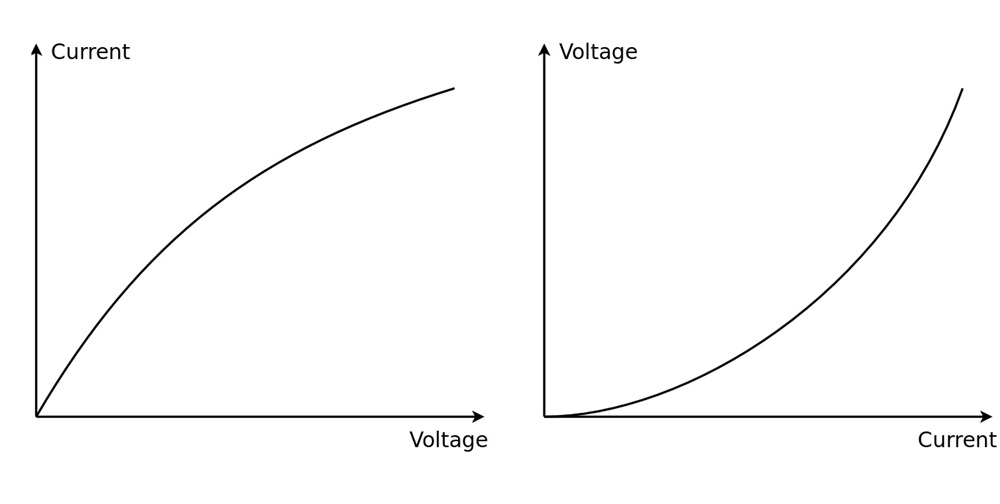
The current-voltage (I-V) graph of an ohmic resistor forms a straight line passing through the origin, showing a direct proportional relationship. The slope of this line represents the inverse of resistance, confirming consistent electrical behavior. Equal changes in voltage produce equal changes in current under stable conditions.
I-V characteristics are commonly used in educational and technical settings to identify stable components. Linear graphs indicate proper resistor behavior, while irregular patterns suggest faults or material inconsistencies. Overheating can disrupt linearity, leading to performance checks and adjustments. In system monitoring, these graphs help detect early signs of instability and support reliable operation.
Ohmic resistors improve circuit efficiency by maintaining stable voltage levels and reducing unwanted noise. Linear behavior simplifies circuit design and supports consistent interaction between components. Applications such as power distribution, sensor systems, and low-frequency circuits benefit from uniform resistance. Predictable performance also makes circuit analysis and inspection more straightforward, supporting reliable and long-term operation.
Ohmic vs. Non-Ohmic Resistors Differences
Behavioral Contrasts Between Ohmic and Non-Ohmic Resistors
The distinction between ohmic and non-ohmic resistors lies in their adherence to Ohm’s Law:
• Ohmic Resistors: These components exhibit a constant resistance that results in a linear current-voltage (I-V) relationship. This predictability provides with the confidence to calculate current flows precisely, streamlining circuit design and promoting reliability.• Non-Ohmic Resistors: Deviating from a fixed resistance, these resistors experience variability influenced by factors such as voltage, temperature, or current changes. Their non-linear I-V behavior introduces complexity in mathematical modeling yet unlocks advanced possibilities for adaptive functionality in dynamic environments.
Implications emphasize the contrasting roles of these two types of resistors:
• Stable Environments: Ohmic resistors are suited for applications requiring consistent electrical behavior, common in foundational circuits or educational settings where predictable outcomes aid learning and prototyping.• Adaptive Systems: Non-ohmic devices are instrumental in circuits accommodating fluctuating conditions or engaging with external stimuli. Thermistors stand out in temperature modulation applications, while light-dependent resistors (LDRs) excel in detecting variations in ambient light.
Choosing a resistor type often revolves around the balance between simplicity and adaptability, which becomes important in advanced designs tailored for fluctuating conditions.
Circuit-Level Applications

The operational roles of resistors within circuits diverge markedly:
Ohmic Resistors:
• Carbon film resistors provide cost-effective solutions for low-power applications.• Metal film resistors, appreciated for their precision, serve well in high-frequency and low-noise environments.
• Wirewound resistors, known for their resilience, are important in applications demanding accurate high-power dissipation.
These resistors support elemental tasks, such as limiting current flow, dividing voltage, and conditioning electrical signals. Their straightforward nature makes them highly valued in prototyping, teaching, and rapid iterative design development.
Non-Ohmic Resistors:
• Diodes: Drive the rectification process, selectively allowing current flow and transforming AC into DC.• Thermistors: Monitor and respond to temperature fluctuations, ensuring precise control in applications like HVAC systems and safety equipment.
• Light-Dependent Resistors (LDRs): Translate ambient light intensity into electrical responses, enabling technologies like automatic lighting controls or exposure meters in photography.
While these components fulfill distinct operational needs, combining their strengths often yields optimal results, especially in sophisticated circuits where predictability meets adaptability to thrive under dynamic conditions.
Mechanistic Foundations of Non-Ohmic Behavior
The non-linear behavior of non-ohmic resistors is rooted in the interplay between material properties and external electrical stress.
• Thermal Influences: In incandescent bulbs, the rising temperature causes atomic vibrations to intensify, raising resistance and disrupting linear current-voltage behavior. This exemplifies how temperature profoundly impacts electrical conduction.• Semiconductor Dynamics: Doped semiconductors, such as those in diodes and transistors, exhibit non-linear phenomena due to changes in the flow of charge carriers within their structures. Shifts in applied voltage yield outcomes like threshold voltage activation or saturation, mechanisms essential to power regulation and signal amplification in increasingly complex electronic systems.
Designing for non-ohmic variability calls for specialized engineering practices:
• Safety margins are added in designs to handle changes in resistance.• Dynamic analysis tools help predict operational behavior under stress.
• Collaborations between electrical engineering and material science facilitate the development of innovative solutions tailored to practical challenges.
Such efforts underline the dynamic relationship between system design and material properties, showcasing the intricate balance required for effective device operation.
Strategic Decisions in Resistor Integration
The decision to utilize ohmic versus non-ohmic resistors is influenced by the needs and goals of the circuit.
• Straightforward Requirements: Those who prioritize simplicity or are navigating fundamental system designs often find ohmic resistors highly practical. Their consistent behavior aligns with applications seeking stable and predictable performance.• Dynamic and Smart Systems: Resistors with non-linear characteristics shine in applications engaging with their surroundings, such as energy-efficient technology or automated systems. Diodes prevent reverse current in solar panels; varistors protect against unexpected voltage transients; thermistors adjust resource flow in heating systems to enhance reliability and safety.
Emerging technologies emphasize the cooperative roles of both resistor types. For advanced systems such as IoT devices, renewable energy installations, and smart grids, the seamless integration of ohmic stability with non-ohmic adaptability ensures the overall system is not only efficient but responsive to operational demands.
How Does Ohm’s Law Apply to Ohmic Resistors?
Ohm’s Law, expressed mathematically as ( V = I times R ), encapsulates the proportional relationship among voltage ( V ), current ( I ), and resistance ( R ) in an ohmic resistor. As a core concept in electrical engineering, it provides a reliable framework for predicting how these parameters interact, enabling professionals to fine-tune circuits under varying conditions. The ability to translate this linear relationship into practices emphasizes its multifaceted value across countless applications.
This principle isn’t just theoretical, it’s deeply interwoven with routine engineering tasks. For example, in basic resistive circuit measurements, Ohm’s Law is used to confirm voltage drops and gauge current levels, ensuring circuits adhere to original design intents. Such verification processes are instrumental in avoiding unexpected operational setbacks. In environments requiring on-the-spot adjustments, such as prototype testing or troubleshooting electrical systems, the law’s straightforward calculations alleviate complexities, enhancing efficiency during interventions.
Ohm’s Law are used in diverse engineering practices, often serving as a foundation for component selection and circuit integrity. For instance:
• Current-limiting resistors for LEDs: These resistors prevent excessive current from damaging LEDs, calculated using ( R = V/I ). This deliberate selection prolongs the functionality of sensitive components while enhancing reliability. Professionals working with intricate electronics often approach this task with a balance of precision and foresight.
• Voltage dividers for predictable outputs: Configuring resistors in a series allows designers to generate steady output voltages with minimal fluctuation. This technique is advantageous in applications such as powering sensors or analog devices. Ensuring control over voltage variations reflects both technical aptitude and an intuitive grasp of how Ohm’s Law governs these setups.
By understanding the link between theoretical principles and practical outcomes, it can fine-tune resistor configurations to meet performance requirements, ensuring optimal functionality for devices used to modern electronic systems.
While Ohm's Law provides clarity for ohmic resistors, components where resistance remains constant, it is ineffective for describing the behavior of non-ohmic devices, such as diodes, transistors, or varistors. These elements exhibit a non-linear relationship between voltage and current, necessitating alternative analytical methods. Dynamic resistance models, written as (R = dV/dI), are used to capture small changes in component behavior.
• Design considerations for non-ohmic elements: In domains such as power electronics or semiconductor systems, professionals confront the unpredictable nature of non-ohmic behavior. Meeting these challenges frequently involves iterative calibrations, computational simulations, and experimental validations. Mastering this balance between analytical rigor and adaptability underpins the development of high-performance circuitry.
• Importance of flexible approaches: Working through these complexities builds a flexible approach. This supports adapting techniques to different electrical situations. Grasping the distinction between ohmic and non-ohmic elements further enhances their capability to navigate intricate system designs with precision.
The principles of Ohm’s Law transcend traditional applications, finding utility in progressive and sustainability-driven engineering endeavors. In these scenarios, its insights are instrumental for optimizing power consumption and refining circuit-specific configurations.
Some notable applications include:
• Energy-efficient designs: Achieving reduced energy loss while maintaining desired operational performance requires judicious examination of voltage and current dynamics in resistive networks. Resistors are configured to support low-power designs and reduce energy use.
• Diagnostics and fault analysis: Whether identifying damaged resistors or isolating irregular current pathways, Ohm’s Law serves as a quick and reliable reference point for system troubleshooting. Understanding how varying parameters correlate allows for expeditious fault detection, conserving both manpower and resources during maintenance or repair efforts.
Applications of Ohmic Resistors

Electronic Circuitry
Ohmic resistors occupy a central position in facilitating reliable electronic circuits, ensuring precise control over electrical dynamics. They regulate current flow and stabilize voltage levels, fostering durability and consistent performance for sensitive components, such as light-emitting diodes (LEDs), transistors, and integrated circuits. For example, through their use as current-limiting resistors, electrical surges and potential damage to these components are effectively mitigated, a preventive measure critical to operational longevity. Their consistent electrical characteristics make them a favored option across diverse circuit designs demanding predictability and efficiency.
• Voltage dividers benefit from their precision, enabling accurate output voltage adjustments ideal for circuit subcomponents. Use cases span the fine-tuning of sensor output sensitivity and optimizing audio signal frequencies.
• RC circuits leverage the controlled charge-discharge cycles facilitated by ohmic resistors for applications such as timing processes, waveform modifications, and electromagnetic filtering. These capabilities translate directly into daily-use technologies, including oscillators, signal processors, and basic electronic timers.
Across Industrial Domains
Industrial ecosystems have embraced the value of ohmic resistors as foundational hardware, with their applications spanning audio system design, power electronics, automation control, and renewable energy adaptations.
• In audio technology, ohmic resistors manage signal gain and stabilize sound strength, synergizing performance to maintain tonal fidelity and reduce distortions. Whether applied in high-precision studio setups or everyday consumer products like headphones, their contribution enriches auditory experiences for across different equipment tiers.• Power electronics leverage ohmic resistors as bleeder resistors to dissipate residual charges from capacitors during power shutoff, enhancing safety protocols while catering to engineering compliance and maintenance convenience.
• Digital systems integrate pull-up and pull-down resistors to define logic states, ensuring robust initialization and stable interactions with microcontrollers and sensor clusters.
• Ohmic resistors are used in automotive and HVAC systems to control motor current and reduce voltage fluctuations in power inverters. These roles support modern electromechanical design.
These varied applications underline the adaptability and practicality of ohmic resistors in shaping highly efficient and specialized machinery for industrial and consumer use.
The widespread integration of ohmic resistors stems from critical advantages that cater to reliability, affordability, and technical accessibility. Their linear resistance ensures consistency across different voltage ranges, a cornerstone feature for circuits requiring precise electrical behavior. Additionally, entry-level design and advanced projects benefit equally from their straightforward implementation, extending their relevance from educational settings to professional innovations.
However, challenges do arise within their operational scope:
• Fixed resistance limits circuit flexibility. Variable resistors or potentiometers are used when adjustable control is needed.
• Heat dissipation issues emerge under high-current conditions, requiring extra measures such as heatsinks, forced cooling mechanisms, or higher-power-rated resistor selections to maintain functionality without degradation.
Design strategies help reduce these limits. Trade-offs between cost and performance guide the choice of components.
Ohmic resistors suit stable sections, while adjustable parts are used in changing conditions. This approach supports efficiency and meets cost and performance targets.
Case Studies and Examples
A straightforward experiment provides a pragmatic approach to verifying ohmic behavior. By employing a variable DC power supply, repeated measurements of current and voltage are collected as they pass through a resistor. The data is subsequently plotted on an I-V graph, where the observation of a linear graph intersecting the origin confirms adherence to Ohm's law. This outcome signifies that the resistance remains constant despite changes in the electrical conditions. In contrast, deviations from linearity hint at non-ohmic behavior, wherein the resistance varies depending on the applied voltage or current.
Within engineering workflows, this seemingly simple test holds significant value for ensuring the alignment of a resistor with its designated specifications.
For instance:
• Circuit prototypes often incorporate such tests to verify stable operations under various conditions.
• The process aids in identifying potential manufacturing anomalies or inconsistencies in material quality that may compromise performance.
This method is based on basic principles and supports reliable system design. It helps confirm performance for manufacturing and reduces risk during design development.
The technique of validating ohmic behavior transcends its perceived simplicity. It serves as a gateway to understanding key aspects of circuit performance and aids in laying down a trustworthy foundation for complex systems. Even the sophisticated electronic constructs that govern modern technology trace their origins back to rigorously-tested components. Such tests exemplify the axiom that mastery over fundamentals often translates to precision at scale.
The ability to analyze I-V graphs is integral for investigating both ohmic and non-ohmic resistor behaviors. For ohmic resistors, observing a linear trend in the I-V relationship not only verifies predictable performance but also simplifies the process of precise circuit design. This reliability tailor components precisely within predefined operational ranges, offering stability in applications that demand meticulous control.
In contrast, non-ohmic resistors such as diodes, thermistors, and light-dependent resistors reveal nonlinear I-V curves.
These curves encapsulate key data regarding variable resistance under different external influences:
• Thermistors showcase their responsiveness to temperature changes.
• Light-dependent resistors correlate alterations in their resistance with changes in light intensity.
Such resistance variability transforms these components into indispensable tools for specialized applications, including industrial temperature monitoring systems and adaptive light-detection modules in smart-device ecosystems.
I-V plots are used not only to show resistor behavior but also to support prediction in dynamic system design. Expertise in interpreting these graphs can guide decisions around selecting components that meet functional requirements while adhering to operational safety measures.
In professional environments:
• A graph’s slope often instantly unveils critical material properties or highlights a resistor’s capacity to handle elevated current levels.
• The inclusion of modern digital tools and simulation platforms has amplified the potential to analyze, manipulate, and predict outcomes based on I-V data.
By offering clarity, precision, and deeper layers of understanding, this visualization method propels the development of increasingly sophisticated technologies, enriching projects ranging from circuit optimization to advanced material research.
Technical Considerations
Analyze Temperature Effects on Resistance
The interaction between temperature and electrical resistance are used in shaping the behavior of electrical systems. For resistors with positive temperature coefficients, resistance increases with rising temperature due to enhanced electron-lattice collisions, restricting current flow. Although this behavior is negligible under typical operational conditions, its influence becomes pronounced in precision instrumentation, sensor arrays, and high-power circuits, where minor fluctuations can amplify into inefficiencies or inaccuracies.
To address these thermal challenges, often employ design strategies such as temperature compensation techniques or the integration of heat sinks. Resistance temperature detectors (RTDs) serve as an innovative exploitation of this phenomenon; their predictable resistance variations enable precise temperature monitoring. These examples emphasize not just the challenges posed by thermal effects but also the creative possibilities they afford, making thermal dynamics an integral consideration in electronic design.
Examine the Influences of Material Composition
The material properties of resistors significantly dictate their functional characteristics and adaptability to various applications.
• Carbon composition resistors are preferred for situations demanding rapid energy dissipation, owing to their superior pulse-handling capabilities. Despite their strengths, they offer lower precision and stability compared to alternatives.• Metal film resistors excel in applications requiring minimal noise, tighter tolerances, and exceptional temperature stability, making them particularly suitable for signal processing circuits and medical-grade devices.
• Wirewound resistors are indispensable in high-power environments, withstanding extreme thermal and electrical stresses without substantial performance degradation. Their construction involves resistive wires coiled around insulating cores, ensuring durability under demanding conditions.
By evaluating aspects like cost, durability, noise characteristics, and temperature coefficients, designers can tailor the selection of resistive materials to align with specific circuit requirements, thereby securing reliable system operation.
Ohmic resistors, characterized by a linear voltage-current relationship in accordance with Ohm’s law, are fundamental building blocks in electrical circuits. Their identification involves decoding the color bands and numerical specifications marked on the component's surface, and cross-referencing these against technical datasheets for verification. For greater precision, testing their I-V characteristics using tools like multimeters or bench power supplies confirms their ohmic properties under controlled conditions.
This identification process transcends mere recognition, feeding into critical decisions during circuit design. Whether integrated into regulated power supplies, amplifiers, or sensor systems, the selection of these components involves not just passive verification but active performance assessment under scenarios. Such rigorous evaluations safeguard against potential design flaws, ensuring operational stability and prolonging system reliability.
Practical Experience
Typical Design Challenges
Design challenges frequently emerge from neglecting foundational principles or insufficient awareness of how environmental variables affect performance. A common error is surpassing resistor power ratings, which can lead to overheating and malfunction. Similarly, assuming uniform ohmic behavior across all resistors is a pitfall that often arises due to theoretical expectations lacking validation through application. Designs are tailored to specific conditions instead of relying on general assumptions.
• High-power circuits require selecting resistors with ample margins for power ratings and thermal tolerance to ensure sustained performance.• The shift in resistance due to temperature variations is a critical factor; metal-oxide resistors, for example, are especially susceptible given their material temperature coefficient. Resistors rated for improved thermal stability or employing thermistors as corrective measures can mitigate associated risks.
• Thermal simulations are included early in the design phase to improve prediction of heat dissipation and overall thermal behavior.
Managing parasitic inductance becomes paramount in circuits intended for high-frequency applications. Spiral-wound resistors, widely used owing to their practicality, can unintentionally introduce inductive properties that impair circuit stability at higher frequencies.
• Opting for non-inductive resistor designs addresses this issue effectively.
• Conducting prototype tests under conditions mimicking practical use helps detect any instability before implementation.
Evolving Market Directions
Resistors remain a foundational component across electronic systems, with the global market forecasts suggesting growth to $12.84 billion by 2030. This reflects the expanding roles resistors play in increasingly intricate electronic environments. Technical skills must expand to meet changing market demands, with greater focus on precision and handling complex applications.
• IoT devices, cutting-edge sensors, and next-generation networks (e.g., 5G) demand consistent electrical performance and elevated reliability.• Wire-wound resistors have gained traction in critical sectors such as energy and industrial automation that require high durability and temperature endurance.
• SMD resistors cater to the miniaturization demands of modern consumer electronics by offering space-saving attributes alongside heightened versatility.
• Historical reliance on carbon composite resistors for noise reduction has dwindled due to the emergence of newer materials delivering enhanced thermal properties and improved environmental profiles.
• Hands-on experience urge ongoing exploration of resistor advancements, ensuring designs remain aligned with contemporary technological capabilities rather than outdated methodologies.
Selecting the Most Suitable Ohmic Resistor
Factors Influencing Resistor Selection
Selecting an appropriate ohmic resistor demands careful consideration to align with circuit requirements and ensure dependable performance over time.
Particular attention can be paid to the following aspects:
• Resistance Value and Power Rating
These attributes determine the resistor's capability to endure the applied voltage and dissipate generated heat. Accurately matching the resistance value with the circuit's design helps optimize energy use and minimize power losses. For example, experience reveals that selecting a resistor with an inadequate power rating can lead to overheating or even failure, compromising safety and function.
• Temperature Stability and Noise Characteristics
Resistors exhibit varying degrees of resistance stability when subjected to temperature fluctuations. Applications requiring precision often favor materials like metal film due to their superior stability. Similarly, low-noise resistors are significant in systems such as audio and signal processing, where even slight interference can degrade performance. Careful selection ensures consistent operation under demanding conditions.
• Material Composition, Tolerance, and Frequency Response
The composition of the resistor (e.g., carbon, metal film, wire-wound) influences factors such as longevity, thermal properties, and accuracy. The required tolerance level is especially critical in high-precision applications. Frequency response is another important consideration for components used in high-frequency scenarios. Practical evaluations, including trial implementations, can provide insights into the resistor's behavior under variable operational conditions.
• Analysis of Datasheets and Specifications
Manufacturer-provided datasheets offer detailed technical attributes that correlate component properties with circuit requirements. Features such as thermal derating curves illustrate performance variations under different environments, assisting in well-informed decision-making.
Long-Term Benefits of Appropriate Resistor Selection
Choosing the right resistor not only promotes consistent circuit operation but also contributes to system reliability and maintenance cost reduction. A carefully selected resistor mitigates overheating risks, supports stability in operation, and minimizes problems like electromagnetic interference. Careful design work helps reduce the need for troubleshooting and component replacement later. Emphasizing both durability and precision in the selection process enhances the dependability of critical applications, securing long-term operational success.
Conclusion
Ohmic resistors remain important in electronics because of their stable resistance, linear current-voltage behavior, and wide practical use across many types of circuits. A clear understanding of how they differ from non-ohmic components, how Ohm’s Law applies to them, and how factors such as temperature, material, and power rating affect performance supports better design decisions. Proper selection and correct use of ohmic resistors improve circuit stability, efficiency, safety, and long-term reliability.
Frequently Asked Questions [FAQ]
1. Do perfect ohmic resistors exist?
Perfect ohmic resistors do not exist in real conditions. All resistors are affected by factors like temperature and material limits. These factors cause small changes in resistance. However, most resistors behave very close to ideal under normal conditions, which makes them reliable for practical use.
2. What happens if power ratings are exceeded?
Exceeding the power rating causes the resistor to overheat. This can damage the component, change its resistance, or cause it to fail. In severe cases, it may burn or damage nearby parts. Using a higher-rated resistor helps prevent these problems.
3. Are wirewound resistors ohmic?
Wirewound resistors act like ohmic resistors under DC conditions. Their resistance stays stable as voltage changes. Under AC, especially at high frequency, they show inductive effects due to their coil structure. This can affect performance in some circuits.
4. Can non-ohmic resistors replace ohmic resistors?
Non-ohmic resistors are not suitable where stable resistance is required. Their resistance changes with voltage or temperature. They are designed for specific uses, such as sensing or protection. Using them in place of ohmic resistors can cause unstable circuit behavior.
Related Blog
-
How Many Zeros in a Million, Billion, Trillion?
![How Many Zeros in a Million, Billion, Trillion?]()
July 29th, 2024
Million represents 106, an easily graspable figure when compared to everyday items or annual salaries. Billion, equivalent to 109, starts to stretch t... -
IRLZ44N MOSFET Datasheet, Circuit, Equivalent, Pinout
![IRLZ44N MOSFET Datasheet, Circuit, Equivalent, Pinout]()
August 28th, 2024
The IRLZ44N is a widely-used N-Channel Power MOSFET. Renowned for its excellent switching capabilities, it is highly suited for numerous applications,... -
Battery Temperature Too Low, Charging Stopped. How to Fix It?
![Battery Temperature Too Low, Charging Stopped. How to Fix It?]()
October 6th, 2024
Mobile phone battery charging issues are common but can be effectively managed. Temperature plays a big role in battery efficiency, as smartphone batt... -
BC547 Transistor Comprehensive Guide
![BC547 Transistor Comprehensive Guide]()
July 4th, 2024
The BC547 transistor is commonly used in a variety of electronic applications, ranging from basic signal amplifiers to complex oscillator circuits and... -
Comprehensive Guide to SCR (Silicon Controlled Rectifier)
![Comprehensive Guide to SCR (Silicon Controlled Rectifier)]()
April 22th, 2024
Silicon Controlled Rectifiers (SCR), or thyristors, play a pivotal role in power electronics technology because of their performance and reliability. ... -
LR621, SR621SW, 364, AG1 Battery Equivalents and Replacements
![LR621, SR621SW, 364, AG1 Battery Equivalents and Replacements]()
July 15th, 2024
LR621 and SR621SW button batteries are prevalent in compact electronic devices like watches, small toys, calculators, and remote keys. Multiple manufa... -
A Complete Guide to Multiplexers and Their Role in Digital Systems
![A Complete Guide to Multiplexers and Their Role in Digital Systems]()
September 20th, 2025
Multiplexers are components in digital systems, designed to channel multiple input signals into a single output line using binary logic and control si... -
Fundamentals of Op-Amp Circuits
![Fundamentals of Op-Amp Circuits]()
December 28th, 2023
In the intricate world of electronics, a journey into its mysteries invariably leads us to a kaleidoscope of circuit components, both exquisite and co... -
Comparing NMOS and PMOS Differences and Applications
![Comparing NMOS and PMOS Differences and Applications]()
November 15th, 2024
Understanding the differences between NMOS and PMOS transistors is important in designing efficient circuits. NMOS (N-type Metal-Oxide-Semiconductor) ... -
CR2450 vs CR2032 Comparison: All You Need to Know
![CR2450 vs CR2032 Comparison: All You Need to Know]()
September 15th, 2025
Button batteries like CR2450 and CR2032 power many everyday electronics, from watches and remotes to medical and industrial devices. Though small, the...




Hot Parts
- AD8129ARZ-REEL7
- ISC-060102
- SO3G2010-40QFN-01
- MC1723CP
- GRM188R72A103KA01D
- STTH1212D
- CL21C562JBC1PNC
- UDA3000HL/N1
- Z8523L08VSG
- LM2687MM/NOPB
- R5C593-BGA272
- CY283460CL
- STM32F103RBH6TR
- LTC2758BCLX#PBF
- BQ24160YFFT
- TLC7628CDWRG4
- MCIMX515DVK8B
- C1005JB1H332K050BA
- GCM1555C1H2R2CZ13D
- 04025A3R6BAT2A
- MCZ33977EG
- ADP3420J
- TC74VHC126FK
- 12102U101JAT2A
- LT1176CSW-5#PBF
- NJM4565MD
- STM32F205VET7
- USB2251-NU-05
- GRM152C80G104ME19D
- GRM1555C1H9R8WZ01D
- PEF22834FV1.2
- CWR29KB335KBEZ
- GCM1555C1H6R1DA16D
- SKM75GAR123D
- XC5VLX220-1FF1760I
- FM1182E-GE
- TZA3004HL
- UC3524ADW
- SI7170DP-T1-E3
- LD103D106KAB2A
- BSC098N10NS3G
- LQW18AN5N6G80D
- 79RC32T365-150BCI
- PIC16F1320-I/SS
- TMP96PM40F
- TP6133QN
- DS1007-13
- TW9966AT
- 2006-1201
- UPD70F3422GJ