- English
-
EnglishDeutschItaliaFrançais한국의русскийSvenskaNederlandespañolPortuguêspolski繁体中文SuomiGaeilgeSlovenskáSlovenijaČeštinaMelayuMagyarországHrvatskaDanskromânescIndonesiaΕλλάδαБългарски езикGalegolietuviųMaoriRepublika e ShqipërisëالعربيةአማርኛAzərbaycanEesti VabariikEuskeraБеларусьLëtzebuergeschAyitiAfrikaansBosnaíslenskaCambodiaမြန်မာМонголулсМакедонскиmalaɡasʲພາສາລາວKurdîსაქართველოIsiXhosaفارسیisiZuluPilipinoසිංහලTürk diliTiếng ViệtहिंदीТоҷикӣاردوภาษาไทยO'zbekKongeriketবাংলা ভাষারChicheŵaSamoa日本語SesothoCрпскиKiswahiliУкраїнаनेपालीעִבְרִיתپښتوКыргыз тилиҚазақшаCatalàCorsaLatviešuHausaગુજરાતીಕನ್ನಡkannaḍaमराठी

Converting Battery Amps to Amp-Hours
Catalog

What is Battery Amps and Amp-Hours?
Battery amps measure the instantaneous power output of a battery. They indicate the rate at which electrical current is delivered at a given moment, which can be required for devices requiring high initial power. For instance, this surge of power needed to start an electric motor. The ability to consistently supply adequate current determines a battery's suitability for certain applications.
Amp-hours quantify the total energy storage capacity of a battery over time. This measurement reflects how long a battery can sustain a certain level of current before it requires recharging. In everyday use, it translates to devices like laptops or electric cars where the duration of operation between charges.
Being able to design more efficient energy systems for homes or businesses, ensuring that power needs are met without overloading the system or draining storage too quickly.
Importance of Battery Amps to Amp-Hours Conversion
Understanding how to convert battery amps to amp-hours has a profound influence on power optimization. Rooted in your ability to accurately estimate battery life and plan usage accordingly. Whether you're dealing with minor gadgets or large-scale systems, this knowledge is empowering. For instance, a battery rated at 60 amp-hours and 12 volts will provide an approximate runtime of 5 hours, offering a tangible metric to evaluate power availability.
Calculating Battery Life
Converting amps to amp-hours allows you to figure out how long a battery can power a device before running out of charge. For example, if you have a 60 amp-hour battery and you’re powering a 12-volt device, you can estimate the battery life by dividing the battery’s capacity (60 amp-hours) by the current (in amps) your device consumes. This will give you a rough idea of the runtime.
Easy Conversion Formula
The conversion is simple. Take a lithium-ion battery rated at 2000 milliamp-hours (mAh) with an average operating voltage of 3 volts. First, convert mAh to Ah by dividing 2000 mAh by 1000, which gives you 2 amp-hours (Ah). To calculate runtime, divide the amp-hours by the average voltage, which gives you the number of hours the battery can last under typical use.
Maximizing Battery Lifespan
To get the most out of your battery, avoid overcharging or fully draining it. Store batteries in cool environments, use energy-efficient devices, and consider higher-capacity batteries for longer-lasting power.
By understanding how to convert amps to amp-hours and applying smart maintenance habits, you can optimize battery performance, reduce costs, and avoid unexpected power failures.
Guide in Converting Battery Amps to Amp-Hours
The conversion formula between battery amps and amp-hours opens up nuanced insights into battery capacity assessments and optimization strategies. The equation dividing the battery's amp-hour (Ah) rating by the device's current draw in amps enables initial calculations of battery life. For instance, a 100Ah battery powering a device with a 5-amp draw theoretically lasts 20 hours, indicating the formula’s applicability in static scenarios.
Knowing how to convert battery amps to amp-hours for accurately determining how long a battery will last.
Factors Influencing Battery Life Calculations
Diverse conditions render the simple formula for battery life redundant. Considerations such as battery efficiency, temperature fluctuations, and age-related wear certainly challenge the equation's reliability. These factors unpredictably extend or shorten battery life.
To estimate battery life, divide the battery’s amp-hour (Ah) rating by the device's current draw in amps. For example, if you have a 12-volt battery rated at 100Ah and your device uses 5 amps, you divide 100 by 5, giving you 20 hours of runtime.
Mastering this conversion will help to choose the right batteries for your devices and ensures they can meet your power needs.
Advancing Beyond Basic Calculations
Technologies such as battery management systems (BMS) and smart monitoring solutions advance the understanding of battery dynamics. This calculation assumes the current draw remains constant, but in reality, devices often consume power at varying rates. Be sure to account for any fluctuations in power usage when making your estimates for a more accurate result.
Understanding and Calculating Battery Amp-Hours
Battery capacity is commonly measured in amp-hours (Ah), which indicates the total amount of electric charge a battery can store and deliver over time. The formula to calculate battery amp-hours is:
Amp-Hours (Ah) = Current (A) × Time (h)
This formula helps determine if how long a battery can supply power to a device or how much capacity a battery has based on its usage. There are some examples of Calculating Battery Amp-Hours.
Example 1
Calculating total amp-hours for a battery with a specific discharge rate.
•Given: A battery rated at 10 amps is used for 2 hours.
•Calculation:

•Result: The battery provides 20 amp-hours of energy.
Example 2
Determining battery capacity for a low-power device running for an extended period.
•Given: A device consumes 0.5 amps and runs continuously for 24 hours.
•Calculation:

•Result: The battery provides 12 amp-hours of energy to the device.
Example 3
Estimating the run time of a battery based on the device's amp-hour requirement.
•Given: A device requires 6 amp-hours to operate, and you want to find out how long a 12 amp-hour battery can power it.
•Calculation to find the run time, rearrange the formula:
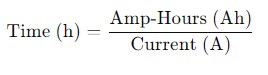
•Here, the current can be derived from the required amp-hours: 6Ah=Current (A)×Time (h).
•If using a 12 amp-hour battery:
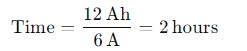
•Result: The 12 amp-hour battery can power the device for 2 hours.
These examples illustrate how to effectively calculate and understand battery capacity in amp-hours, ensuring efficient usage and longevity of your battery systems.
Strategies for Extending Battery Life
Recharge Before Complete Depletion
Exhausting a battery's charge fully can shorten its lifespan due to the strain put on the battery cells. Instead, recharging at around 20-30% capacity optimizes energy usage and reduces wear and tear over time. Consistently allowing a battery to deplete completely can cause irreversible damage, so it's prudent to recharge earlier.
Opt for Chargers Matching Voltage Requirements
Using a charger that doesn't meet the battery's voltage specifications can result in overcharging or undercharging, both detrimental to battery health. Chargers specifically designed for the battery type provide a stable charging process. Checking the device manual for correct charger specifications can prevent potential damage and ensure longevity.
Proper Battery Storage Techniques
To maximize battery lifespan, store them in cool, dry environments. High temperatures can accelerate chemical reactions, resulting in increased self-discharge. Conversely, low temperatures can diminish battery capacity. Proper storage also aids in preventing moisture formation, which can lead to corrosion and eventual battery failure.
Ensure Accessory Compatibility
When batteries and accessories are not compatible, it can result in improper connections and uneven power distribution. This can harm the battery and degrade its performance. Ensuring accessories are designed for your specific battery type enhances safety and functionality.
Regular Maintenance of Battery Terminals
Unclean terminals affect battery efficiency accumulated dirt and oxidization on battery terminals can obstruct electrical flow, leading to inefficient performance. Regular cleaning with a dry cloth or brush ensures a good connection, improving energy transfer and helping in the early detection of potential issues.
Curb Fast Charging Practices
Despite its convenience, fast charging can stress battery cells, hastening their degradation. Whenever possible, opt for standard charging methods. This simple habit can substantially extend the health and longevity of the battery cells.
Manage Exposure to Extreme Temperatures
Batteries are highly sensitive to temperature extremes. High temperatures can increase internal resistance, leading to reduced efficiency and accelerated wear. Low temperatures, on the other hand, can severely limit a battery’s capacity. Using and storing batteries within recommended temperature ranges ensures good performance.
Implementing these thoughtful strategies can greatly enhance battery performance and longevity. This not only offers financial benefits but also promotes sustainability by reducing the frequency of battery replacements.
Frequently Asked Questions [FAQ]
1. What do amp hours mean?
Ampere-hour (Ah) measures electric charge, indicating how much charge a battery can deliver over time. For example, a 10Ah battery can provide 1 amp for 10 hours. Higher Ah means longer usage before needing a recharge, crucial for selecting the right battery for your needs.
2.How long is 1 amp-hour?
One amp-hour (Ah) is the charge delivered by 1 amp flowing for 1 hour, indicating battery capacity. For instance, a 10Ah battery provides 1 amp for 10 hours or 10 amps for 1 hour, helping gauge how long a battery lasts under specific current draws.
3. What does 100Ah mean on a battery?
A 100Ah rating means the battery can supply 1 amp for 100 hours or 10 amps for 10 hours. Higher Ah ratings signify longer-lasting batteries under given loads, important for selecting suitable batteries for various applications.
4. Is a higher Ah battery better?
A higher Ah battery offers longer runtime and can power demanding devices efficiently, though it may be larger and costlier. Suitability depends on your specific power requirements, device compatibility, and practical considerations like size and weight.
5.How to convert amp hours back to amps?
To convert amp hours back to amps, divide the amp hour rating by the hours. For instance, a 100Ah battery over 10 hours gives 10A. This helps optimize battery usage and extends lifespan, critical for efficient energy storage systems.
6. How does the amps and amp hours relationship determine battery lifespan?
The relationship between amps and amp-hours helps determine how long a battery can power a device. High current draws (amps) reduce battery runtime, while managing these factors can optimize battery lifespan and performance.
7. What types of batteries are mentioned and how do they impact capacity?
Various battery types, including lead-acid, lithium-ion, nickel-cadmium, and emerging technologies like flow and solid-state batteries, impact capacity by different discharge rates, lifespan, and efficiency, influencing overall system performance.
8. How to calculate battery capacity using amp hours, watt hours, and voltage?
Calculate battery capacity by multiplying voltage by amp hours for watt hours. For example, a 12V battery with 50Ah gives 600Wh. This helps estimate device operation time, for choosing the right battery.
9.What is an amp hour and why is it important?
Amp hours measure the charge a battery can deliver over time, aiding in effective power management for various applications, ensuring your devices have sufficient power to operate efficiently.
10. Why consider different C ratings when comparing battery amp hour ratings?
C ratings indicate discharge rates. Higher C ratings mean faster discharge, suitable for applications needing quick bursts of power. Consider both C and amp hour ratings to choose batteries matching specific usage needs.
11. Why does a battery provide more power at lower C-ratings over longer durations?
Lower C-ratings discharge batteries slower, sustaining power over longer periods, ideal for applications needing prolonged energy delivery, enhancing battery efficiency and longevity.
12. What does “amp hour” represent and how is it measured for batteries?
Amp hour (Ah) measures a battery’s capacity to deliver current over time, determined by discharging the battery at a constant current until it reaches endpoint voltage, essential for choosing suitable batteries.
13. Where to find amp hour rating and differences for deep cycle vs. starting batteries?
Amp hour ratings are on battery labels or documentation. Deep cycle batteries are for long, steady power use, while starting batteries provide high bursts for engines. Select based on application needs.
Related Blog
-
How Many Zeros in a Million, Billion, Trillion?
![How Many Zeros in a Million, Billion, Trillion?]()
July 29th, 2024
Million represents 106, an easily graspable figure when compared to everyday items or annual salaries. Billion, equivalent to 109, starts to stretch t... -
IRLZ44N MOSFET Datasheet, Circuit, Equivalent, Pinout
![IRLZ44N MOSFET Datasheet, Circuit, Equivalent, Pinout]()
August 28th, 2024
The IRLZ44N is a widely-used N-Channel Power MOSFET. Renowned for its excellent switching capabilities, it is highly suited for numerous applications,... -
Battery Temperature Too Low, Charging Stopped. How to Fix It?
![Battery Temperature Too Low, Charging Stopped. How to Fix It?]()
October 6th, 2024
Mobile phone battery charging issues are common but can be effectively managed. Temperature plays a big role in battery efficiency, as smartphone batt... -
BC547 Transistor Comprehensive Guide
![BC547 Transistor Comprehensive Guide]()
July 4th, 2024
The BC547 transistor is commonly used in a variety of electronic applications, ranging from basic signal amplifiers to complex oscillator circuits and... -
Comprehensive Guide to SCR (Silicon Controlled Rectifier)
![Comprehensive Guide to SCR (Silicon Controlled Rectifier)]()
April 22th, 2024
Silicon Controlled Rectifiers (SCR), or thyristors, play a pivotal role in power electronics technology because of their performance and reliability. ... -
LR621, SR621SW, 364, AG1 Battery Equivalents and Replacements
![LR621, SR621SW, 364, AG1 Battery Equivalents and Replacements]()
July 15th, 2024
LR621 and SR621SW button batteries are prevalent in compact electronic devices like watches, small toys, calculators, and remote keys. Multiple manufa... -
Fundamentals of Op-Amp Circuits
![Fundamentals of Op-Amp Circuits]()
December 28th, 2023
In the intricate world of electronics, a journey into its mysteries invariably leads us to a kaleidoscope of circuit components, both exquisite and co... -
Comparing NMOS and PMOS Differences and Applications
![Comparing NMOS and PMOS Differences and Applications]()
November 15th, 2024
Understanding the differences between NMOS and PMOS transistors is important in designing efficient circuits. NMOS (N-type Metal-Oxide-Semiconductor) ... -
A Complete Guide to Multiplexers and Their Role in Digital Systems
![A Complete Guide to Multiplexers and Their Role in Digital Systems]()
September 20th, 2025
Multiplexers are components in digital systems, designed to channel multiple input signals into a single output line using binary logic and control si... -
What Do STD, AGM, and Gel Mean On a Battery Charger
![What Do STD, AGM, and Gel Mean On a Battery Charger]()
July 10th, 2024
Traditional lead-acid battery chargers are known for their simplicity and reliability. They have been serving their purpose effectively for years, lar...



Hot Parts
- CC0402JRX7R8BB103
- 1812GA471KAT9A
- R5F6417ADFB
- T428P187K016AH6110
- GRM0335C2A9R5DA01D
- ATMXT3432S-SXES-CUI
- ES29LV800EB-70TG
- ICS552G-02ILN
- ADM3491EARZ
- ADSP-21061LKBZ-160
- HA1-5320-2
- K5L2731CAA-D770
- LC4064C75T100-10I
- DS92LV090ATVEH
- EBS106-H
- L86V7655
- OPA2381AIDGKT
- V961PBC-33LP
- MAX3221EIDBR
- LT3010EMS8E
- TRS3232ECDR
- R80C186XL25
- 1-917809-3
- TRJD107K010RRJ
- EDJ8416E6MB-GN-F-D
- EP610ILI-12
- V24A24T400AN
- TC220G08XB0001
- L-FW802C-DB
- RT0805BRE07105KL
- ZVN4525ZTA
- T491B105K035AT4160
- VI-JW2-MW
- VI-25Y-MU
- LM3671TLX-3.3
- M30302MCA-203FP
- PI49FCT38022E
- PS2801C-4-F3-A/NL
- S14C12-8
- SMI4025CES
- TC528257FT-70
- XC2S50-FG256AMS
- MT58L256L32DS-6
- R5F35M6EJFB#U0
- TMP47C421ADF-VA66
- TSUMO88CDT9-1
- WT61P803-RG480WT
- SKKT 91/16 E
- ISO8200AQTR
- R5F5210BBDFB#V0